Boreal Chickadee

Boreal Chickadee

Poecile hudsonicus

Silhouette: Andy Wilson · PhyloPic

LCLeast ConcernNTVUENCR
Daily sighting probability ~50% · Likely
at Denali National Park

In 3 days ~90% in a week >90%

748 Verified sightings at Denali National Park From 2019 to 2026
4,129 In all 14 parks
January Best month
☀️ Diurnal When it's spotted

About the Boreal Chickadee

The boreal chickadee (Poecile hudsonicus) is a small passerine songbird in the tit family Paridae. It is found in the boreal forests of Alaska, Canada and the northern United States and remains within this range all year. This bird is known for its high pitched trill patterns used in communication with other birds and food storage habits in preparation for winter months.

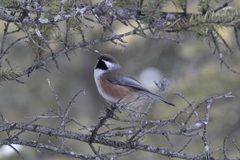
Adults are 12.5–14.5 cm (4.9–5.7 in) long with a weight of 7–12.4 g (0.25–0.44 oz). They have grey-brown upperparts with a brown cap and greyish wings and tail; their face is mainly grey with white on the sides. Their underparts are white with brown on the flanks and a black throat. They have a short dark bill, short wings and a long notched tail. Their flight consists of brief gliding patterns followed by fast and bouncy wing beats as they travel through the air.

The call is a husky tsee-day-day, as well as a high pitched trill sound, dididididididi a variant on the call which gives chickadees their name. This call is composed of five distinct note-type categories consisting of A, B, C, D and D-hybrid with the beginning and end note both displaying a high frequency pitch... Wikipedia →

Sounds

Call1:05

United States · 2021

© Jorge de Leon Cardozo & Susan Hochgraf · XC691193 · CC BY-NC-SA 4.0

Song0:42

United States · 2021

© Christopher McPherson · XC691175 · CC BY-NC-SA 4.0

Call0:27

United States · 2015

© Frank Lambert · XC356193 · CC BY-NC-ND 4.0

Global Distribution

Parks Where Found

# Park Country Daily sighting probability
1 Denali National Park 🇺🇸 United States
~50%
2 Wrangell-St. Elias National Park 🇺🇸 United States
~50%
3 Kluane National Park 🇨🇦 Canada
~50%
4 Riding Mountain National Park 🇨🇦 Canada
~40%
5 Banff National Park 🇨🇦 Canada
~30%
6 Gros Morne National Park 🇨🇦 Canada
~30%
7 Cape Breton Highlands National Park 🇨🇦 Canada
~30%
8 Katmai National Park 🇺🇸 United States
~30%
9 Jasper National Park 🇨🇦 Canada
~20%
10 Wood Buffalo National Park 🇨🇦 Canada
~20%
11 Glacier National Park 🇺🇸 United States
~10%
12 Elk Island National Park 🇨🇦 Canada
<5%
13 Voyageurs National Park 🇺🇸 United States
<5%
14 Kenai Fjords National Park 🇺🇸 United States
<5%

Cities Where Found

# City Country Daily sighting probability
1 Anchorage 🇺🇸 United States
~10%
2 Calgary 🇨🇦 Canada
<5%
3 Edmonton 🇨🇦 Canada
<5%

Before you go

What are the chances of seeing a Boreal Chickadee in Denali National Park?

Likely

About 50% of wildlife watchers report a Boreal Chickadee sighting in Denali National Park on a given day, based on 748 verified sightings from GBIF citizen-science data from 2019 to 2026. It is the 10th most-seen of the 113 birds we can rate there. Over three days the chance rises to about 90%, and over a week to over 90%, if each day is a fresh chance.

When is the best time to see a Boreal Chickadee in Denali National Park?

September and December–February

In those months about 80% of wildlife watchers report a Boreal Chickadee in Denali National Park on a given day, against about 40% in March and October, the lowest months. November has too few records to rate.

What time of day is best to see a Boreal Chickadee?

Between 10 am and 1 pm

Across all the parks we cover, that three-hour window holds the most Boreal Chickadee sightings with a recorded time, and about 9 in 10 of them come between 6 am and 6 pm: it is a daytime animal.

Where does the Boreal Chickadee sighting chance come from?

GBIF citizen-science records

It is estimated from how often the Boreal Chickadee is recorded against all the birds logged in Denali National Park (748 verified sightings from 2019 to 2026), calibrated against known sighting rates. Figures are rounded to the nearest 10% because citizen-science data supports honest approximations, not decimals, and months with records from fewer than five people show "—". How it works.

← Back to Denali National Park