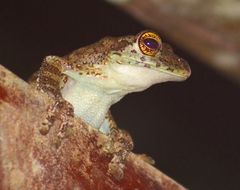
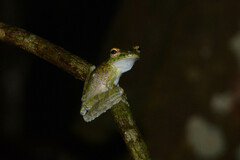
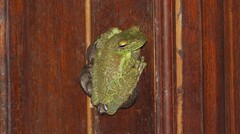
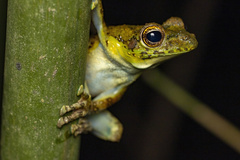
ocellated tree frog

ocellated tree frog

Itapotihyla langsdorffii

Silhouette: Dmitry Bogdanov (vectorized by T. Michael Keesey) · PhyloPic

LCLeast ConcernNTVUENCR
Daily sighting probability ~20% · Possible
at Iguaçu National Park

In 3 days ~40% in a week ~70%

24 Verified sightings at Iguaçu National Park From 2019 to 2026
43 In all 2 parks
September Best month
☀️🌙 Day & Night When it's spotted

About the ocellated tree frog

Itapotihyla is a genus of frogs in the family Hylidae. It is monotypic, being represented by the single species Itapotihyla langsdorffii, commonly known as the ocellated treefrog. It is found in the Atlantic Forest biome of Brazil, with an isolated population in eastern Paraguay and adjacent Brazil and northeastern Argentina.

Itapotihyla langsdorffii are relatively large treefrogs. They show sexual dimorphism, with females (mean snout–vent length 103 mm (4.1 in)) being larger than males (81 mm (3.2 in)). Reproduction takes place in temporary and permanent pools inside rainforest. It is an explosive breeder with a mean brood size of over 6000 eggs. Breeding is associated with intense vocalization by males. In addition to vocalization, male–male interactions may involve grabbing and pushing and even direct physical combat. This kind of behaviour is more common in species where males are larger than females (see sexual selection in frogs).

Its diet mainly consists of arthropods (in particular grasshoppers and crickets), but also vertebrate remains (other frogs including Physalaemus crombiei and Scinax argyreornatus as well... Wikipedia →

Global Distribution

Parks Where Found

# Park Country Daily sighting probability
1 Iguaçu National Park 🇧🇷 Brazil
~20%
2 Iguazú National Park 🇦🇷 Argentina
~20%

Zoos & Centres Where Found

# Zoo / Centre Country
1 São Paulo Zoo 🇧🇷 Brazil In captivity
2 Moody Gardens 🇺🇸 United States In captivity

Before you go

What are the chances of seeing an ocellated tree frog in Iguaçu National Park?

Possible

About 20% of wildlife watchers report an ocellated tree frog sighting in Iguaçu National Park on a given day, based on 24 verified sightings from GBIF citizen-science data from 2019 to 2026. Over three days the chance rises to about 40%, and over a week to about 70%, if each day is a fresh chance.

When is the best time to see an ocellated tree frog in Iguaçu National Park?

February and September

In those months about 30% of wildlife watchers report an ocellated tree frog in Iguaçu National Park on a given day, against under 5% in May to July, the lowest months.

What time of day is best to see an ocellated tree frog?

Between 7 and 10 pm

Across all the parks we cover, that three-hour window holds the most ocellated tree frog sightings with a recorded time, and about 6 in 10 of them come between 6 pm and 6 am: it is seen both by day and at night.

Is Iguaçu National Park the best place to see an ocellated tree frog?

Yes

Of the 2 parks where we can rate ocellated tree frog sightings, Iguaçu National Park has the highest daily chance: about 20%. Next come Iguazú National Park (Argentina, about 20%).

Where does the ocellated tree frog sighting chance come from?

GBIF citizen-science records

It is estimated from how often the ocellated tree frog is recorded against all the amphibians logged in Iguaçu National Park (24 verified sightings from 2019 to 2026), calibrated against known sighting rates. Figures are rounded to the nearest 10% because citizen-science data supports honest approximations, not decimals, and months with records from fewer than five people show "—". How it works.

← Back to Iguaçu National Park