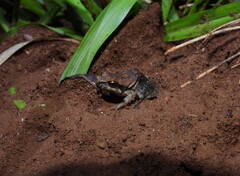
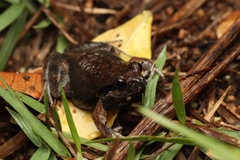
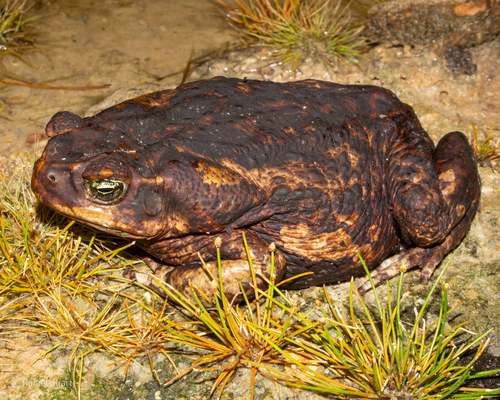
Cuvier’s Foam Frog

Cuvier’s Foam Frog

Physalaemus cuvieri

Silhouette: PhyloPic

LCLeast ConcernNTVUENCR
Daily sighting probability ~10% · With luck
at Iguaçu National Park

In 3 days ~20% in a week ~40%

7 Verified sightings at Iguaçu National Park From 2019 to 2026
12 In all 2 parks
September Best month
☀️🌙 Day & Night When it's spotted

About the Cuvier’s Foam Frog

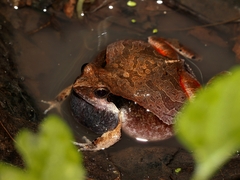
Physalaemus cuvieri is a species of frog in the family Leptodactylidae. It is found in Argentina, Brazil, Paraguay, and possibly also Bolivia, Guyana, Uruguay, and Venezuela. This nocturnal frog lives in forests, savannah, flooded grassland, and livestock pasture. Scientists have seen it between 0 and 2,000 m (0 and 6,562 ft) above sea level. Scientists have reported the frog in protected places.

These frogs reproduce in temporary ponds, puddles, and even cow footprints. The adult frog builds a foam nest for the eggs, which adheres to the base of a blade of grass near the edge of the water. The IUCN classifies this frog as least concern of extinction. What threats it faces include habitat loss, such as the loss of Argentina's Chaco in favor of farms and wood extraction. In other areas water pollution from agricultural runoff affects the frogs. Fires used for land conversion for the creation and improvement of cattle pasture affect the frogs. In Venezuela, gold mining and its many resulting ecological issues affect the frog. Wikipedia →

Sounds

Uncertain0:18

Brazil · 2025

© Fabrício Grigolin · XC1062607 · CC BY-NC-SA 4.0

Recording0:17

Brazil · 2024

© vinicius_s_domingues · iNaturalist · CC BY-NC 4.0

Recording0:14

Argentina · 2023

© mirv · iNaturalist · CC BY-NC 4.0

Global Distribution

Parks Where Found

# Park Country Daily sighting probability
1 Iguaçu National Park 🇧🇷 Brazil
~10%
2 Iguazú National Park 🇦🇷 Argentina
~10%

Cities Where Found

# City Country Daily sighting probability
1 Curitiba 🇧🇷 Brazil
~10%
2 Fortaleza 🇧🇷 Brazil
~10%
3 Maceió 🇧🇷 Brazil
~10%
4 Belo Horizonte 🇧🇷 Brazil
~10%
5 São Paulo 🇧🇷 Brazil
<5%

Before you go

What are the chances of seeing a Cuvier’s Foam Frog in Iguaçu National Park?

With luck

About 10% of wildlife watchers report a Cuvier’s Foam Frog sighting in Iguaçu National Park on a given day, based on 7 verified sightings from GBIF citizen-science data from 2019 to 2026. Over three days the chance rises to about 20%, and over a week to about 40%, if each day is a fresh chance.

When is the best time to see a Cuvier’s Foam Frog in Iguaçu National Park?

September

In that month about 30% of wildlife watchers report a Cuvier’s Foam Frog in Iguaçu National Park on a given day, against under 5% in November to August, the lowest months.

What time of day is best to see a Cuvier’s Foam Frog?

Between 6 and 9 pm

Across all the parks we cover, that three-hour window holds the most Cuvier’s Foam Frog sightings with a recorded time, and about half of them come between 6 pm and 6 am: it is seen both by day and at night.

Is Iguaçu National Park the best place to see a Cuvier’s Foam Frog?

Yes

Of the 2 parks where we can rate Cuvier’s Foam Frog sightings, Iguaçu National Park has the highest daily chance: about 10%. Next come Iguazú National Park (Argentina, about 10%).

Which relatives of the Cuvier’s Foam Frog live in Iguaçu National Park?

Same order: Anura

The closest relatives of the Cuvier’s Foam Frog that you can see in Iguaçu National Park (order Anura, Frogs and Toads) are ocellated tree frog (about 20%), Cururu Toad (about 10%) and Fuscous-blotched Snouted Tree Frog (about 10%), with each one's daily chance of a sighting.

Where does the Cuvier’s Foam Frog sighting chance come from?

GBIF citizen-science records

It is estimated from how often the Cuvier’s Foam Frog is recorded against all the amphibians logged in Iguaçu National Park (7 verified sightings from 2019 to 2026), calibrated against known sighting rates. Figures are rounded to the nearest 10% because citizen-science data supports honest approximations, not decimals, and months with records from fewer than five people show "—". How it works.

← Back to Iguaçu National Park