Solitary Tinamou

Solitary Tinamou

Tinamus solitarius

Silhouette: Kai Caspar · PhyloPic

LCNTNear ThreatenedVUENCR
Daily sighting probability <5% · Rare
at Iguaçu National Park

In 3 days ~10% in a week ~30%

185 Verified sightings at Iguaçu National Park From 2019 to 2026
408 In all 2 parks
August Best month
☀️ Diurnal When it's spotted

About the Solitary Tinamou

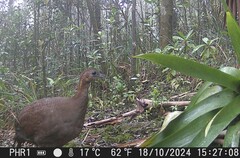
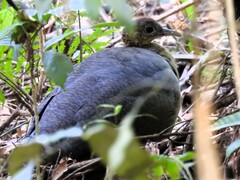
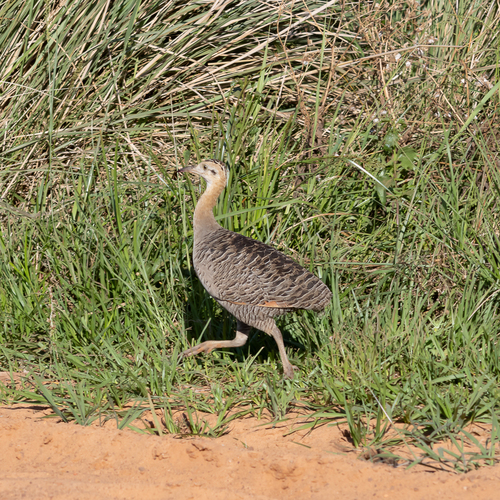
The solitary tinamou (Tinamus solitarius) is a species of paleognath ground bird. This species is native to Atlantic forest of eastern Brazil. All tinamou are from the family Tinamidae, and in the larger scheme are also ratites. Unlike other ratites, tinamous can fly, although in general, they are not strong fliers. All ratites evolved from prehistoric flying birds, and tinamous are the closest living relative of these birds. The former, however, turned out to be not distinct from the nominate but rather individual birds that showed a particular color morph which is now known to also occur elsewhere. Notably, the hue of the back varies between olive and rusty, and the intensity of the lower neck's plumage color also varies. The black barring in these areas is more or less strong. pernambucensis refers to yellower birds with much barring, especially on the neck.

The solitary tinamou is a large brownish tinamou heavily barred with black. Its neck, breast... Wikipedia →

Sounds

Song0:06

Brazil · 2025

© Joost van Bruggen · XC1050604 · CC BY-NC-ND 4.0

Call0:04

Brazil · 2025

© Daniel Hinckley · XC1043495 · CC BY-NC-SA 4.0

Song0:45

Argentina · 2014

© Marcos E. Sosa · XC1018701 · CC BY-NC-SA 4.0

Global Distribution

Parks Where Found

# Park Country Daily sighting probability
1 Iguaçu National Park 🇧🇷 Brazil
<5%
2 Iguazú National Park 🇦🇷 Argentina
<5%

Cities Where Found

# City Country Daily sighting probability
1 São Paulo 🇧🇷 Brazil
<5%

Zoos & Centres Where Found

# Zoo / Centre Country
1 Parque das Aves 🇧🇷 Brazil In captivity
2 Walsrode World Bird Park 🇩🇪 Germany In captivity
3 Curitiba Zoo 🇧🇷 Brazil In captivity
4 Wilhelma 🇩🇪 Germany In captivity
5 Zoo das Aves 🇧🇷 Brazil In captivity
6 Parque Zoológico Bosque Guarani 🇧🇷 Brazil In captivity
7 GüiráOga 🇦🇷 Argentina In captivity
8 Zooparque Itatiba 🇧🇷 Brazil In captivity

Before you go

What are the chances of seeing a Solitary Tinamou in Iguaçu National Park?

Rare

Under 5% of wildlife watchers report a Solitary Tinamou sighting in Iguaçu National Park on a given day, based on 185 verified sightings from GBIF citizen-science data from 2019 to 2026. It is the 170th most-seen of the 346 birds we can rate there. Over three days the chance rises to about 10%, and over a week to about 30%, if each day is a fresh chance.

When is the best time to see a Solitary Tinamou in Iguaçu National Park?

February, May and August–November

In those months about 10% of wildlife watchers report a Solitary Tinamou in Iguaçu National Park on a given day, against under 5% in March–April, June–July and December–January, the lowest months.

What time of day is best to see a Solitary Tinamou?

Between 3 and 6 pm

Across all the parks we cover, that three-hour window holds the most Solitary Tinamou sightings with a recorded time, and about 8 in 10 of them come between 6 am and 6 pm: it is a daytime animal.

Is Iguaçu National Park the best place to see a Solitary Tinamou?

Yes

Of the 2 parks where we can rate Solitary Tinamou sightings, Iguaçu National Park has the highest daily chance: under 5%. Next come Iguazú National Park (Argentina, under 5%).

Which relatives of the Solitary Tinamou live in Iguaçu National Park?

Same family: Tinamidae

The closest relatives of the Solitary Tinamou that you can see in Iguaçu National Park (family Tinamidae, Tinamous) are Brown Tinamou (about 10%) and Tataupá Tinamou (about 10%), with each one's daily chance of a sighting.

Where does the Solitary Tinamou sighting chance come from?

GBIF citizen-science records

It is estimated from how often the Solitary Tinamou is recorded against all the birds logged in Iguaçu National Park (185 verified sightings from 2019 to 2026), calibrated against known sighting rates. Figures are rounded to the nearest 10% because citizen-science data supports honest approximations, not decimals, and months with records from fewer than five people show "—". How it works.

← Back to Iguaçu National Park