
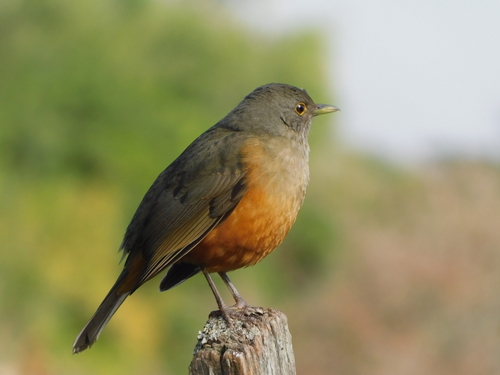
Pale-breasted Thrush

Pale-breasted Thrush

Turdus leucomelas

Silhouette: Sharon Wegner-Larsen · PhyloPic

LCLeast ConcernNTVUENCR
Daily sighting probability ~60% · Likely
at Iguaçu National Park

In 3 days >90%

3,358 Verified sightings at Iguaçu National Park From 2019 to 2026
13,982 In all 17 parks
October Best month
☀️ Diurnal When it's spotted

About the Pale-breasted Thrush

The pale-breasted thrush (Turdus leucomelas) is a species of bird in the family Turdidae. It is found in every mainland South American country except Chile and Ecuador. The pale-breasted thrush was originally described in 1818 with the binomial Turdus leucomelas and has retained it ever since. However, taxonomic systems differ in their assignment of subspecies.

The IOC, the Clements taxonomy, and AviList assign it these four subspecies: However, BirdLife International's Handbook of the Birds of the World does not recognize T. l. upichiarum. This article follows the IOC et al. four-subspecies model. The pale-breasted thrush is 23 to 27 cm (9.1 to 11 in) long and weighs 47 to 78 g (1.7 to 2.8 oz). The sexes have essentially the same plumage, though females sometimes have darker heads than males. Adults of the nominate subspecies T. l. leucomelas have a medium gray crown and whitish-streaked grayish ear coverts. Their upperparts, wings, and tail are generally pale olive brown. Their wing coverts and the edges... Wikipedia →

Sounds

Alarm call0:17

Brazil · 2026

© JAYRSON ARAUJO DE OLIVEIRA · XC1164947 · CC BY-NC-SA 4.0

Call0:56

French Guiana · 2024

© Tristan Guillebot de Nerville · XC1100521 · CC BY-NC-SA 4.0

Uncertain0:16

Brazil · 2025

© Fabrício Grigolin · XC1064447 · CC BY-NC-SA 4.0

Global Distribution

Parks Where Found

# Park Country Daily sighting probability
1 Iguazú National Park 🇦🇷 Argentina
~70%
2 Tijuca National Park 🇧🇷 Brazil
~70%
3 Chapada dos Guimarães National Park 🇧🇷 Brazil
~70%
4 Iguaçu National Park 🇧🇷 Brazil
~60%
5 Serra dos Órgãos National Park 🇧🇷 Brazil
~60%
6 Chapada Diamantina National Park 🇧🇷 Brazil
~60%
7 Serra da Canastra National Park 🇧🇷 Brazil
~60%
8 Tayrona National Natural Park 🇨🇴 Colombia
~50%
9 Henri Pittier National Park 🇻🇪 Venezuela
~50%
10 Itatiaia National Park 🇧🇷 Brazil
~30%
11 Emas National Park 🇧🇷 Brazil
~30%
12 Sierra de la Macarena National Park 🇨🇴 Colombia
~30%
13 Anavilhanas National Park 🇧🇷 Brazil
~20%
14 Brownsberg Nature Park 🇸🇷 Suriname
<5%
15 Iberá National Park 🇦🇷 Argentina
<5%
16 Chingaza National Natural Park 🇨🇴 Colombia
<5%
17 Parque Estadual Encontro das Águas 🇧🇷 Brazil
<5%

Cities Where Found

# City Country Daily sighting probability
1 Belém 🇧🇷 Brazil
~80%
2 Salvador 🇧🇷 Brazil
~70%
3 Belo Horizonte 🇧🇷 Brazil
~70%
4 João Pessoa 🇧🇷 Brazil
~70%
5 Natal 🇧🇷 Brazil
~60%
6 Rio de Janeiro 🇧🇷 Brazil
~60%
7 Maceió 🇧🇷 Brazil
~60%
8 Campinas 🇧🇷 Brazil
~60%
9 Recife 🇧🇷 Brazil
~60%
10 São Paulo 🇧🇷 Brazil
~60%

Zoos & Centres Where Found

# Zoo / Centre Country
1 Parque das Aves 🇧🇷 Brazil In captivity
2 Parque Zoobotânico Getúlio Vargas 🇧🇷 Brazil In captivity
3 Mangal das Garças 🇧🇷 Brazil In captivity

Before you go

What are the chances of seeing a Pale-breasted Thrush in Iguaçu National Park?

Likely

About 60% of wildlife watchers report a Pale-breasted Thrush sighting in Iguaçu National Park on a given day, based on 3,358 verified sightings from GBIF citizen-science data from 2019 to 2026. It is the 4th most-seen of the 346 birds we can rate there. Over three days the chance rises to over 90%, if each day is a fresh chance.

When is the best time to see a Pale-breasted Thrush in Iguaçu National Park?

April–June and August–November

In those months about 70% of wildlife watchers report a Pale-breasted Thrush in Iguaçu National Park on a given day, against about 50% in January and February, the lowest months.

What time of day is best to see a Pale-breasted Thrush?

Between 2 and 5 pm

Across all the parks we cover, that three-hour window holds the most Pale-breasted Thrush sightings with a recorded time, and about 9 in 10 of them come between 6 am and 6 pm: it is a daytime animal.

Which relatives of the Pale-breasted Thrush live in Iguaçu National Park?

Same genus: Turdus

The closest relatives of the Pale-breasted Thrush that you can see in Iguaçu National Park (genus Turdus, Typical Thrushes) are Rufous-bellied Thrush (about 30%), Creamy-bellied Thrush (about 20%) and White-necked Thrush (about 10%), with each one's daily chance of a sighting.

Where does the Pale-breasted Thrush sighting chance come from?

GBIF citizen-science records

It is estimated from how often the Pale-breasted Thrush is recorded against all the birds logged in Iguaçu National Park (3,358 verified sightings from 2019 to 2026), calibrated against known sighting rates. Figures are rounded to the nearest 10% because citizen-science data supports honest approximations, not decimals, and months with records from fewer than five people show "—". How it works.

← Back to Iguaçu National Park