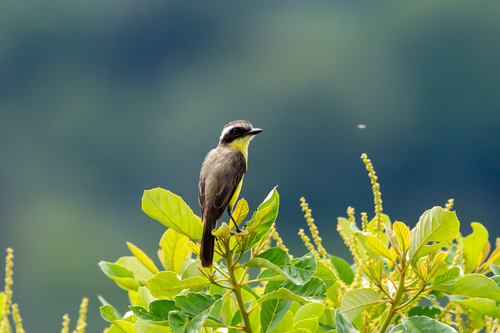
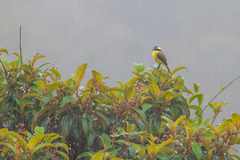
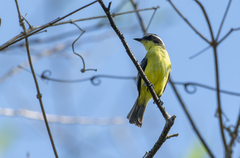
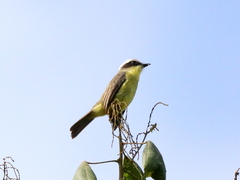

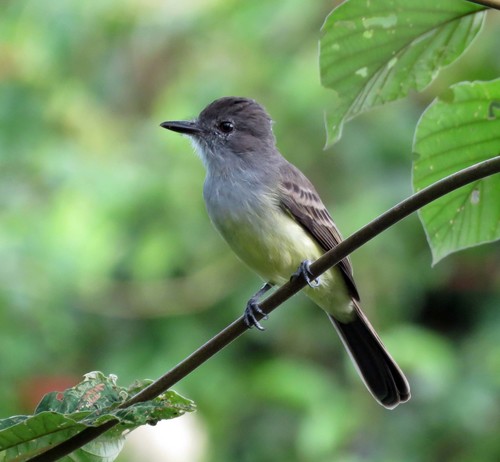
Three-striped Flycatcher

Three-striped Flycatcher

Conopias trivirgatus

Silhouette: Emily Willoughby · PhyloPic

LCLeast ConcernNTVUENCR
Daily sighting probability <5% · Rare
at Iguaçu National Park

In 3 days ~10% in a week ~30%

166 Verified sightings at Iguaçu National Park From 2019 to 2026
409 In all 3 parks
July Best month
☀️ Diurnal When it's spotted

About the Three-striped Flycatcher

The three-striped flycatcher (Conopias trivirgatus) is a species of bird in the family Tyrannidae, the tyrant flycatchers. It is found in Argentina, Bolivia, Brazil, Ecuador, Paraguay, Peru, and Venezuela. The three-striped flycatcher was originally described as Muscicapa trivirgata, mistakenly placing it in the Old World flycatcher family. It was later moved into genus Conopias that had been erected in 1860. Early in the twenty-first century Conopias was recognized as masculine so the specific epithet was changed to trivirgatus to match that gender.

At least one author has suggested that C. t. berlepschi might be a separate species. The three-striped flycatcher is the smallest member of genus Conopias. It is 13.5 to 14.5 cm (5.3 to 5.7 in) long. The sexes have the same plumage. Adults of the nominate subspecies C t. trivirgatus have a dusky brown crown and face with a white supercilium that begins at the lores and wraps all the way around the nape. Their upperparts are pale olive. Their wings are dusky... Wikipedia →

Sounds

Call0:10

Brazil · 2026

© Glauko Corrêa da Silva · XC1183255 · CC BY-NC-SA 4.0

Song0:13

Brazil · 2022

© JAYRSON ARAUJO DE OLIVEIRA · XC725267 · CC BY-NC-SA 4.0

Canto0:21

Brazil · 2019

© Caio Brito · XC556233 · CC BY-NC-SA 4.0

Global Distribution

Parks Where Found

# Park Country Daily sighting probability
1 Anavilhanas National Park 🇧🇷 Brazil
~10%
2 Iguazú National Park 🇦🇷 Argentina
~10%
3 Iguaçu National Park 🇧🇷 Brazil
<5%

Cities Where Found

# City Country Daily sighting probability
1 Santos 🇧🇷 Brazil
<5%

Before you go

What are the chances of seeing a Three-striped Flycatcher in Iguaçu National Park?

Rare

Under 5% of wildlife watchers report a Three-striped Flycatcher sighting in Iguaçu National Park on a given day, based on 166 verified sightings from GBIF citizen-science data from 2019 to 2026. It is the 173rd most-seen of the 346 birds we can rate there. Over three days the chance rises to about 10%, and over a week to about 30%, if each day is a fresh chance.

When is the best time to see a Three-striped Flycatcher in Iguaçu National Park?

July to October

In those months about 10% of wildlife watchers report a Three-striped Flycatcher in Iguaçu National Park on a given day, against under 5% in November to June, the lowest months.

What time of day is best to see a Three-striped Flycatcher?

Between 8 and 11 am

Across all the parks we cover, that three-hour window holds the most Three-striped Flycatcher sightings with a recorded time, and about 8 in 10 of them come between 6 am and 6 pm: it is a daytime animal.

Is Iguaçu National Park the best place to see a Three-striped Flycatcher?

3rd of 3

Of the 3 parks where we can rate Three-striped Flycatcher sightings, Iguaçu National Park ranks 3rd at under 5%. The best odds are in Anavilhanas National Park (Brazil, about 10%) and Iguazú National Park (Argentina, about 10%).

Which relatives of the Three-striped Flycatcher live in Iguaçu National Park?

Same family: Tyrannidae

The closest relatives of the Three-striped Flycatcher that you can see in Iguaçu National Park (family Tyrannidae, Tyrant Flycatchers) are Great Kiskadee (about 80%), Social Flycatcher (about 40%) and Boat-billed Flycatcher (about 30%), with each one's daily chance of a sighting.

Where does the Three-striped Flycatcher sighting chance come from?

GBIF citizen-science records

It is estimated from how often the Three-striped Flycatcher is recorded against all the birds logged in Iguaçu National Park (166 verified sightings from 2019 to 2026), calibrated against known sighting rates. Figures are rounded to the nearest 10% because citizen-science data supports honest approximations, not decimals, and months with records from fewer than five people show "—". How it works.

← Back to Iguaçu National Park