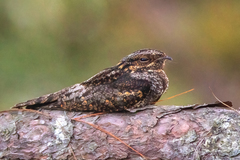

Gray Nightjar

Gray Nightjar

Caprimulgus jotaka

Silhouette: Ferran Sayol · PhyloPic

LCLeast ConcernNTVUENCR
Daily sighting probability <5% · Rare
at Doi Inthanon National Park

In 3 days <5% in a week ~10%

24 Verified sightings at Doi Inthanon National Park From 2019 to 2026
79 In all 5 parks
October Best month
☀️🌙 Day & Night When it's spotted

About the Gray Nightjar

The grey nightjar (Caprimulgus jotaka; also "gray" in some non-local literature) is a species of nightjar found in East Asia, breeding from southeastern Russia south through China, the Korean Peninsula and Japan to northern Indochina and westward along the Himalayas. It is largely migratory, wintering in Indochina south to Java in Indonesia, but is resident in warmer areas in the south of its breeding range. It is sometimes treated as a subspecies of the jungle nightjar (C. indicus), its South Asian relative. The grey nightjar breeds and forages in early successional habitats surrounded by forests; its populations have declined since the 1970s in Japan. Like all nightjars, it is crepuscular to nocturnal, feeding on flying insects, including moths, beetles, flying ants, grasshoppers, and others.

The species was formally described in 1845 by Coenraad Jacob Temminck and Hermann Schlegel with the binomial name Caprimulgus jotaka based on specimens collected in Japan. The specific epithet is the Japanese word for the species, Yo taka meaning "night hawk". The grey nightjar was subsequently included as a subspecies of the jungle nightjar (C. indicus; also called grey nightjar... Wikipedia →

Sounds

Call0:17

Vietnam · 2026

© Tim Dinh / Annambirding · XC1185368 · CC BY-NC-SA 4.0

Song0:11

China · 2023

© 脉动 · XC917579 · CC BY-NC-ND 4.0

Call0:46

India · 2018

© Peter Boesman · XC426431 · CC BY-NC-ND 4.0

Global Distribution

Parks Where Found

# Park Country Daily sighting probability
1 Langtang National Park 🇳🇵 Nepal
<5%
2 Khao Sok National Park 🇹🇭 Thailand
<5%
3 Khao Yai National Park 🇹🇭 Thailand
<5%
4 Doi Inthanon National Park 🇹🇭 Thailand
<5%
5 Kaeng Krachan National Park 🇹🇭 Thailand
<5%

Cities Where Found

# City Country Daily sighting probability
1 Taipei 🇹🇼 Taiwan
<5%
2 Wuhan 🇨🇳 China
<5%
3 Shanghai 🇨🇳 China
<5%
4 Hangzhou 🇨🇳 China
<5%
5 Nanjing 🇨🇳 China
<5%
6 Singapore 🇸🇬 Singapore
<5%
7 Guangzhou 🇨🇳 China
<5%
8 Bangkok 🇹🇭 Thailand
<5%
9 Beijing 🇨🇳 China
<5%

Before you go

What are the chances of seeing a Gray Nightjar in Doi Inthanon National Park?

Rare

Under 5% of wildlife watchers report a Gray Nightjar sighting in Doi Inthanon National Park on a given day, based on 24 verified sightings from GBIF citizen-science data from 2019 to 2026. It is the 290th most-seen of the 367 birds we can rate there. Over three days the chance rises to under 5%, and over a week to about 10%, if each day is a fresh chance.

When is the best time to see a Gray Nightjar in Doi Inthanon National Park?

October

In that month about 10% of wildlife watchers report a Gray Nightjar in Doi Inthanon National Park on a given day, against under 5% in November to September, the lowest months.

What time of day is best to see a Gray Nightjar?

Between 7 and 10 pm

Across all the parks we cover, that three-hour window holds the most Gray Nightjar sightings with a recorded time, and about half of them come between 6 pm and 6 am: it is seen both by day and at night.

Is Doi Inthanon National Park the best place to see a Gray Nightjar?

Among the best

Of the 5 parks where we can rate Gray Nightjar sightings, Doi Inthanon National Park ranks 4th at under 5%, level with the leaders once rounded. The best odds are in Langtang National Park (Nepal, under 5%), Khao Sok National Park (Thailand, under 5%) and Khao Yai National Park (Thailand, under 5%).

Where does the Gray Nightjar sighting chance come from?

GBIF citizen-science records

It is estimated from how often the Gray Nightjar is recorded against all the birds logged in Doi Inthanon National Park (24 verified sightings from 2019 to 2026), calibrated against known sighting rates. Figures are rounded to the nearest 10% because citizen-science data supports honest approximations, not decimals, and months with records from fewer than five people show "—". How it works.

← Back to Doi Inthanon National Park