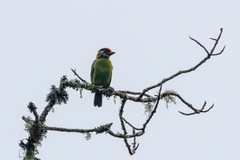
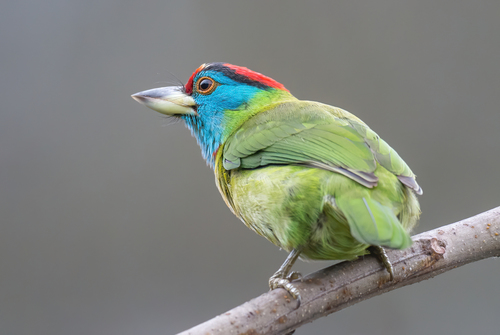
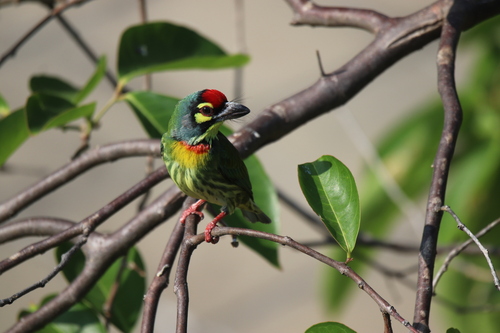
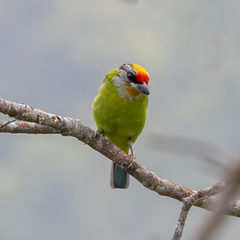
Golden-throated Barbet

Golden-throated Barbet

Psilopogon franklinii

Silhouette: Vijay Cavale (photo), John E. McCormack, Michael G. Harvey, Brant C. Faircloth, Nicholas G. Crawford, Travis C. Glenn, Robb T. Brumfield & T. Michael Keesey · PhyloPic

LCLeast ConcernNTVUENCR
Daily sighting probability ~50% · Likely
at Doi Inthanon National Park

In 3 days ~90% in a week >90%

2,012 Verified sightings at Doi Inthanon National Park From 2019 to 2026
2,288 In all 5 parks
February Best month
☀️ Diurnal When it's spotted

About the Golden-throated Barbet

The golden-throated barbet (Psilopogon franklinii) is an Asian barbet native to Southeast Asia, where it inhabits foremost forests between 900 and 2,700 m (3,000 and 8,900 ft) altitude. It is listed as Least Concern on the IUCN Red List because of its wide distribution and stable population.

Bucco franklinii was the scientific name proposed by Edward Blyth in 1842 who described a vivid green barbet with a golden throat collected in Darjeeling. It was placed in the genus Megalaima proposed by George Robert Gray in 1842 who suggested to use this name instead of Bucco. In the 19th and 20th centuries, the following golden-throated barbet zoological specimens were described:

Megalaema ramsayi proposed by Arthur Viscount Walden in 1875 was a golden-throated barbet collected in the Karen Hills. Cyanops franklinii auricularis proposed by Herbert C. Robinson and C. Boden Kloss in 1919 for a barbet collected at the Langbian Plateau in southern Vietnam.

Cyanops franklinii minor proposed by C. Boden Kloss and Frederick Nutter Chasen in 1926 for a specimen collected in Perak, Malaysia. Cyanops franklinii trangensis proposed by Joseph Harvey Riley in 1934 for a barbet collected in... Wikipedia →

Sounds

Song0:54

China · 2026

© Yang Li · XC1133290 · CC BY-NC-SA 4.0

Song0:33

China · 2026

© JJSUN · XC1086612 · CC BY-NC-SA 4.0

Song1:13

Thailand · 1986

© Jelle Scharringa · XC1074036 · CC BY-NC-SA 4.0

Global Distribution

Parks Where Found

# Park Country Daily sighting probability
1 Doi Inthanon National Park 🇹🇭 Thailand
~50%
2 Royal Manas National Park 🇧🇹 Bhutan
~20%
3 Langtang National Park 🇳🇵 Nepal
<5%
4 Namdapha National Park 🇮🇳 India
<5%
5 Kaeng Krachan National Park 🇹🇭 Thailand
<5%

Cities Where Found

# City Country Daily sighting probability
1 Kathmandu 🇳🇵 Nepal
<5%

Before you go

What are the chances of seeing a Golden-throated Barbet in Doi Inthanon National Park?

Likely

About 50% of wildlife watchers report a Golden-throated Barbet sighting in Doi Inthanon National Park on a given day, based on 2,012 verified sightings from GBIF citizen-science data from 2019 to 2026. It is the 6th most-seen of the 367 birds we can rate there. Over three days the chance rises to about 90%, and over a week to over 90%, if each day is a fresh chance.

When is the best time to see a Golden-throated Barbet in Doi Inthanon National Park?

February and March

In those months about 60% of wildlife watchers report a Golden-throated Barbet in Doi Inthanon National Park on a given day, against about 30% in October and November, the lowest months. Those are among Doi Inthanon National Park's driest months, with about 25 mm of rain a month against 340 mm in August.

What time of day is best to see a Golden-throated Barbet?

Between 8 and 11 am

Across all the parks we cover, that three-hour window holds the most Golden-throated Barbet sightings with a recorded time, and about 9 in 10 of them come between 6 am and 6 pm: it is a daytime animal.

Is Doi Inthanon National Park the best place to see a Golden-throated Barbet?

Yes

Of the 5 parks where we can rate Golden-throated Barbet sightings, Doi Inthanon National Park has the highest daily chance: about 50%. Next come Royal Manas National Park (Bhutan, about 20%) and Langtang National Park (Nepal, under 5%).

Which relatives of the Golden-throated Barbet live in Doi Inthanon National Park?

Same genus: Psilopogon

The closest relatives of the Golden-throated Barbet that you can see in Doi Inthanon National Park (genus Psilopogon, Typical Asian Barbets) are Blue-throated Barbet (about 30%), Lineated Barbet (about 20%) and Great Barbet (about 20%), with each one's daily chance of a sighting.

Where does the Golden-throated Barbet sighting chance come from?

GBIF citizen-science records

It is estimated from how often the Golden-throated Barbet is recorded against all the birds logged in Doi Inthanon National Park (2,012 verified sightings from 2019 to 2026), calibrated against known sighting rates. Figures are rounded to the nearest 10% because citizen-science data supports honest approximations, not decimals, and months with records from fewer than five people show "—". How it works.

← Back to Doi Inthanon National Park