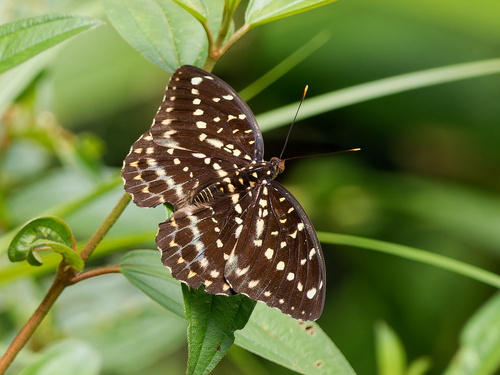
Red-Based Jezebel

Red-Based Jezebel

Delias pasithoe

Daily sighting probability ~20% · Possible
at Doi Inthanon National Park

In 3 days ~40% in a week ~70%

15 Verified sightings at Doi Inthanon National Park From 2019 to 2026
21 In all 2 parks
November Best month
☀️ Diurnal When it's spotted

About the Red-Based Jezebel

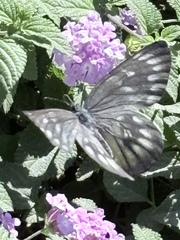
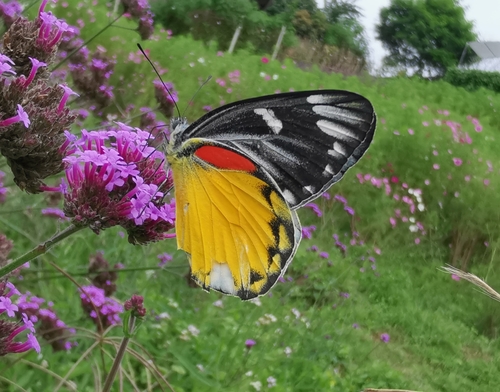
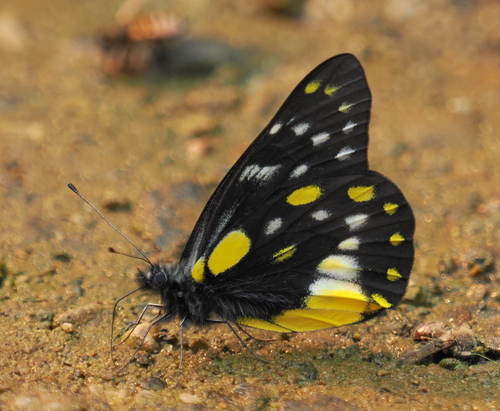
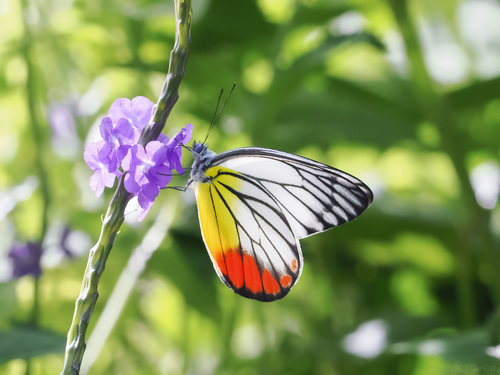
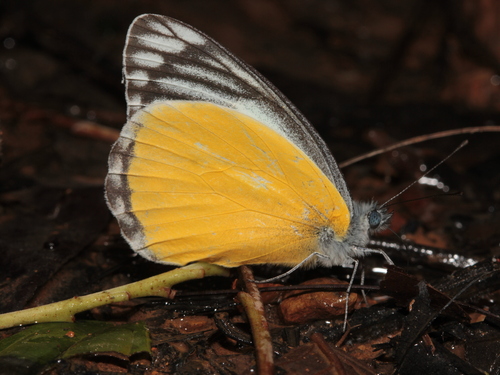
Delias pasithoe, the redbase Jezebel is a medium-sized butterfly of the family Pieridae, that is, the yellows and whites. The species is found in parts of South Asia and Southeast Asia. There has been some dispute for which species the specific name aglaja (or aglaia), used twice by Linnaeus in 1758, applies – the redbase Jezebel, or the dark green fritillary (Speyeria aglaja), a brush-footed butterfly. Here, Delias pasithoe is used for the redbase Jezebel, based on the replacement name proposed by Linnaeus himself.

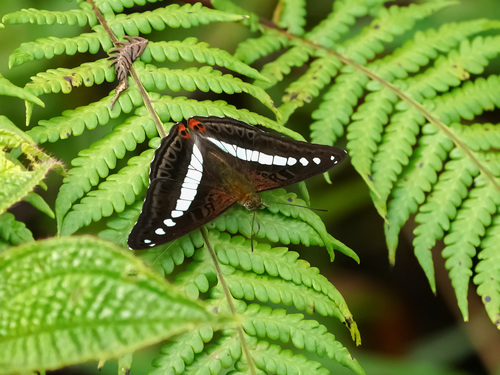
Upperside: black. Forewing with more or less distinct, somewhat diffuse, broad streaks from base, in the discoidal cell and interspaces 1 and 2, the streak in the last the most produced; a white oval spot at lower apex of cell traversed by the lower discocellular, followed by a subterminal series of greyish-white hastate (spear-shaped) markings with their points turned inwards, the markings opposite the apex of the wing elongate and shifted a little inwards. Hindwing: a broad subbasal transverse greyish-white band merged posteriorly in a large bright yellow dorsal patch that fills the apical two-thirds, the extreme apex excepted, of interspaces... Wikipedia →
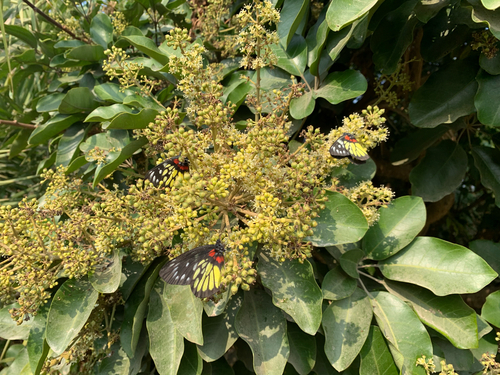
Global Distribution

Parks Where Found

# Park Country Daily sighting probability
1 Doi Inthanon National Park 🇹🇭 Thailand
~20%
2 Taroko National Park 🇹🇼 Taiwan
~10%

Cities Where Found

# City Country Daily sighting probability
1 Hong Kong 🇨🇳 China
~40%
2 Tuen Mun 🇨🇳 China
~30%
3 Zhuhai [Macau] 🇨🇳 China
~30%
4 Quanzhou 🇨🇳 China
~30%
5 Nanning 🇨🇳 China
~20%
6 Xiamen City 🇨🇳 China
~20%
7 Guangzhou 🇨🇳 China
~20%
8 Hanoi 🇻🇳 Vietnam
~20%
9 Kathmandu 🇳🇵 Nepal
~10%
10 Yogyakarta 🇮🇩 Indonesia
~10%

Before you go

What are the chances of seeing a Red-Based Jezebel in Doi Inthanon National Park?

Possible

About 20% of wildlife watchers report a Red-Based Jezebel sighting in Doi Inthanon National Park on a given day, based on 15 verified sightings from GBIF citizen-science data from 2019 to 2026. It is the 44th most-seen of the 153 insects we can rate there. Over three days the chance rises to about 40%, and over a week to about 70%, if each day is a fresh chance.

When is the best time to see a Red-Based Jezebel in Doi Inthanon National Park?

November

In that month about 30% of wildlife watchers report a Red-Based Jezebel in Doi Inthanon National Park on a given day, against under 5% in May to September, the lowest months. That is one of Doi Inthanon National Park's driest months, with about 90 mm of rain against 340 mm in August.

What time of day is best to see a Red-Based Jezebel?

Between 10 am and 1 pm

Across all the parks we cover, that three-hour window holds the most Red-Based Jezebel sightings with a recorded time, and about 8 in 10 of them come between 6 am and 6 pm: it is a daytime animal.

Is Doi Inthanon National Park the best place to see a Red-Based Jezebel?

Yes

Of the 2 parks where we can rate Red-Based Jezebel sightings, Doi Inthanon National Park has the highest daily chance: about 20%. Next come Taroko National Park (Taiwan, about 10%).

Which relatives of the Red-Based Jezebel live in Doi Inthanon National Park?

Same genus: Delias

The closest relatives of the Red-Based Jezebel that you can see in Doi Inthanon National Park (genus Delias, Jezebels) are Red-Spot Jezebel (about 20%), Hill Jezebel (about 20%) and Painted Jezebel (about 10%), with each one's daily chance of a sighting.

Where does the Red-Based Jezebel sighting chance come from?

GBIF citizen-science records

It is estimated from how often the Red-Based Jezebel is recorded against all the insects logged in Doi Inthanon National Park (15 verified sightings from 2019 to 2026), calibrated against known sighting rates. Figures are rounded to the nearest 10% because citizen-science data supports honest approximations, not decimals, and months with records from fewer than five people show "—". How it works.

← Back to Doi Inthanon National Park