Adalbert's Eagle

Adalbert's Eagle

Aquila adalberti

Silhouette: Andy Wilson · PhyloPic

LCNTVUVulnerableENCR
Daily sighting probability ~10% · With luck
at Doñana National Park

In 3 days ~20% in a week ~40%

241 Verified sightings at Doñana National Park From 2019 to 2026
1,975 In all 3 parks
November Best month
☀️ Diurnal When it's spotted

About the Adalbert's Eagle

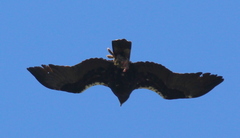
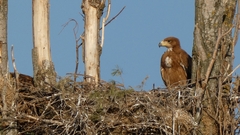
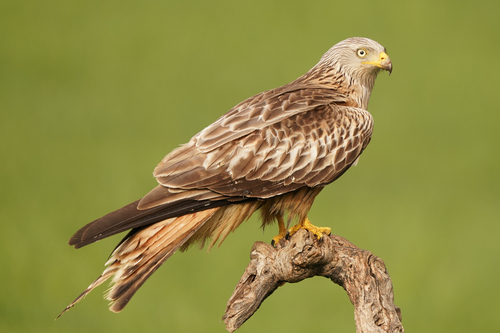
The Spanish imperial eagle, Spanish eagle, Iberian imperial eagle or Adalbert's eagle (Aquila adalberti) is a species of eagle native to the Iberian Peninsula. The binomial commemorates Prince Adalbert of Bavaria. Due to its distinct "epaulettes", old literature often referred to this species as the white-shouldered eagle.

Formerly, the Spanish imperial eagle was considered to be a subspecies of the eastern imperial eagle, then known simply as the imperial eagle, but is now widely recognised as a separate species due to differences in morphology, ecology, and molecular characteristics.

This is a large raptor and quite large eagle, broadly similar in size to its cousin, the eastern imperial eagle, which is found in a considerably different distributional range. Compared to sympatric largish booted eagles, it is somewhat smaller than the golden eagle and somewhat larger than Bonelli's eagle. Spanish imperial eagles can weigh from 2.5 to 4.8 kg (5.5 to 10.6 lb). The average weight of males in a sample of 10 was 3.19 kg (7.0 lb) while that of 17 females was found to be 3.43 kg (7.6 lb). Meanwhile, another sample of 10 unsexed adults weighed an average of 3.93 kg (8.7... Wikipedia →

Sounds

Begging call0:54

Spain · 2026

© SonoNatura · XC1163894 · CC BY-NC-ND 4.0

Call0:04

Spain · 2018

© Stanislas Wroza · XC423970 · CC BY-NC-SA 4.0

Flight call0:58

Spain · 2017

© Esperanza Poveda · XC401066 · CC BY-NC-SA 4.0

Global Distribution

Parks Where Found

# Park Country Daily sighting probability
1 Monfragüe National Park 🇪🇸 Spain
~10%
2 Doñana National Park 🇪🇸 Spain
~10%
3 Sierra de Guadarrama National Park 🇪🇸 Spain
<5%

Cities Where Found

# City Country Daily sighting probability
1 Madrid 🇪🇸 Spain
<5%

Zoos & Centres Where Found

# Zoo / Centre Country
1 Zoobotánico Jerez 🇪🇸 Spain In captivity
2 Zoo de Guadalajara 🇪🇸 Spain In captivity
3 Zoo de Córdoba 🇪🇸 Spain In captivity
4 Centro de Recuperación de Rapaces Brinzal 🇪🇸 Spain In captivity
5 Bird Park 🇷🇺 Russia In captivity

Before you go

What are the chances of seeing an Adalbert's Eagle in Doñana National Park?

With luck

About 10% of wildlife watchers report an Adalbert's Eagle sighting in Doñana National Park on a given day, based on 241 verified sightings from GBIF citizen-science data from 2019 to 2026. It is the 126th most-seen of the 234 birds we can rate there. Over three days the chance rises to about 20%, and over a week to about 40%, if each day is a fresh chance.

When is the best time to see an Adalbert's Eagle in Doñana National Park?

June and October–February

In those months about 10% of wildlife watchers report an Adalbert's Eagle in Doñana National Park on a given day, against under 5% in March–May and July–September, the lowest months.

What time of day is best to see an Adalbert's Eagle?

Between 10 am and 1 pm

Across all the parks we cover, that three-hour window holds the most Adalbert's Eagle sightings with a recorded time, and about 9 in 10 of them come between 6 am and 6 pm: it is a daytime animal.

Is Doñana National Park the best place to see an Adalbert's Eagle?

Among the best

Of the 3 parks where we can rate Adalbert's Eagle sightings, Doñana National Park ranks 2nd at about 10%, level with the leaders once rounded. The best odds are in Monfragüe National Park (Spain, about 10%).

Where does the Adalbert's Eagle sighting chance come from?

GBIF citizen-science records

It is estimated from how often the Adalbert's Eagle is recorded against all the birds logged in Doñana National Park (241 verified sightings from 2019 to 2026), calibrated against known sighting rates. Figures are rounded to the nearest 10% because citizen-science data supports honest approximations, not decimals, and months with records from fewer than five people show "—". How it works.

← Back to Doñana National Park