
Great Skua

Great Skua

Stercorarius skua

Silhouette: Liam Quinn (photo) and Albertonykus (silhouette) · PhyloPic

Daily sighting probability <5% · Rare
at Doñana National Park

In 3 days <5%

30 Verified sightings at Doñana National Park From 2019 to 2026
843 In all 4 parks
April Best month
☀️ Diurnal When it's spotted

About the Great Skua

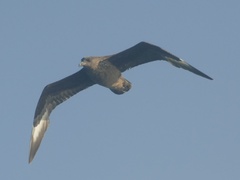
The great skua (Stercorarius skua), sometimes known by the name bonxie in Britain, is a large seabird in the skua family Stercorariidae. It is roughly the size of a herring gull. It mainly eats fish caught at the sea surface or taken from other birds.

The great skua was described from the Faroe Islands and Iceland by the Danish zoologist Morten Thrane Brünnich in 1764 under the binomial name Catharacta skua. It is now placed in the genus Stercorarius that was introduced by the French zoologist Mathurin Jacques Brisson in 1760. The English name and species name "skua" is believed to originate from the Faroese skúvur or skúgvur [ˈskɪkvʊər] and is the only known bird name to originate from the Faroes that has come into regular use elsewhere. In Britain, it is sometimes known by the name bonxie, a Shetland name of Norse origin. The genus name Stercorarius is Latin and means "of dung"; the food disgorged by other birds when pursued by skuas was once thought to be excrement. The species is monotypic: no subspecies are recognised.

Great skuas measure 50–58 cm (20–23 in) long and have a 125–140 cm (49–55 in) wingspan. One study found that 112 males weighed... Wikipedia →

Sounds

Call0:52

Norway · 2011

© Erik Normark · XC779449 · CC BY-NC-ND 4.0

Flight call0:05

Iceland · 2018

© Stanislas Wroza · XC479354 · CC BY-NC-SA 4.0

Song0:06

United Kingdom · 2016

© Timo Janhonen · XC319896 · CC BY-NC-SA 4.0

Global Distribution

Parks Where Found

# Park Country Daily sighting probability
1 Vatnajokull National Park 🇮🇸 Iceland
~60%
2 Svalbard 🇳🇴 Norway
~20%
3 Doñana National Park 🇪🇸 Spain
<5%
4 Wadden Sea National Park 🇩🇪 Germany
<5%

Cities Where Found

# City Country Daily sighting probability
1 Dakar 🇸🇳 Senegal
<5%
2 Valencia 🇪🇸 Spain
<5%
3 Barcelona 🇪🇸 Spain
<5%
4 Lisbon 🇵🇹 Portugal
<5%

Before you go

What are the chances of seeing a Great Skua in Doñana National Park?

Rare

Under 5% of wildlife watchers report a Great Skua sighting in Doñana National Park on a given day, based on 30 verified sightings from GBIF citizen-science data from 2019 to 2026. It is the 205th most-seen of the 234 birds we can rate there. Over three days the chance rises to under 5%, if each day is a fresh chance.

When is the best time to see a Great Skua in Doñana National Park?

Any time of year

In every month with enough records, under 5% of wildlife watchers report a Great Skua in Doñana National Park on a given day, so our monthly data shows no clear season.

What time of day is best to see a Great Skua?

Between 11 am and 2 pm

Across all the parks we cover, that three-hour window holds the most Great Skua sightings with a recorded time, and about 8 in 10 of them come between 6 am and 6 pm: it is a daytime animal.

Is Doñana National Park the best place to see a Great Skua?

3rd of 4

Of the 4 parks where we can rate Great Skua sightings, Doñana National Park ranks 3rd at under 5%. The best odds are in Vatnajokull National Park (Iceland, about 60%) and Svalbard (Norway, about 20%).

Which relatives of the Great Skua live in Doñana National Park?

Same order: Charadriiformes

The closest relatives of the Great Skua that you can see in Doñana National Park (order Charadriiformes, Shorebirds and Allies) are Black-winged Stilt (about 70%), Pied Avocet (about 40%) and Black-tailed Godwit (about 30%), with each one's daily chance of a sighting.

Where does the Great Skua sighting chance come from?

GBIF citizen-science records

It is estimated from how often the Great Skua is recorded against all the birds logged in Doñana National Park (30 verified sightings from 2019 to 2026), calibrated against known sighting rates. Figures are rounded to the nearest 10% because citizen-science data supports honest approximations, not decimals, and months with records from fewer than five people show "—". How it works.

← Back to Doñana National Park