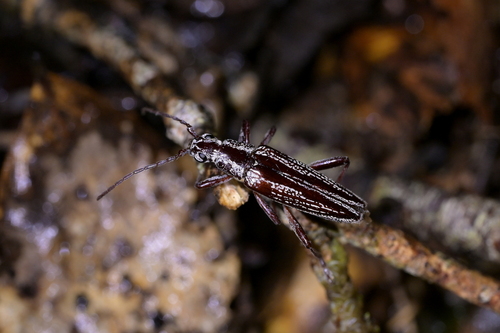
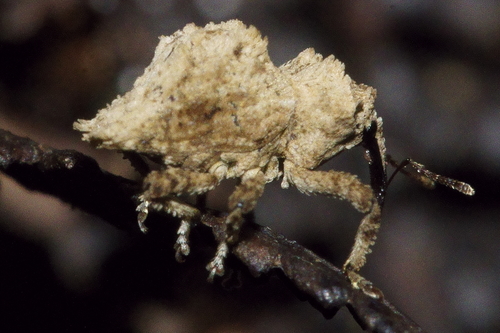
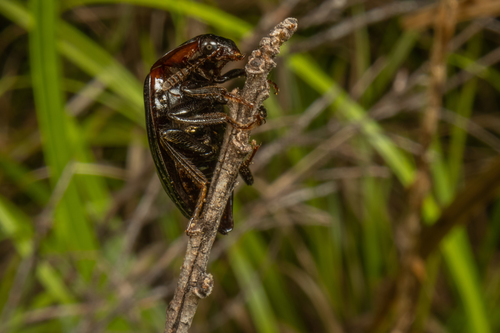

Cosmopolitan Diving Beetle

Cosmopolitan Diving Beetle

Rhantus suturalis

Daily sighting probability ~10% · With luck
at Egmont National Park

In 3 days ~20% in a week ~50%

8 Verified sightings at Egmont National Park From 2019 to 2026
13 In all 2 parks
April Best month
🌅 Crepuscular When it's spotted

About the Cosmopolitan Diving Beetle

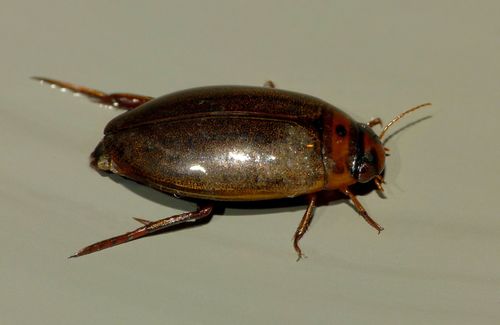
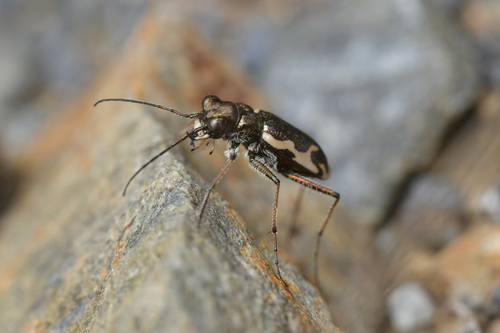
Rhantus suturalis, commonly known as the supertramp beetle or cosmopolitan diving beetle, is a species of diving beetle (Dytiscidae) with a cosmopolitan distribution. Adult Rhantus suturalis range from 10.5 to 13.0 mm in length. The head is black with a pale anterior margin and a pale marking between the eyes, and the antennae and palps are also pale. The pronotum is pale with a usually well-defined dark mark in the middle. The elytra are pale brown and covered in fine punctures. The sternites of the abdomen are completely black. The legs are brown and often have the metatibiae and metatarsi darker. Males differ from females in the basal tarsomeres of the prolegs and midlegs being weakly dilated, and the protarsal claws being unequal and much shorter than the terminal tarsomere.

In Europe, R. suturalis coexists with the also-common species R. exsoletus, but that species has a vague black posterior margin to the pronotum instead of a central dark mark, and its abdominal sternites are yellow instead of black. In Australia, the only other Rhantus species is R. simulans, which is larger (12.8-13.5 mm) and only found in the country's southwest, unlike the more widespread... Wikipedia →

Global Distribution

Parks Where Found

# Park Country Daily sighting probability
1 Egmont National Park 🇳🇿 New Zealand
~10%
2 Great Otway National Park 🇦🇺 Australia
<5%

Cities Where Found

# City Country Daily sighting probability
1 Beijing 🇨🇳 China
<5%
2 Melbourne 🇦🇺 Australia
<5%
3 Seoul 🇰🇷 South Korea
<5%
4 Auckland 🇳🇿 New Zealand
<5%
5 Brisbane 🇦🇺 Australia
<5%
6 Sydney 🇦🇺 Australia
<5%
7 Tokyo 🇯🇵 Japan
<5%

Before you go

What are the chances of seeing a Cosmopolitan Diving Beetle in Egmont National Park?

With luck

About 10% of wildlife watchers report a Cosmopolitan Diving Beetle sighting in Egmont National Park on a given day, based on 8 verified sightings from GBIF citizen-science data from 2019 to 2026. It is the 153rd most-seen of the 191 insects we can rate there. Over three days the chance rises to about 20%, and over a week to about 50%, if each day is a fresh chance.

When is the best time to see a Cosmopolitan Diving Beetle in Egmont National Park?

April and December–February

In those months about 10% of wildlife watchers report a Cosmopolitan Diving Beetle in Egmont National Park on a given day, against under 5% in March and May–November, the lowest months.

What time of day is best to see a Cosmopolitan Diving Beetle?

Between 7 and 10 pm

Across all the parks we cover, that three-hour window holds the most Cosmopolitan Diving Beetle sightings with a recorded time, and about half of them come between 6 pm and 6 am: it is most active around dawn and dusk.

Is Egmont National Park the best place to see a Cosmopolitan Diving Beetle?

Yes

Of the 2 parks where we can rate Cosmopolitan Diving Beetle sightings, Egmont National Park has the highest daily chance: about 10%. Next come Great Otway National Park (Australia, under 5%).

Where does the Cosmopolitan Diving Beetle sighting chance come from?

GBIF citizen-science records

It is estimated from how often the Cosmopolitan Diving Beetle is recorded against all the insects logged in Egmont National Park (8 verified sightings from 2019 to 2026), calibrated against known sighting rates. Figures are rounded to the nearest 10% because citizen-science data supports honest approximations, not decimals, and months with records from fewer than five people show "—". How it works.

← Back to Egmont National Park