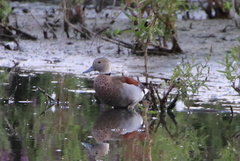
Ringed Teal

Ringed Teal

Callonetta leucophrys

Silhouette: Sheatherius · PhyloPic

LCLeast ConcernNTVUENCR
Daily sighting probability ~10% · With luck
at El Impenetrable National Park

In 3 days ~30% in a week ~60%

32 Verified sightings at El Impenetrable National Park From 2019 to 2026
51 In all 2 parks
October Best month
☀️ Diurnal When it's spotted

About the Ringed Teal

The ringed teal (Callonetta leucophrys) is a small duck of marshes, pools, and forest wetlands native to south-central South America. It is the only species of the genus Callonetta. Formerly often placed with the perching ducks in the tribe Cairinini, this species is now known to be closer to shelducks and belongs in the subfamily Tadorninae.

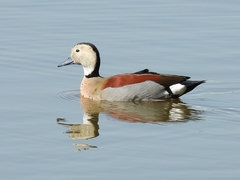
The ringed teal is 35–38 cm (14–15 in) long, with a 70 cm (28 in) wingspan, and a weight of 190–360 g (6.7–12.7 oz). The drake has a rich chestnut back, pale grey flanks, and a salmon-coloured breast speckled in black. A black band runs from the top of its head down to the nape.

Females have an olive-brownish back, a head blotched and striated in white, and pencilled barring on a pale chest and belly. Both males and females have a dark tail, a contrasting pale rump, and a distinctive white patch on the wing. The bill is grey and legs and feet are pink in both sexes. Pairs easily bond.

Their contact calls are a cat-like mee-oowing in ducks and a lingering peewoo in drakes. The male and female retain similar plumage throughout the year, lacking an eclipse plumage. Ringed teals also have webbed toes with long, pointed claws that... Wikipedia →

Sounds

Call0:06

France · 2020

© Stanislas Wroza · XC522569 · CC BY-NC-SA 4.0

Song0:06

Argentina · 2001

© Bernabe Lopez-Lanus · XC52156 · CC BY-NC-SA 3.0

Call0:19

Argentina · 2021

© Niels Krabbe · XC687765 · CC BY-NC-SA 4.0

Global Distribution

Parks Where Found

# Park Country Daily sighting probability
1 El Impenetrable National Park 🇦🇷 Argentina
~10%
2 Iberá National Park 🇦🇷 Argentina
<5%

Cities Where Found

# City Country Daily sighting probability
1 Santa Cruz de la Sierra 🇧🇴 Bolivia
~20%
2 Rosario 🇦🇷 Argentina
~20%
3 Buenos Aires 🇦🇷 Argentina
~10%
4 Curitiba 🇧🇷 Brazil
<5%
5 Cordoba 🇦🇷 Argentina
<5%
6 Porto Alegre 🇧🇷 Brazil
<5%
7 Montevideo 🇺🇾 Uruguay
<5%
8 Paris 🇫🇷 France
<5%
9 London 🇬🇧 United Kingdom
<5%
10 Washington 🇺🇸 United States
<5%

Zoos & Centres Where Found

# Zoo / Centre Country
1 Disney's Animal Kingdom 🇺🇸 United States In captivity
2 Busch Gardens Tampa 🇺🇸 United States In captivity
3 Pairi Daiza 🇧🇪 Belgium In captivity
4 Prague Zoo 🇨🇿 Czechia In captivity
5 National Zoological Park 🇺🇸 United States In captivity
6 ZooParc de Beauval 🇫🇷 France In captivity
7 Leipzig Zoological Garden 🇩🇪 Germany In captivity
8 Copenhagen Zoo 🇩🇰 Denmark In captivity
9 North Carolina Zoo 🇺🇸 United States In captivity
10 Zlín-Lešná Zoo 🇨🇿 Czechia In captivity
11 Zoo Pilsen 🇨🇿 Czechia In captivity
12 Jihlava Zoo 🇨🇿 Czechia In captivity
13 Zoo de Doué 🇫🇷 France In captivity
14 Zoobotánico Jerez 🇪🇸 Spain In captivity
15 Toronto Zoo 🇨🇦 Canada In captivity
16 Safari West 🇺🇸 United States In captivity
17 Columbus Zoo and Aquarium 🇺🇸 United States In captivity
18 Bronx Zoo 🇺🇸 United States In captivity
19 Brookfield Zoo 🇺🇸 United States In captivity
20 Chester Zoo 🇬🇧 United Kingdom In captivity
21 Slimbridge Wetland Centre 🇬🇧 United Kingdom In captivity
22 Wildpark Schwarze Berge 🇩🇪 Germany In captivity
23 Hellabrunn Zoo 🇩🇪 Germany In captivity
24 Kyiv Zoo 🇺🇦 Ukraine In captivity
25 Paignton Zoo 🇬🇧 United Kingdom In captivity
26 Temaikén 🇦🇷 Argentina In captivity
27 Franklin Park Zoo 🇺🇸 United States In captivity
28 Night Safari 🇸🇬 Singapore In captivity
29 Zoologischer Garten Leipzig 🇩🇪 Germany In captivity
30 Fort Worth Zoo 🇺🇸 United States In captivity
31 Memphis Zoo 🇺🇸 United States In captivity
32 Singapore Zoo 🇸🇬 Singapore In captivity
33 Wilhelma 🇩🇪 Germany In captivity
34 Houston Zoo 🇺🇸 United States In captivity
35 Centro Cicogne e Anatidi 🇮🇹 Italy In captivity
36 San Antonio Zoo 🇺🇸 United States In captivity
37 Cameron Park Zoo 🇺🇸 United States In captivity
38 Cologne Zoological Garden 🇩🇪 Germany In captivity
39 Philadelphia Zoo 🇺🇸 United States In captivity
40 Mesker Park Zoo and Botanic Garden 🇺🇸 United States In captivity
41 Honolulu Zoo 🇺🇸 United States In captivity
42 Zoo Atlanta 🇺🇸 United States In captivity
43 Bird Paradise 🇸🇬 Singapore In captivity
44 Rosamond Gifford Zoo 🇺🇸 United States In captivity
45 Plock Zoo 🇵🇱 Poland In captivity
46 Rainforest Wild Asia 🇸🇬 Singapore In captivity
47 Krefelder Zoo 🇩🇪 Germany In captivity
48 NaturZoo Rheine 🇩🇪 Germany In captivity
49 Biotropica 🇫🇷 France In captivity
50 Affen- und Vogelpark Eckenhagen 🇩🇪 Germany In captivity

Before you go

What are the chances of seeing a Ringed Teal in El Impenetrable National Park?

With luck

About 10% of wildlife watchers report a Ringed Teal sighting in El Impenetrable National Park on a given day, based on 32 verified sightings from GBIF citizen-science data from 2019 to 2026. It is the 128th most-seen of the 219 birds we can rate there. Over three days the chance rises to about 30%, and over a week to about 60%, if each day is a fresh chance.

When is the best time to see a Ringed Teal in El Impenetrable National Park?

October

In that month about 40% of wildlife watchers report a Ringed Teal in El Impenetrable National Park on a given day, against under 5% in April and July–August, the lowest months. December has too few records to rate.

What time of day is best to see a Ringed Teal?

Between 9 am and noon

Across all the parks we cover, that three-hour window holds the most Ringed Teal sightings with a recorded time, and about 9 in 10 of them come between 6 am and 6 pm: it is a daytime animal.

Is El Impenetrable National Park the best place to see a Ringed Teal?

Yes

Of the 2 parks where we can rate Ringed Teal sightings, El Impenetrable National Park has the highest daily chance: about 10%. Next come Iberá National Park (Argentina, under 5%).

Which relatives of the Ringed Teal live in El Impenetrable National Park?

Same family: Anatidae

The closest relatives of the Ringed Teal that you can see in El Impenetrable National Park (family Anatidae, Ducks, Geese, and Swans) are Brazilian Teal (about 20%) and Black-bellied Whistling-Duck (about 10%), with each one's daily chance of a sighting.

Where does the Ringed Teal sighting chance come from?

GBIF citizen-science records

It is estimated from how often the Ringed Teal is recorded against all the birds logged in El Impenetrable National Park (32 verified sightings from 2019 to 2026), calibrated against known sighting rates. Figures are rounded to the nearest 10% because citizen-science data supports honest approximations, not decimals, and months with records from fewer than five people show "—". How it works.

← Back to El Impenetrable National Park