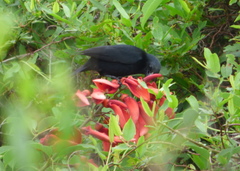
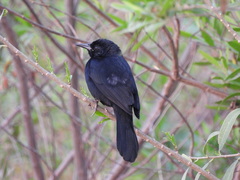
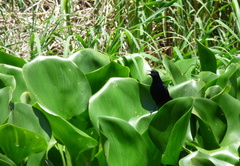

Unicoloured Blackbird

Unicoloured Blackbird

Agelasticus cyanopus

Silhouette: Sheatherius · PhyloPic

LCLeast ConcernNTVUENCR
Daily sighting probability <5% · Rare
at El Impenetrable National Park

In 3 days ~10% in a week ~30%

11 Verified sightings at El Impenetrable National Park From 2019 to 2026
1,520 In all 5 parks
November Best month
☀️ Diurnal When it's spotted

About the Unicoloured Blackbird

The unicolored blackbird (Agelasticus cyanopus) is a species of bird in the family Icteridae, the oropendolas, New World orioles, and New World blackbirds. It is found in Argentina, Bolivia, Brazil, Paraguay, Uruguay, and as a vagrant in Peru.

The unicolored blackbird was formally described in 1819 with the binomial Agelaius cyanopus. The species was later assigned to genus Chrysomus. By the 1990s Agelaius and Chrysomus were beginning to be recognized as polyphyletic, and early in the twenty-first century Agelasticus, which had been erected in 1851, was resurrected for the unicolored blackbird and two other species.

The unicolored blackbird's further taxonomy is unsettled. The IOC, AviList, and BirdLife International's Handbook of the Birds of the World recognize these four subspecies: The females have notably different plumage and some authors have suggested... Wikipedia →

Sounds

Call0:34

Brazil · 2026

© JAYRSON ARAUJO DE OLIVEIRA · XC1163677 · CC BY-NC-SA 4.0

Song0:13

Argentina · 2026

© Marcos E. Sosa · XC1133736 · CC BY-NC-SA 4.0

Alarm call0:26

Argentina

© Bernabe Lopez-Lanus · XC48023 · CC BY-NC-SA 3.0

Global Distribution

Parks Where Found

# Park Country Daily sighting probability
1 Parque Estadual Encontro das Águas 🇧🇷 Brazil
~50%
2 Iberá National Park 🇦🇷 Argentina
~30%
3 El Impenetrable National Park 🇦🇷 Argentina
<5%
4 Iguazú National Park 🇦🇷 Argentina
<5%
5 Iguaçu National Park 🇧🇷 Brazil
<5%

Cities Where Found

# City Country Daily sighting probability
1 Asuncion 🇵🇾 Paraguay
~10%
2 São Paulo 🇧🇷 Brazil
<5%
3 Buenos Aires 🇦🇷 Argentina
<5%

Before you go

What are the chances of seeing a Unicoloured Blackbird in El Impenetrable National Park?

Rare

Under 5% of wildlife watchers report a Unicoloured Blackbird sighting in El Impenetrable National Park on a given day, based on 11 verified sightings from GBIF citizen-science data from 2019 to 2026. It is the 184th most-seen of the 219 birds we can rate there. Over three days the chance rises to about 10%, and over a week to about 30%, if each day is a fresh chance.

When is the best time to see a Unicoloured Blackbird in El Impenetrable National Park?

February, April and November

In those months about 10% of wildlife watchers report a Unicoloured Blackbird in El Impenetrable National Park on a given day, against under 5% in January, March and May–October, the lowest months. December has too few records to rate.

What time of day is best to see a Unicoloured Blackbird?

Between 8 and 11 am

Across all the parks we cover, that three-hour window holds the most Unicoloured Blackbird sightings with a recorded time, and about 9 in 10 of them come between 6 am and 6 pm: it is a daytime animal.

Is El Impenetrable National Park the best place to see a Unicoloured Blackbird?

3rd of 5

Of the 5 parks where we can rate Unicoloured Blackbird sightings, El Impenetrable National Park ranks 3rd at under 5%. The best odds are in Parque Estadual Encontro das Águas (Brazil, about 50%) and Iberá National Park (Argentina, about 30%).

Which relatives of the Unicoloured Blackbird live in El Impenetrable National Park?

Same family: Icteridae

The closest relatives of the Unicoloured Blackbird that you can see in El Impenetrable National Park (family Icteridae, New World Blackbirds and Orioles) are Solitary Black Cacique (about 60%), Orange-backed Oriole (about 60%) and Epaulet Oriole (about 50%), with each one's daily chance of a sighting.

Where does the Unicoloured Blackbird sighting chance come from?

GBIF citizen-science records

It is estimated from how often the Unicoloured Blackbird is recorded against all the birds logged in El Impenetrable National Park (11 verified sightings from 2019 to 2026), calibrated against known sighting rates. Figures are rounded to the nearest 10% because citizen-science data supports honest approximations, not decimals, and months with records from fewer than five people show "—". How it works.

← Back to El Impenetrable National Park