
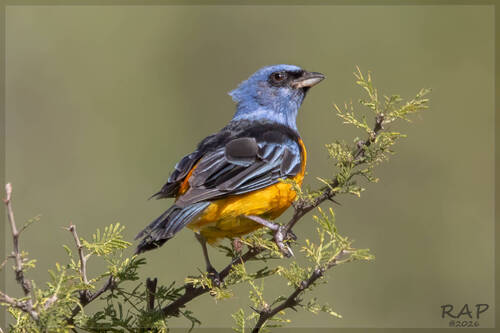

Diademed Tanager

Diademed Tanager

Stephanophorus diadematus

Silhouette: Sheatherius · PhyloPic

LCLeast ConcernNTVUENCR
Daily sighting probability ~40% · Likely
at El Palmar National Park

In 3 days ~80% in a week >90%

189 Verified sightings at El Palmar National Park From 2019 to 2026
1,176 In all 4 parks
September Best month
☀️ Diurnal When it's spotted

About the Diademed Tanager

The diademed tanager (Stephanophorus diadematus) is a species of Neotropical bird in the tanager family Thraupidae. It is the only member of the genus Stephanophorus. It is purple-blue with a white crown characterised by a small red patch, and it is found mostly in open areas in southern Brazil, northeast Argentina, and Uruguay.

The diademed tanager was formally described and illustrated in 1823 by the Dutch zoologist Coenraad Jacob Temminck under the binomial name Tanagra diademata. The type locality is Curitiba in Brazil. This is now the only species placed in the genus Stephanophorus that was introduced in 1841 by the English naturalist Hugh Edwin Strickland. The genus name combines the Ancient Greek stephanē meaning "diadem" and -phoros meaning "carrying". The specific epithet diadematus is Latin meaning "diademed". The diademed tanager is monotypic: no subspecies are recognised.

The diademed tanager is, on average, 19 cm (7.5 in) long and weighs 35–41.5 g (1–1 oz). When illuminated well, it is mostly dark glossy bluish-violet in color, although the coloration often seems dull blackish in poor light. The wings and tail have blue-bordered black feathers... Wikipedia →

Sounds

Song0:42

Brazil · 2025

© JAYRSON ARAUJO DE OLIVEIRA · XC1053056 · CC BY-NC-SA 4.0

Call0:31

Brazil · 2020

© GABRIEL LEITE · XC563042 · CC BY-NC-SA 4.0

Chamado0:33

Brazil · 2018

© Caio Brito · XC556604 · CC BY-NC-SA 4.0

Global Distribution

Parks Where Found

# Park Country Daily sighting probability
1 El Palmar National Park 🇦🇷 Argentina
~40%
2 Itatiaia National Park 🇧🇷 Brazil
~30%
3 Serra dos Órgãos National Park 🇧🇷 Brazil
<5%
4 Iberá National Park 🇦🇷 Argentina
<5%

Cities Where Found

# City Country Daily sighting probability
1 Curitiba 🇧🇷 Brazil
<5%
2 Buenos Aires 🇦🇷 Argentina
<5%
3 Montevideo 🇺🇾 Uruguay
<5%

Before you go

What are the chances of seeing a Diademed Tanager in El Palmar National Park?

Likely

About 40% of wildlife watchers report a Diademed Tanager sighting in El Palmar National Park on a given day, based on 189 verified sightings from GBIF citizen-science data from 2019 to 2026. It is the 32nd most-seen of the 151 birds we can rate there. Over three days the chance rises to about 80%, and over a week to over 90%, if each day is a fresh chance.

When is the best time to see a Diademed Tanager in El Palmar National Park?

September

In that month about 70% of wildlife watchers report a Diademed Tanager in El Palmar National Park on a given day, against about 30% in October, the lowest month.

What time of day is best to see a Diademed Tanager?

Between 8 and 11 am

Across all the parks we cover, that three-hour window holds the most Diademed Tanager sightings with a recorded time, and about 9 in 10 of them come between 6 am and 6 pm: it is a daytime animal.

Is El Palmar National Park the best place to see a Diademed Tanager?

Yes

Of the 4 parks where we can rate Diademed Tanager sightings, El Palmar National Park has the highest daily chance: about 40%. Next come Itatiaia National Park (Brazil, about 30%) and Serra dos Órgãos National Park (Brazil, under 5%).

Which relatives of the Diademed Tanager live in El Palmar National Park?

Same family: Thraupidae

The closest relatives of the Diademed Tanager that you can see in El Palmar National Park (family Thraupidae, Tanagers and Allies) are Golden-billed Saltator (about 80%), Sayaca Tanager (about 70%) and Brazilian Cardinal (about 60%), with each one's daily chance of a sighting.

Where does the Diademed Tanager sighting chance come from?

GBIF citizen-science records

It is estimated from how often the Diademed Tanager is recorded against all the birds logged in El Palmar National Park (189 verified sightings from 2019 to 2026), calibrated against known sighting rates. Figures are rounded to the nearest 10% because citizen-science data supports honest approximations, not decimals, and months with records from fewer than five people show "—". How it works.

← Back to El Palmar National Park