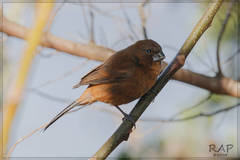
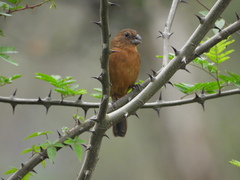
Glaucous-blue Grosbeak

Glaucous-blue Grosbeak

Cyanoloxia glaucocaerulea

Silhouette: Sheatherius · PhyloPic

LCLeast ConcernNTVUENCR
Daily sighting probability ~20% · Possible
at El Palmar National Park

In 3 days ~50% in a week ~80%

107 Verified sightings at El Palmar National Park From 2019 to 2026
120 In all 3 parks
February Best month
☀️ Diurnal When it's spotted

About the Glaucous-blue Grosbeak

The glaucous-blue grosbeak (Cyanoloxia glaucocaerulea), also known as the indigo grosbeak, is a species of bird in the family Cardinalidae, the cardinals or cardinal grosbeaks. It is found in Brazil, Argentina, Paraguay, and Uruguay.

The glaucous-blue grosbeak is monotypic. For much of its history, the glaucous-blue grosbeak was the only member of genus Cyanoloxia. Following a 2004 publication, the blue-black grosbeak (now Cyanoloxia cyanoides) and ultramarine grosbeak (now Cyanoloxia brissonii) were moved from genus Cyanocompsa. What is now Amazonian grosbeak (Cyanoloxia cyanoides) was later split from blue-black grosbeak.

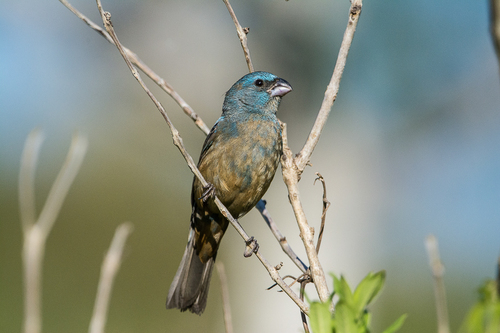
The glaucous-blue grosbeak is approximately 14 cm (5.5 in) long. Three birds weighed from 16 to 19.5 g (0.56 to 0.69 oz). The male is generally dark sky blue that is lighter on the forehead and rump and is grayish on the lower belly. It has a small black "mask". The female is brown overall, warm and dark above and orange-tinged below. The immature is orange-brown that is darker on the back, and it has a hint of blue on the forehead and cheek.

The glaucous-blue grosbeak nests in northeastern... Wikipedia →
Sounds

Call0:57

Brazil · 2021

© JAYRSON ARAUJO DE OLIVEIRA · XC686573 · CC BY-NC-SA 4.0

Song0:41

Brazil · 2008

© Fernando Jacobs · XC200400 · CC BY-NC-SA 4.0

Recording0:14

Argentina

© Dante Gabriel Moresco · XC658069 · CC BY-NC-SA 4.0

Global Distribution

Parks Where Found

# Park Country Daily sighting probability
1 El Palmar National Park 🇦🇷 Argentina
~20%
2 Iguaçu National Park 🇧🇷 Brazil
<5%
3 Iguazú National Park 🇦🇷 Argentina
<5%

Cities Where Found

# City Country Daily sighting probability
1 Buenos Aires 🇦🇷 Argentina
<5%
2 São Paulo 🇧🇷 Brazil
<5%

Before you go

What are the chances of seeing a Glaucous-blue Grosbeak in El Palmar National Park?

Possible

About 20% of wildlife watchers report a Glaucous-blue Grosbeak sighting in El Palmar National Park on a given day, based on 107 verified sightings from GBIF citizen-science data from 2019 to 2026. It is the 63rd most-seen of the 151 birds we can rate there. Over three days the chance rises to about 50%, and over a week to about 80%, if each day is a fresh chance.

When is the best time to see a Glaucous-blue Grosbeak in El Palmar National Park?

January and February

In those months about 40% of wildlife watchers report a Glaucous-blue Grosbeak in El Palmar National Park on a given day, against about 10% in May–July and September, the lowest months.

What time of day is best to see a Glaucous-blue Grosbeak?

Between 8 and 11 am

Across all the parks we cover, that three-hour window holds the most Glaucous-blue Grosbeak sightings with a recorded time, and about 8 in 10 of them come between 6 am and 6 pm: it is a daytime animal.

Is El Palmar National Park the best place to see a Glaucous-blue Grosbeak?

Yes

Of the 3 parks where we can rate Glaucous-blue Grosbeak sightings, El Palmar National Park has the highest daily chance: about 20%. Next come Iguaçu National Park (Brazil, under 5%) and Iguazú National Park (Argentina, under 5%).

Where does the Glaucous-blue Grosbeak sighting chance come from?

GBIF citizen-science records

It is estimated from how often the Glaucous-blue Grosbeak is recorded against all the birds logged in El Palmar National Park (107 verified sightings from 2019 to 2026), calibrated against known sighting rates. Figures are rounded to the nearest 10% because citizen-science data supports honest approximations, not decimals, and months with records from fewer than five people show "—". How it works.

← Back to El Palmar National Park