
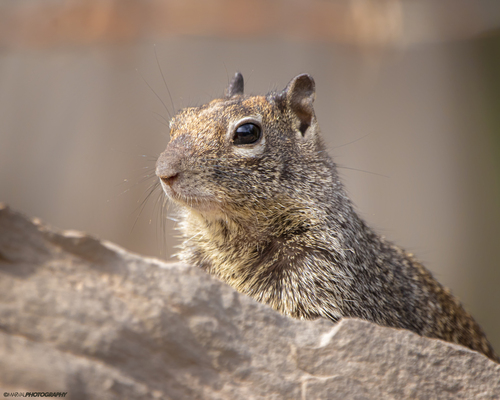
California Ground Squirrel

California Ground Squirrel

Otospermophilus beecheyi

Silhouette: Joseph Smit · PhyloPic

LCLeast ConcernNTVUENCR
Daily sighting probability ~20% · Possible
at El Vizcaíno Biosphere Reserve

In 3 days ~40% in a week ~70%

10 Verified sightings at El Vizcaíno Biosphere Reserve From 2019 to 2026
1,569 In all 5 parks
June Best month
☀️ Diurnal When it's spotted

About the California Ground Squirrel

The California ground squirrel (Otospermophilus beecheyi), also known as the Beechey ground squirrel, is a common and easily observed ground squirrel of the western United States and the Baja California Peninsula. It is common in California with its range spanning through much of the state, as well as northeastern Nevada in areas around Reno and Lake Tahoe.

Formerly placed in Spermophilus, as Spermophilus beecheyi, it was reclassified in Otospermophilus in 2009, as it became clear that Spermophilus as previously defined was not a natural (monophyletic) group. John Richardson, who originally described the species as Arctomys (Spermophilus) beecheyi, or "Beechey's marmot", named it after Frederick William Beechey, an early 19th-century British explorer and naval officer. The squirrel's upper parts are mottled, with the fur containing a mixture of gray, light brown and dusky hairs. The shoulders, neck and sides are a lighter gray. The fur around the eyes is whitish. The underside is lighter, buff or grayish yellow. Head and body are about 30 cm (12 in) long and the tail an additional 15 centimetres (5.9 in). They can weigh from 280 to 738 g (9.9 to 26... Wikipedia →

Sounds

Alarm call0:38

United States · 2019

© Daan Drukker · XC959773 · CC BY-NC-ND 4.0

Recording0:09

United States · 2025

© Nathan J Taylor · iNaturalist · CC BY-NC 4.0

Recording0:13

United States · 2026

© robertbogdon · iNaturalist · CC BY-NC 4.0

Global Distribution

Parks Where Found

# Park Country Daily sighting probability
1 Yosemite National Park 🇺🇸 United States
~70%
2 Sequoia and Kings Canyon National Parks 🇺🇸 United States
~40%
3 Joshua Tree National Park 🇺🇸 United States
~30%
4 Channel Islands National Park 🇺🇸 United States
~30%
5 El Vizcaíno Biosphere Reserve 🇲🇽 Mexico
~20%

Cities Where Found

# City Country Daily sighting probability
1 Tijuana 🇲🇽 México
~60%
2 San Diego 🇺🇸 United States
~40%
3 San Francisco 🇺🇸 United States
~30%
4 Sacramento 🇺🇸 United States
~30%
5 Los Angeles 🇺🇸 United States
~30%

Zoos & Centres Where Found

# Zoo / Centre Country
1 Sierra Safari Zoo 🇺🇸 United States In captivity

Before you go

What are the chances of seeing a California Ground Squirrel in El Vizcaíno Biosphere Reserve?

Possible

About 20% of wildlife watchers report a California Ground Squirrel sighting in El Vizcaíno Biosphere Reserve on a given day, based on 10 verified sightings from GBIF citizen-science data from 2019 to 2026. It is the 10th most-seen of the 16 mammals we can rate there. Over three days the chance rises to about 40%, and over a week to about 70%, if each day is a fresh chance.

When is the best time to see a California Ground Squirrel in El Vizcaíno Biosphere Reserve?

June

In that month about 40% of wildlife watchers report a California Ground Squirrel in El Vizcaíno Biosphere Reserve on a given day, against under 5% in April–May and October–January, the lowest months.

What time of day is best to see a California Ground Squirrel?

Between 10 am and 1 pm

Across all the parks we cover, that three-hour window holds the most California Ground Squirrel sightings with a recorded time, and about 9 in 10 of them come between 6 am and 6 pm: it is a daytime animal.

Where does the California Ground Squirrel sighting chance come from?

GBIF citizen-science records

It is estimated from how often the California Ground Squirrel is recorded against all the mammals logged in El Vizcaíno Biosphere Reserve (10 verified sightings from 2019 to 2026), calibrated against known sighting rates. Figures are rounded to the nearest 10% because citizen-science data supports honest approximations, not decimals, and months with records from fewer than five people show "—". How it works.

← Back to El Vizcaíno Biosphere Reserve