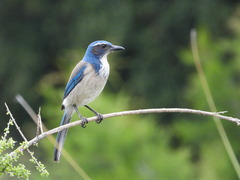

California Scrub-Jay

California Scrub-Jay

Aphelocoma californica

Silhouette: Sheatherius · PhyloPic

LCLeast ConcernNTVUENCR
Daily sighting probability <5% · Rare
at El Vizcaíno Biosphere Reserve

In 3 days ~10% in a week ~30%

49 Verified sightings at El Vizcaíno Biosphere Reserve From 2019 to 2026
3,292 In all 9 parks
June Best month
☀️ Diurnal When it's spotted

About the California Scrub-Jay

The California scrub jay (Aphelocoma californica) is a species of scrub jay native to western North America. It ranges from southern British Columbia throughout California and western Nevada near Reno to west of the Sierra Nevada. The California scrub jay was once lumped with Woodhouse's scrub jay and collectively called the western scrub jay. IUCN and the Handbook of the Birds of the World maintain this lumped taxon. The group was also lumped with the island scrub jay and the Florida scrub jay; the taxon was then called simply scrub jay. The California scrub jay is nonmigratory and can be found in urban areas, where it can become tame and will come to bird feeders. While many refer to scrub jays as "blue jays", the blue jay is a different species of bird entirely.

The generic name, Aphelocoma, derives from Latinized Ancient Greek apheles- (from ἀφελής-) "simple" + Latin coma (from Greek kome κόμη) "hair", in reference to the lack of striped or banded feathers in this genus, compared to other jays. The species name, californica, is Latin for "from California".

The California scrub jay is a medium-sized bird, approximately 27–31 cm (11–12 in) in length... Wikipedia →

Sounds

Call1:06

United States · 2024

© Bobby Wilcox · XC914678 · CC BY-NC-SA 4.0

Alarm call0:56

United States · 2021

© Steve Hampton · XC703907 · CC BY-NC-SA 4.0

Flight call0:17

Mexico · 2021

© Richard E. Webster · XC662079 · CC BY-NC-SA 4.0

Global Distribution

Parks Where Found

# Park Country Daily sighting probability
1 Cabo Pulmo National Park 🇲🇽 Mexico
~60%
2 Sequoia and Kings Canyon National Parks 🇺🇸 United States
~40%
3 Joshua Tree National Park 🇺🇸 United States
~40%
4 Bahía de Loreto National Park 🇲🇽 Mexico
~10%
5 Yosemite National Park 🇺🇸 United States
~10%
6 Redwood National Park 🇺🇸 United States
~10%
7 El Vizcaíno Biosphere Reserve 🇲🇽 Mexico
<5%
8 Channel Islands National Park 🇺🇸 United States
<5%
9 Olympic National Park 🇺🇸 United States
<5%

Cities Where Found

# City Country Daily sighting probability
1 Sacramento 🇺🇸 United States
~90%
2 Portland 🇺🇸 United States
~50%
3 San Francisco 🇺🇸 United States
~40%
4 Los Angeles 🇺🇸 United States
~20%
5 San Diego 🇺🇸 United States
~20%
6 Seattle 🇺🇸 United States
<5%
7 Vancouver 🇨🇦 Canada
<5%

Before you go

What are the chances of seeing a California Scrub-Jay in El Vizcaíno Biosphere Reserve?

Rare

Under 5% of wildlife watchers report a California Scrub-Jay sighting in El Vizcaíno Biosphere Reserve on a given day, based on 49 verified sightings from GBIF citizen-science data from 2019 to 2026. It is the 149th most-seen of the 237 birds we can rate there. Over three days the chance rises to about 10%, and over a week to about 30%, if each day is a fresh chance.

When is the best time to see a California Scrub-Jay in El Vizcaíno Biosphere Reserve?

January, April, June and August

In those months about 10% of wildlife watchers report a California Scrub-Jay in El Vizcaíno Biosphere Reserve on a given day, against under 5% in February–March, May, July and September–December, the lowest months.

What time of day is best to see a California Scrub-Jay?

Between 8 and 11 am

Across all the parks we cover, that three-hour window holds the most California Scrub-Jay sightings with a recorded time, and about 8 in 10 of them come between 6 am and 6 pm: it is a daytime animal.

Where does the California Scrub-Jay sighting chance come from?

GBIF citizen-science records

It is estimated from how often the California Scrub-Jay is recorded against all the birds logged in El Vizcaíno Biosphere Reserve (49 verified sightings from 2019 to 2026), calibrated against known sighting rates. Figures are rounded to the nearest 10% because citizen-science data supports honest approximations, not decimals, and months with records from fewer than five people show "—". How it works.

← Back to El Vizcaíno Biosphere Reserve