Horned Sungem

Horned Sungem

Heliactin bilophus

Silhouette: Ferran Sayol · PhyloPic

LCLeast ConcernNTVUENCR
Daily sighting probability ~10% · With luck
at Emas National Park

In 3 days ~20% in a week ~30%

12 Verified sightings at Emas National Park From 2019 to 2026
193 In all 4 parks
May Best month
☀️ Diurnal When it's spotted

About the Horned Sungem

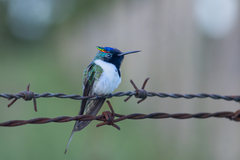
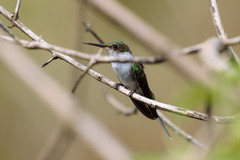
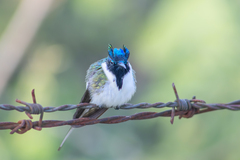
The horned sungem (Heliactin bilophus) is a species of hummingbird native to much of central Brazil and parts of Bolivia and Suriname. It prefers open habitats such as savanna and grassland and readily occupies human-created habitats such as gardens. It recently expanded its range into southern Amazonas and Espírito Santo, probably as a result of deforestation; few other hummingbird species have recently expanded their range. The horned sungem is a small hummingbird with a long tail and a comparatively short, black bill. The sexes differ markedly in appearance, with males sporting two feather tufts ("horns") above the eyes that are shiny red, golden, and green. Males also have a shiny blue head crest and a black throat with a pointed "beard". The female is plainer and has a brown or yellow-buff throat. The species is the only one within its genus, Heliactin.

The horned sungem is a nomadic species, moving between areas in response to the seasonal flowering of the plants on which it feeds. It relies on a broad variety of flowering plants for nectar. If the shape of the flower is incompatible with the bird's comparatively short bill, it may rob the nectar through a little hole at the base of the flower. The sungem does also consume small insects. Only the female builds the nest, incubates the eggs, and rears the chicks. She lays two white eggs in a small cup nest which are incubated for about 13 days. The chicks are naked and black after hatching, and can fly when 20 to 22 days old. The horned sungem has been reported to readily defend territories both against members of its own species and against subordinate hummingbird species. The species is currently classified as least concern by the International Union for Conservation of Nature, and its population is thought to be increasing. Wikipedia →

Sounds

Call1:25

Brazil · 2026

© JAYRSON ARAUJO DE OLIVEIRA · XC1094184 · CC BY-NC-SA 4.0

Song0:38

Brazil · 2023

© Robson Silva e Silva · XC1018280 · CC BY-NC-SA 4.0

?0:11

Brazil · 2008

© Nunes D'Acosta · XC38145 · CC BY-NC-ND 2.5

Global Distribution

Parks Where Found

# Park Country Daily sighting probability
1 Chapada Diamantina National Park 🇧🇷 Brazil
~20%
2 Emas National Park 🇧🇷 Brazil
~10%
3 Serra da Canastra National Park 🇧🇷 Brazil
<5%
4 Chapada dos Guimarães National Park 🇧🇷 Brazil
<5%

Before you go

What are the chances of seeing a Horned Sungem in Emas National Park?

With luck

About 10% of wildlife watchers report a Horned Sungem sighting in Emas National Park on a given day, based on 12 verified sightings from GBIF citizen-science data from 2019 to 2026. It is the 147th most-seen of the 187 birds we can rate there. Over three days the chance rises to about 20%, and over a week to about 30%, if each day is a fresh chance.

When is the best time to see a Horned Sungem in Emas National Park?

May

In that month about 20% of wildlife watchers report a Horned Sungem in Emas National Park on a given day, against under 5% in March and July–November, the lowest months. That is one of Emas National Park's driest months, with about 30 mm of rain against 190 mm in January. April and December–February have too few records to rate.

What time of day is best to see a Horned Sungem?

Between 6 and 9 am

Across all the parks we cover, that three-hour window holds the most Horned Sungem sightings with a recorded time, and about 9 in 10 of them come between 6 am and 6 pm: it is a daytime animal.

Is Emas National Park the best place to see a Horned Sungem?

2nd of 4

Of the 4 parks where we can rate Horned Sungem sightings, Emas National Park ranks 2nd at about 10%. The best odds are in Chapada Diamantina National Park (Brazil, about 20%).

Where does the Horned Sungem sighting chance come from?

GBIF citizen-science records

It is estimated from how often the Horned Sungem is recorded against all the birds logged in Emas National Park (12 verified sightings from 2019 to 2026), calibrated against known sighting rates. Figures are rounded to the nearest 10% because citizen-science data supports honest approximations, not decimals, and months with records from fewer than five people show "—". How it works.

← Back to Emas National Park