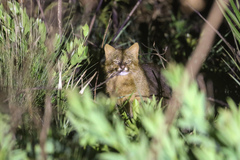
Pantanal Cat

Pantanal Cat

Leopardus braccatus

Silhouette: Francisca Zamora-Cornejo · PhyloPic

Daily sighting probability ~30% · Possible
at Emas National Park

In 3 days ~60% in a week ~90%

15 Verified sightings at Emas National Park From 2019 to 2026
15 In 1 park
March Best month
☀️🌙 Day & Night When it's spotted

About the Pantanal Cat

The Pantanal cat (Leopardus colocola braccatus) is a Pampas cat subspecies, a small wild cat native to South America. It is named after the Pantanal wetlands in central South America, where it inhabits mainly grassland, shrubland, savannas and deciduous forests.

The Pantanal cat is brown agouti on the back with a little darker spinal crest. In the face it has two transverse dark lines across each cheek. Its ears are reddish on their base, creamy-white on the outer side and bordered with a black band. Its throat is whitish and blending into orangish towards the sides and on the belly. It has some dark brown rosettes on the flanks and stripes on the legs between elbow and wrist. The tip of the tail and paws are black. It is about the size of a domestic cat.

There is a single report of a wild melanistic individual from Brazil, although this coat pattern has also been observed in some captive specimens. Pantanal cats are found from sea level to 2,000 metres (6,600 ft) in east-central Brazil, Uruguay, and neighbouring regions of central South America (Bolivia, Paraguay and Argentina). Within this region, they inhabit a range of habitats... Wikipedia →

Global Distribution

Parks Where Found

# Park Country Daily sighting probability
1 Emas National Park 🇧🇷 Brazil
~30%

More parks will be added in future updates.

Zoos & Centres Where Found

# Zoo / Centre Country
1 Zoológico de Brasília 🇧🇷 Brazil In captivity

Before you go

What are the chances of seeing a Pantanal Cat in Emas National Park?

Possible

About 30% of wildlife watchers report a Pantanal Cat sighting in Emas National Park on a given day, based on 15 verified sightings from GBIF citizen-science data from 2019 to 2026. It is the 8th most-seen of the 15 mammals we can rate there. Over three days the chance rises to about 60%, and over a week to about 90%, if each day is a fresh chance.

When is the best time to see a Pantanal Cat in Emas National Park?

March

In that month about 50% of wildlife watchers report a Pantanal Cat in Emas National Park on a given day, against under 5% in April, June, August and December–January, the lowest months. That is one of Emas National Park's wettest months, with about 160 mm of rain against almost none in July.

What time of day is best to see a Pantanal Cat?

Between 6 and 9 pm

Across all the parks we cover, that three-hour window holds the most Pantanal Cat sightings with a recorded time, and about half of them come between 6 pm and 6 am: it is seen both by day and at night.

Where else can you see a Pantanal Cat?

Only Emas National Park, in our data

Emas National Park is the only park on Wallace's Line with enough records to rate Pantanal Cat sightings: about 30% of wildlife watchers there report one on a given day.

Which relatives of the Pantanal Cat live in Emas National Park?

Same order: Carnivora

The closest relatives of the Pantanal Cat that you can see in Emas National Park (order Carnivora, Carnivorans) are Maned Wolf (about 70%), Crab-eating Fox (about 60%) and Hoary Fox (about 20%), with each one's daily chance of a sighting.

Where does the Pantanal Cat sighting chance come from?

GBIF citizen-science records

It is estimated from how often the Pantanal Cat is recorded against all the mammals logged in Emas National Park (15 verified sightings from 2019 to 2026), calibrated against known sighting rates. Figures are rounded to the nearest 10% because citizen-science data supports honest approximations, not decimals, and months with records from fewer than five people show "—". How it works.

← Back to Emas National Park