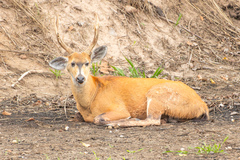
Marsh Deer

Marsh Deer

Blastocerus dichotomus

Silhouette: Steven Traver · PhyloPic

LCNTVUVulnerableENCR
Daily sighting probability ~30% · Possible
at Emas National Park

In 3 days ~60% in a week ~90%

13 Verified sightings at Emas National Park From 2019 to 2026
603 In all 3 parks
January Best month
☀️ Diurnal When it's spotted

About the Marsh Deer

The marsh deer (Blastocerus dichotomus) is a species of deer native to South America. It is the largest living species of South American deer. It is the only species in the genus Blastocerus. It is found in Argentina, Bolivia, Peru, Brazil, Uruguay and Paraguay. Formerly found in much of tropical and subtropical South America, it ranged east of the Andes, south from the Amazon rainforest, west of the Brazilian Atlantic rainforest and north of the Argentinian Pampa. Today it is largely reduced to isolated populations at marsh and lagoon zones in the Paraná, Paraguay, Araguaia and Guapore river basins. Small populations also occur in the southern Amazon, including Peru where protected in Bahuaja-Sonene National Park. It is listed as a vulnerable species by the IUCN and is protected under CITES Appendix I.

Marsh deer resemble the North American mule deer or blacktail deer. They possess very large ears lined with white hairs, red-gold to tawny brown fur, blackish eyes and long dark legs. The hair turns darker during winter. There are also white marks on the hips and around the eyes. The legs are black below the tarsal as is the muzzle. The tail... Wikipedia →

Global Distribution

Parks Where Found

# Park Country Daily sighting probability
1 Iberá National Park 🇦🇷 Argentina
~70%
2 Parque Estadual Encontro das Águas 🇧🇷 Brazil
~40%
3 Emas National Park 🇧🇷 Brazil
~30%

Zoos & Centres Where Found

# Zoo / Centre Country
1 Zoológico de Brasília 🇧🇷 Brazil In captivity
2 Gramado Zoo 🇧🇷 Brazil In captivity
3 Parque Zoobotânico Getúlio Vargas 🇧🇷 Brazil In captivity
4 Bioparque Municipal Vesty Pakos 🇧🇴 Bolivia In captivity
5 Parque Ecológico de São Carlos 🇧🇷 Brazil In captivity
6 Parque Zoológico Bosque Guarani 🇧🇷 Brazil In captivity
7 Zooparque Itatiba 🇧🇷 Brazil In captivity

Before you go

What are the chances of seeing a Marsh Deer in Emas National Park?

Possible

About 30% of wildlife watchers report a Marsh Deer sighting in Emas National Park on a given day, based on 13 verified sightings from GBIF citizen-science data from 2019 to 2026. It is the 8th most-seen of the 15 mammals we can rate there. Over three days the chance rises to about 60%, and over a week to about 90%, if each day is a fresh chance.

When is the best time to see a Marsh Deer in Emas National Park?

December to February

In those months about 40% of wildlife watchers report a Marsh Deer in Emas National Park on a given day, against under 5% in March and October–November, the lowest months. Those are among Emas National Park's wettest months, with about 180 mm of rain a month against almost none in July.

What time of day is best to see a Marsh Deer?

Between 9 am and noon

Across all the parks we cover, that three-hour window holds the most Marsh Deer sightings with a recorded time, and about 9 in 10 of them come between 6 am and 6 pm: it is a daytime animal.

Is Emas National Park the best place to see a Marsh Deer?

3rd of 3

Of the 3 parks where we can rate Marsh Deer sightings, Emas National Park ranks 3rd at about 30%. The best odds are in Iberá National Park (Argentina, about 70%) and Parque Estadual Encontro das Águas (Brazil, about 40%).

Where does the Marsh Deer sighting chance come from?

GBIF citizen-science records

It is estimated from how often the Marsh Deer is recorded against all the mammals logged in Emas National Park (13 verified sightings from 2019 to 2026), calibrated against known sighting rates. Figures are rounded to the nearest 10% because citizen-science data supports honest approximations, not decimals, and months with records from fewer than five people show "—". How it works.

← Back to Emas National Park