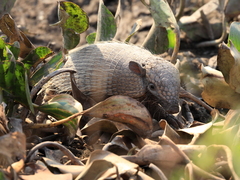
Six-banded Armadillo

Six-banded Armadillo

Euphractus sexcinctus

Silhouette: Victor Geovanne Ferreira · PhyloPic

LCLeast ConcernNTVUENCR
Daily sighting probability ~40% · Likely
at Emas National Park

In 3 days ~70% in a week >90%

14 Verified sightings at Emas National Park From 2019 to 2026
59 In all 3 parks
August Best month
☀️ Diurnal When it's spotted

About the Six-banded Armadillo

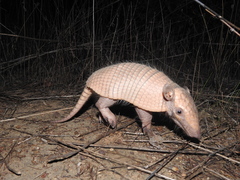
The six-banded armadillo (Euphractus sexcinctus), also known as the yellow armadillo, is an armadillo found in South America. The sole extant member of its genus, it was first described by Swedish zoologist Carl Linnaeus in 1758. The six-banded armadillo is typically between 40 and 50 centimeters (16 and 20 in) in head-and-body length, and weighs 3.2 to 6.5 kilograms (7.1 to 14.3 lb). The carapace (hard shell on the back) is pale yellow to reddish brown, marked by scales of equal length, and scantily covered by buff to white bristle-like hairs. The forefeet have five distinct toes, each with moderately developed claws.

Six-banded armadillos are efficient diggers and form burrows to live in and search for prey. The armadillo is alert and primarily solitary. An omnivore, it feeds on insects, ants, carrion, and plant material. Due to their poor eyesight, armadillos rely on their sense of smell to detect prey and predators. Births take place throughout the year; gestation is 60 to 64 days long, after which a litter of one to three is born. Weaning occurs at one month, and juveniles mature by nine months. The six-banded armadillo inhabits savannas, primary and secondary forests, cerrados, shrublands, and deciduous forests. Fairly common, its range spans from Brazil and southern Suriname in the northeast through Bolivia, Paraguay, and Uruguay into northern Argentina in the southeast. The International Union for the Conservation of Nature and Natural Resources (IUCN) classifies it as least concern, and there are no major threats to its survival. Wikipedia →

Global Distribution

Parks Where Found

# Park Country Daily sighting probability
1 El Palmar National Park 🇦🇷 Argentina
~50%
2 Emas National Park 🇧🇷 Brazil
~40%
3 Serra da Canastra National Park 🇧🇷 Brazil
~30%

Zoos & Centres Where Found

# Zoo / Centre Country
1 National Zoological Park 🇺🇸 United States In captivity
2 ZooParc de Beauval 🇫🇷 France In captivity
3 Paris Zoological Park 🇫🇷 France In captivity
4 Zoo de Doué 🇫🇷 France In captivity
5 Parc zoologique de Montpellier 🇫🇷 France In captivity
6 Wildlife World Zoo 🇺🇸 United States In captivity
7 Novosibirsk Zoo 🇷🇺 Russia In captivity
8 Kyiv Zoo 🇺🇦 Ukraine In captivity
9 Oasis Park 🇪🇸 Spain In captivity
10 Chessington World of Adventures 🇬🇧 United Kingdom In captivity
11 Dierenpark Hoenderdaell 🇳🇱 Netherlands In captivity
12 Terra Natura Benidorm 🇪🇸 Spain In captivity
13 Night Safari 🇸🇬 Singapore In captivity
14 Tanganyika Wildlife Park 🇺🇸 United States In captivity
15 Memphis Zoo 🇺🇸 United States In captivity
16 Singapore Zoo 🇸🇬 Singapore In captivity
17 Virginia Zoological Park 🇺🇸 United States In captivity
18 Senda Verde (Wildlife Sanctuary) 🇧🇴 Bolivia In captivity
19 Fresno Chaffee Zoo 🇺🇸 United States In captivity
20 Akron Zoo 🇺🇸 United States In captivity
21 Zoomarine 🇮🇹 Italy In captivity
22 Northumberland Zoo 🇬🇧 United Kingdom In captivity
23 River Wonders 🇸🇬 Singapore In captivity
24 Touroparc Zoo 🇫🇷 France In captivity
25 Zoológico de Fauna Sudamericana 🇧🇴 Bolivia In captivity
26 Hawk Creek Wildlife Center 🇺🇸 United States In captivity
27 Palmitos Park 🇪🇸 Spain In captivity
28 Bioparc Fuengirola 🇪🇸 Spain In captivity
29 Zoologischer Garten Hof 🇩🇪 Germany In captivity
30 Selwo Marina 🇪🇸 Spain In captivity
31 Randers Tropical Zoo 🇩🇰 Denmark In captivity
32 The Green Planet 🇦🇪 United Arab Emirates In captivity
33 The Living Rainforest 🇬🇧 United Kingdom In captivity
34 Landgoed Hoenderdaell 🇳🇱 Netherlands In captivity
35 Sumida Aquarium 🇯🇵 Japan In captivity

Before you go

What are the chances of seeing a Six-banded Armadillo in Emas National Park?

Likely

About 40% of wildlife watchers report a Six-banded Armadillo sighting in Emas National Park on a given day, based on 14 verified sightings from GBIF citizen-science data from 2019 to 2026. It is the 7th most-seen of the 15 mammals we can rate there. Over three days the chance rises to about 70%, and over a week to over 90%, if each day is a fresh chance.

When is the best time to see a Six-banded Armadillo in Emas National Park?

August and October

In those months about 50% of wildlife watchers report a Six-banded Armadillo in Emas National Park on a given day, against under 5% in March–May and November, the lowest months.

What time of day is best to see a Six-banded Armadillo?

Between 10 am and 1 pm

Across all the parks we cover, that three-hour window holds the most Six-banded Armadillo sightings with a recorded time, and about 7 in 10 of them come between 6 am and 6 pm: it is a daytime animal.

Is Emas National Park the best place to see a Six-banded Armadillo?

2nd of 3

Of the 3 parks where we can rate Six-banded Armadillo sightings, Emas National Park ranks 2nd at about 40%. The best odds are in El Palmar National Park (Argentina, about 50%).

Which relatives of the Six-banded Armadillo live in Emas National Park?

Same family: Dasypodidae

The closest relatives of the Six-banded Armadillo that you can see in Emas National Park (family Dasypodidae, Long-nosed Armadillos) are Lesser Long-nosed Armadillo (about 30%) and Cabasu (about 20%), with each one's daily chance of a sighting.

Where does the Six-banded Armadillo sighting chance come from?

GBIF citizen-science records

It is estimated from how often the Six-banded Armadillo is recorded against all the mammals logged in Emas National Park (14 verified sightings from 2019 to 2026), calibrated against known sighting rates. Figures are rounded to the nearest 10% because citizen-science data supports honest approximations, not decimals, and months with records from fewer than five people show "—". How it works.

← Back to Emas National Park