Lesser Long-nosed Armadillo

Lesser Long-nosed Armadillo

Dasypus septemcinctus

Silhouette: Steven Traver · PhyloPic

LCLeast ConcernNTVUENCR
Daily sighting probability ~30% · Possible
at Emas National Park

In 3 days ~60% in a week ~90%

14 Verified sightings at Emas National Park From 2019 to 2026
14 In 1 park
January Best month
☀️ Diurnal When it's spotted

About the Lesser Long-nosed Armadillo

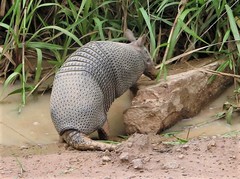
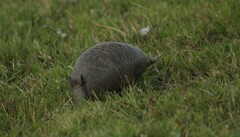
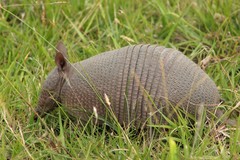
The seven-banded armadillo (Dasypus septemcinctus), also known as the Brazilian lesser long-nosed armadillo, is a species of armadillo from South America found in Paraguay, Argentina, Bolivia and Brazil. It is a solitary nocturnal, terrestrial animal, living mostly in dry habitats, outside of rainforest regions.

Long-nosed armadillos have a broad, depressed body, an obtusely pointed rostrum, long, pointed ears and short legs. The carapace consists of two immobile plates, separated by six or seven movable bands, which are connected to each other by a fold of hairless skin. The carapace is mostly blackish, hairless and with the scales of the anterior edge of the movable bands not notably different in colour from the rest of the dorsum. Lateral scutes have dark blackish-pink centres only slightly discernible from the rest of the carapace, but never as obviously pale as in the nine-banded armadillo. Scutes on the movable bands are triangular in shape, but those on the main plates are rounded. The number of scutes present on the fourth movable band varies from 44 to 52, with a mean of 48.4. Seven-banded armadillo possesses a variety of unique biological and neurological... Wikipedia →

Global Distribution

Parks Where Found

# Park Country Daily sighting probability
1 Emas National Park 🇧🇷 Brazil
~30%

More parks will be added in future updates.

Before you go

What are the chances of seeing a Lesser Long-nosed Armadillo in Emas National Park?

Possible

About 30% of wildlife watchers report a Lesser Long-nosed Armadillo sighting in Emas National Park on a given day, based on 14 verified sightings from GBIF citizen-science data from 2019 to 2026. It is the 8th most-seen of the 15 mammals we can rate there. Over three days the chance rises to about 60%, and over a week to about 90%, if each day is a fresh chance.

When is the best time to see a Lesser Long-nosed Armadillo in Emas National Park?

January

In that month about 50% of wildlife watchers report a Lesser Long-nosed Armadillo in Emas National Park on a given day, against under 5% in March–July and November, the lowest months. That is one of Emas National Park's wettest months, with about 190 mm of rain against almost none in July.

What time of day is best to see a Lesser Long-nosed Armadillo?

Between 10 am and 1 pm

Across all the parks we cover, that three-hour window holds the most Lesser Long-nosed Armadillo sightings with a recorded time, and about 8 in 10 of them come between 6 am and 6 pm: it is a daytime animal.

Where else can you see a Lesser Long-nosed Armadillo?

Only Emas National Park, in our data

Emas National Park is the only park on Wallace's Line with enough records to rate Lesser Long-nosed Armadillo sightings: about 30% of wildlife watchers there report one on a given day.

Which relatives of the Lesser Long-nosed Armadillo live in Emas National Park?

Same family: Dasypodidae

The closest relatives of the Lesser Long-nosed Armadillo that you can see in Emas National Park (family Dasypodidae, Long-nosed Armadillos) are Six-banded Armadillo (about 40%) and Cabasu (about 20%), with each one's daily chance of a sighting.

Where does the Lesser Long-nosed Armadillo sighting chance come from?

GBIF citizen-science records

It is estimated from how often the Lesser Long-nosed Armadillo is recorded against all the mammals logged in Emas National Park (14 verified sightings from 2019 to 2026), calibrated against known sighting rates. Figures are rounded to the nearest 10% because citizen-science data supports honest approximations, not decimals, and months with records from fewer than five people show "—". How it works.

← Back to Emas National Park