
Galaxy Frog

Galaxy Frog

Melanobatrachus indicus

Silhouette: Dmitry Bogdanov (vectorized by T. Michael Keesey) · PhyloPic

LCNTVUVulnerableENCR Endemic
Daily sighting probability ~10% · With luck
at Eravikulam National Park

In 3 days ~30% in a week ~60%

12 Verified sightings at Eravikulam National Park From 2019 to 2026
12 In 1 park
July Best month
🌅 Crepuscular When it's spotted

About the Galaxy Frog

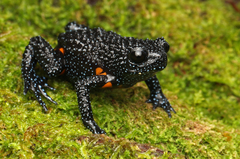
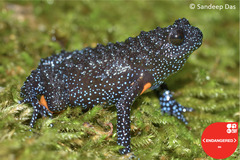
Melanobatrachus is a genus of narrow-mouthed frogs in the family Microhylidae. It is the only remaining genus in the monotypic subfamily Melanobatrachinae. It contains a single species, Melanobatrachus indicus, also known as the Indian black microhylid frog and Malabar black narrow-mouthed frog. It is endemic to wet evergreen forests of southern Western Ghats in Kerala and Tamil Nadu states of India. It has been recorded from Anaimalai, Munnar, Palni hills, Periyar Tiger Reserve and Kalakkad Mundanthurai Tiger Reserve

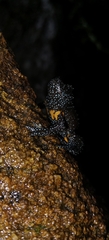
Melanobatrachus indicus is a rare species that was only rediscovered in 1997. It lives amongst leaf-litter, rocks and other ground cover of moist evergreen tropical forests. Melanobatrachus indicus is an Evolutionarily Distinct and Globally Endangered (EDGE) species. It is classified as Vulnerable by the International Union for Conservation of Nature. The species faces danger by photography trips.

Global... Wikipedia →

Global Distribution

Parks Where Found

# Park Country Daily sighting probability
1 Eravikulam National Park 🇮🇳 India
~10%

More parks will be added in future updates.

Before you go

What are the chances of seeing a Galaxy Frog in Eravikulam National Park?

With luck

About 10% of wildlife watchers report a Galaxy Frog sighting in Eravikulam National Park on a given day, based on 12 verified sightings from GBIF citizen-science data from 2019 to 2026. It is the 9th most-seen of the 9 amphibians we can rate there. Over three days the chance rises to about 30%, and over a week to about 60%, if each day is a fresh chance.

When is the best time to see a Galaxy Frog in Eravikulam National Park?

July

In that month about 30% of wildlife watchers report a Galaxy Frog in Eravikulam National Park on a given day, against under 5% in December to May, the lowest months. That is one of Eravikulam National Park's wettest months, with about 450 mm of rain against 25 mm in February.

What time of day is best to see a Galaxy Frog?

Between 5 and 8 pm

Across all the parks we cover, that three-hour window holds the most Galaxy Frog sightings with a recorded time, and about 6 in 10 of them come between 6 am and 6 pm: it is most active around dawn and dusk.

Where else can you see a Galaxy Frog?

Only Eravikulam National Park, in our data

Eravikulam National Park is the only park on Wallace's Line with enough records to rate Galaxy Frog sightings: about 10% of wildlife watchers there report one on a given day.

Which relatives of the Galaxy Frog live in Eravikulam National Park?

Same order: Anura

The closest relatives of the Galaxy Frog that you can see in Eravikulam National Park (order Anura, Frogs and Toads) are False Malabar Gliding Frog (about 30%), Beddome's Bush Frog (about 30%) and Green-eyed Bush Frog (about 20%), with each one's daily chance of a sighting.

Where does the Galaxy Frog sighting chance come from?

GBIF citizen-science records

It is estimated from how often the Galaxy Frog is recorded against all the amphibians logged in Eravikulam National Park (12 verified sightings from 2019 to 2026), calibrated against known sighting rates. Figures are rounded to the nearest 10% because citizen-science data supports honest approximations, not decimals, and months with records from fewer than five people show "—". How it works.

← Back to Eravikulam National Park