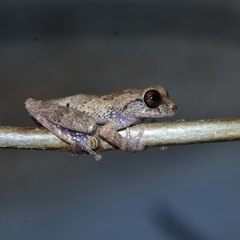
Munnar Bush Frog

Munnar Bush Frog

Raorchestes munnarensis

Silhouette: PhyloPic

LCNTVUENEndangeredCR Endemic
Daily sighting probability ~20% · Possible
at Eravikulam National Park

In 3 days ~50% in a week ~80%

23 Verified sightings at Eravikulam National Park From 2019 to 2026
23 In 1 park
August Best month
🌅 Crepuscular When it's spotted

About the Munnar Bush Frog

Raorchestes munnarensis (Munnar bush frog) is a species of frog in the family Rhacophoridae endemic to Munnar, Kerala, along the Ghat road to Devikulam in the southern Western Ghats, India. It is known only from a small area (less than 20 km2) of secondary vegetation, adjoining the forest along the Ghat road. Specimens were found close to a tea plantation, but not inside the plantation. It breeds by direct development. Its natural habitat is heavily degraded former forest.

The frog's range includes two protected parks: Eravikulam National Park and Anamalai Tiger Reserve. Scientists estimate about 50% of the living population lives in these two parks. The species is threatened by anthropogenic habitat loss. including habitat clearance for tea and eucalyptus plantations, all the more concerning since there are no other areas of suitable habitat known in the surrounding region.

Scientists also cite climate change and the fungal disease chytridiomycosis as threats to this frog. The fungus Batrachochytrium dendrobatidis has been observed on other frogs in Raorchestes, so scientists infer that R. munnarensis mat be susceptible as well. Wikipedia →

Global Distribution

Parks Where Found

# Park Country Daily sighting probability
1 Eravikulam National Park 🇮🇳 India
~20%

More parks will be added in future updates.

Before you go

What are the chances of seeing a Munnar Bush Frog in Eravikulam National Park?

Possible

About 20% of wildlife watchers report a Munnar Bush Frog sighting in Eravikulam National Park on a given day, based on 23 verified sightings from GBIF citizen-science data from 2019 to 2026. It is the 6th most-seen of the 9 amphibians we can rate there. Over three days the chance rises to about 50%, and over a week to about 80%, if each day is a fresh chance.

When is the best time to see a Munnar Bush Frog in Eravikulam National Park?

August

In that month about 40% of wildlife watchers report a Munnar Bush Frog in Eravikulam National Park on a given day, against under 5% in February to May, the lowest months. That is one of Eravikulam National Park's wettest months, with about 420 mm of rain against 25 mm in February.

What time of day is best to see a Munnar Bush Frog?

Between 3 and 6 pm

Across all the parks we cover, that three-hour window holds the most Munnar Bush Frog sightings with a recorded time, and about 7 in 10 of them come between 6 am and 6 pm: it is most active around dawn and dusk.

Where else can you see a Munnar Bush Frog?

Only Eravikulam National Park, in our data

Eravikulam National Park is the only park on Wallace's Line with enough records to rate Munnar Bush Frog sightings: about 20% of wildlife watchers there report one on a given day.

Which relatives of the Munnar Bush Frog live in Eravikulam National Park?

Same genus: Raorchestes

The closest relatives of the Munnar Bush Frog that you can see in Eravikulam National Park (genus Raorchestes, Bush Frogs) are Beddome's Bush Frog (about 30%), Green-eyed Bush Frog (about 20%) and Resplendent Shrubfrog (about 20%), with each one's daily chance of a sighting.

Where does the Munnar Bush Frog sighting chance come from?

GBIF citizen-science records

It is estimated from how often the Munnar Bush Frog is recorded against all the amphibians logged in Eravikulam National Park (23 verified sightings from 2019 to 2026), calibrated against known sighting rates. Figures are rounded to the nearest 10% because citizen-science data supports honest approximations, not decimals, and months with records from fewer than five people show "—". How it works.

← Back to Eravikulam National Park