Kodaikanal Bush Frog

Kodaikanal Bush Frog

Raorchestes dubois

Silhouette: PhyloPic

LCNTVUVulnerableENCR Endemic
Daily sighting probability ~20% · Possible
at Eravikulam National Park

In 3 days ~50% in a week ~80%

37 Verified sightings at Eravikulam National Park From 2019 to 2026
37 In 1 park
August Best month
🌅 Crepuscular When it's spotted

About the Kodaikanal Bush Frog

Raorchestes dubois or the Koadaikanal bush frog is a species of frog in the family Rhacophoridae. It is known from the southern Western Ghats, near Kodaikanal in Dindigul District in the state of Tamil Nadu in India. It has been observed between 1900 and 2300 meters above sea level.

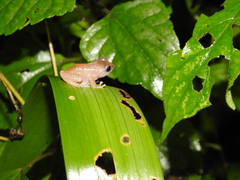
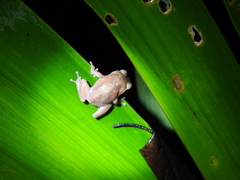
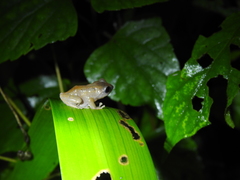
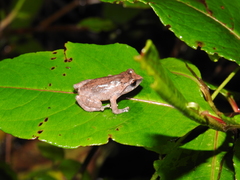
Its habitats include roadside vegetation and gardens. The adult male frog measures about 19.2 mm to 20.8 mm in snout-vent length and the adult female frog 25.1 mm to 25.3 mm. The skin of the dorsum is green in color with some silver and blue-purple pigmentation. There is a mark in the shape of a V on the frog's back reaching from the eyes to the vent. The back and sides have black, brown, silver, and purple spots. The iris of the eye is gold-brown in color with some green and brown. The ends of the toes are white. The sides of the belly have yellow-brown marks.

Like other frogs in Raorchestes, these frogs hatch from eggs as small froglets with no free-swimming tadpole stage. The species is named in honour of Alain Dubois, a French herpetologist associated with the Paris Museum of Natural History.

"Philautus dubois". Integrated... Wikipedia →

Global Distribution

Parks Where Found

# Park Country Daily sighting probability
1 Eravikulam National Park 🇮🇳 India
~20%

More parks will be added in future updates.

Before you go

What are the chances of seeing a Kodaikanal Bush Frog in Eravikulam National Park?

Possible

About 20% of wildlife watchers report a Kodaikanal Bush Frog sighting in Eravikulam National Park on a given day, based on 37 verified sightings from GBIF citizen-science data from 2019 to 2026. It is the 5th most-seen of the 9 amphibians we can rate there. Over three days the chance rises to about 50%, and over a week to about 80%, if each day is a fresh chance.

When is the best time to see a Kodaikanal Bush Frog in Eravikulam National Park?

August

In that month about 40% of wildlife watchers report a Kodaikanal Bush Frog in Eravikulam National Park on a given day, against under 5% in February–April and December, the lowest months. That is one of Eravikulam National Park's wettest months, with about 420 mm of rain against 25 mm in February.

What time of day is best to see a Kodaikanal Bush Frog?

Between 5 and 8 pm

Across all the parks we cover, that three-hour window holds the most Kodaikanal Bush Frog sightings with a recorded time, and about 6 in 10 of them come between 6 am and 6 pm: it is most active around dawn and dusk.

Where else can you see a Kodaikanal Bush Frog?

Only Eravikulam National Park, in our data

Eravikulam National Park is the only park on Wallace's Line with enough records to rate Kodaikanal Bush Frog sightings: about 20% of wildlife watchers there report one on a given day.

Which relatives of the Kodaikanal Bush Frog live in Eravikulam National Park?

Same genus: Raorchestes

The closest relatives of the Kodaikanal Bush Frog that you can see in Eravikulam National Park (genus Raorchestes, Bush Frogs) are Beddome's Bush Frog (about 30%), Green-eyed Bush Frog (about 20%) and Resplendent Shrubfrog (about 20%), with each one's daily chance of a sighting.

Where does the Kodaikanal Bush Frog sighting chance come from?

GBIF citizen-science records

It is estimated from how often the Kodaikanal Bush Frog is recorded against all the amphibians logged in Eravikulam National Park (37 verified sightings from 2019 to 2026), calibrated against known sighting rates. Figures are rounded to the nearest 10% because citizen-science data supports honest approximations, not decimals, and months with records from fewer than five people show "—". How it works.

← Back to Eravikulam National Park