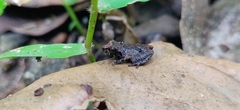
Griet's Bush Frog

Griet's Bush Frog

Raorchestes griet

Silhouette: PhyloPic

LCNTVUVulnerableENCR Endemic
Daily sighting probability ~20% · Possible
at Eravikulam National Park

In 3 days ~40% in a week ~70%

17 Verified sightings at Eravikulam National Park From 2019 to 2026
17 In 1 park
July Best month
🌅 Crepuscular When it's spotted

About the Griet's Bush Frog

Raorchestes griet is a species of frog in the family Rhacophoridae. It is endemic to the Western Ghats south of the Palghat Gap in Kerala and Tamil Nadu states, India. The specific name griet honours Griet Decock, spouse of Franky Bossuyt, the scientist who described the species. The common name Griet bush frog has been coined for it.

Adult males measure 20–22 mm (0.8–0.9 in) and adult females, based on a single specimen, 22 mm (0.9 in) in snout–vent length. The snout is rounded. The tympanum is indistinct, but the supratympanic fold is prominent. The fingers have well-developed discs and dermal fringes but no webbing. The toes have discs and rudimentary webbing. Skin of snout bears small horny spines, and there are horny ridges between eyes, arranged in triangle. Dorsal skin is covered with small horny spines. The dorsum is light greyish brown, light brownish grey, or light-reddish brown. Dark or light red markings may be present.

Raorchestes griet has been observed in roadside vegetation near isolated forest patches or in plantations near forests at about 600–2,000 m (2,000–6,600 ft) above sea level. It is nocturnal and arboreal, which... Wikipedia →

Sounds

Recording0:11

India · 2025

© Amaël Borzée · iNaturalist · CC BY-NC 4.0

Global Distribution

Parks Where Found

# Park Country Daily sighting probability
1 Eravikulam National Park 🇮🇳 India
~20%

More parks will be added in future updates.

Before you go

What are the chances of seeing a Griet's Bush Frog in Eravikulam National Park?

Possible

About 20% of wildlife watchers report a Griet's Bush Frog sighting in Eravikulam National Park on a given day, based on 17 verified sightings from GBIF citizen-science data from 2019 to 2026. It is the 7th most-seen of the 9 amphibians we can rate there. Over three days the chance rises to about 40%, and over a week to about 70%, if each day is a fresh chance.

When is the best time to see a Griet's Bush Frog in Eravikulam National Park?

June to August

In those months about 30% of wildlife watchers report a Griet's Bush Frog in Eravikulam National Park on a given day, against under 5% in May and September–March, the lowest months. Those are among Eravikulam National Park's wettest months, with about 400 mm of rain a month against 25 mm in February.

What time of day is best to see a Griet's Bush Frog?

Between 4 and 7 pm

Across all the parks we cover, that three-hour window holds the most Griet's Bush Frog sightings with a recorded time, and about 6 in 10 of them come between 6 am and 6 pm: it is most active around dawn and dusk.

Where else can you see a Griet's Bush Frog?

Only Eravikulam National Park, in our data

Eravikulam National Park is the only park on Wallace's Line with enough records to rate Griet's Bush Frog sightings: about 20% of wildlife watchers there report one on a given day.

Which relatives of the Griet's Bush Frog live in Eravikulam National Park?

Same genus: Raorchestes

The closest relatives of the Griet's Bush Frog that you can see in Eravikulam National Park (genus Raorchestes, Bush Frogs) are Beddome's Bush Frog (about 30%), Green-eyed Bush Frog (about 20%) and Resplendent Shrubfrog (about 20%), with each one's daily chance of a sighting.

Where does the Griet's Bush Frog sighting chance come from?

GBIF citizen-science records

It is estimated from how often the Griet's Bush Frog is recorded against all the amphibians logged in Eravikulam National Park (17 verified sightings from 2019 to 2026), calibrated against known sighting rates. Figures are rounded to the nearest 10% because citizen-science data supports honest approximations, not decimals, and months with records from fewer than five people show "—". How it works.

← Back to Eravikulam National Park