
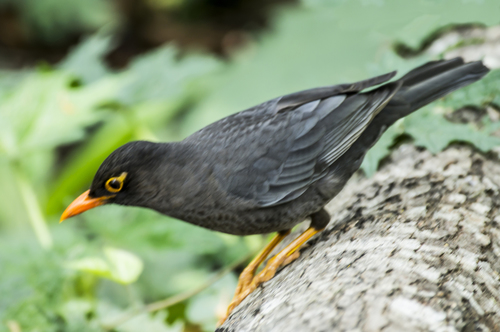
Painted Bush Quail

Painted Bush Quail

Perdicula erythrorhyncha

Silhouette: Sheatherius · PhyloPic

LCLeast ConcernNTVUENCR Endemic
Daily sighting probability ~30% · Possible
at Eravikulam National Park

In 3 days ~70% in a week ~90%

128 Verified sightings at Eravikulam National Park From 2019 to 2026
145 In all 2 parks
December Best month
☀️ Diurnal When it's spotted

About the Painted Bush Quail

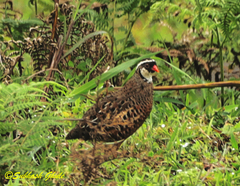
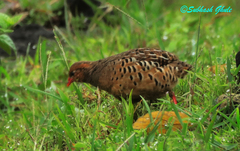
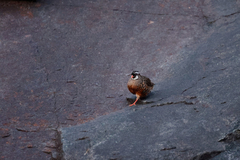
The painted bush quail (Perdicula erythrorhyncha) is a species of quail found in the hill forests of India. They move in small coveys on hillsides and are distinguished by their red bills and legs. They have a liquid alarm call and small groups will run in single file along paths before taking flight when flushed.

This quail is darkish brightly colored with a deep red bill and legs, eye-catching even in flight. The female has brick-red underpart and lacks the white throat and head stripe of the male. The male has a black face with a white supercilium and throat. These quail are typically found in a covey of 6 to 10 birds. They come out in open grassy patches or on forest roads and cart tracks to feed on seeds or grain (and small insects) and dust-bathe in the morning and evening. The covey quickly reunites by the constant call of the members to one another. A series of soft whistles are heard when members of a scattered covey regroup. The territorial call of male is a pleasant, oft-repeated triple note kirikee-kirikee-kirikee.

It is 6.6–7.5 in (17–19 cm) long and weighs roughly 2.4–3.1 oz (68–88 g). This species is mainly found in the... Wikipedia →

Sounds

Song0:11

India · 2020

© Avinash Bhagat · XC586503 · CC BY-NC-SA 4.0

Call0:11

India · 2016

© Frank Lambert · XC473853 · CC BY-NC-ND 4.0

Song0:21

India · 2019

© Prateik Kulkarni · XC497518 · CC BY-NC-SA 4.0

Global Distribution

Parks Where Found

# Park Country Daily sighting probability
1 Eravikulam National Park 🇮🇳 India
~30%
2 Periyar National Park 🇮🇳 India
<5%

Before you go

What are the chances of seeing a Painted Bush Quail in Eravikulam National Park?

Possible

About 30% of wildlife watchers report a Painted Bush Quail sighting in Eravikulam National Park on a given day, based on 128 verified sightings from GBIF citizen-science data from 2019 to 2026. It is the 18th most-seen of the 116 birds we can rate there. Over three days the chance rises to about 70%, and over a week to about 90%, if each day is a fresh chance.

When is the best time to see a Painted Bush Quail in Eravikulam National Park?

July, October and December–January

In those months about 40% of wildlife watchers report a Painted Bush Quail in Eravikulam National Park on a given day, against about 10% in March, the lowest month.

What time of day is best to see a Painted Bush Quail?

Between 6 and 9 am

Across all the parks we cover, that three-hour window holds the most Painted Bush Quail sightings with a recorded time, and nearly all of them come between 6 am and 6 pm: it is a daytime animal.

Is Eravikulam National Park the best place to see a Painted Bush Quail?

Yes

Of the 2 parks where we can rate Painted Bush Quail sightings, Eravikulam National Park has the highest daily chance: about 30%. Next come Periyar National Park (India, under 5%).

Which relatives of the Painted Bush Quail live in Eravikulam National Park?

Same family: Phasianidae

The closest relatives of the Painted Bush Quail that you can see in Eravikulam National Park (family Phasianidae, Pheasants, Grouse, and Allies) are Grey Junglefowl (about 10%) and Common Peafowl (about 10%), with each one's daily chance of a sighting.

Where does the Painted Bush Quail sighting chance come from?

GBIF citizen-science records

It is estimated from how often the Painted Bush Quail is recorded against all the birds logged in Eravikulam National Park (128 verified sightings from 2019 to 2026), calibrated against known sighting rates. Figures are rounded to the nearest 10% because citizen-science data supports honest approximations, not decimals, and months with records from fewer than five people show "—". How it works.

← Back to Eravikulam National Park