Indian Blackbird

Indian Blackbird

Turdus simillimus

Silhouette: Sharon Wegner-Larsen · PhyloPic

LCLeast ConcernNTVUENCR
Daily sighting probability ~60% · Likely
at Eravikulam National Park

In 3 days ~90% in a week >90%

270 Verified sightings at Eravikulam National Park From 2019 to 2026
910 In all 8 parks
January Best month
🌅 Crepuscular When it's spotted

About the Indian Blackbird

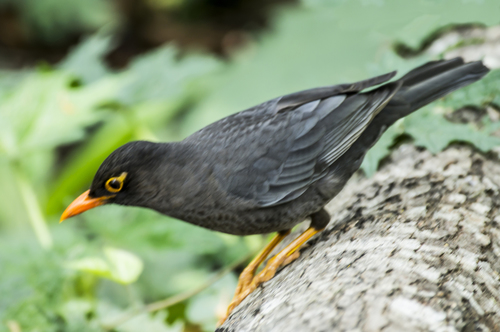
The Indian blackbird (Turdus simillimus) is a member of the thrush family Turdidae. It was formerly considered a subspecies of the common blackbird. It is found only in India and Sri Lanka. The subspecies from most of the Indian subcontinent, simillimus, nigropileus, bourdilloni and spencei, are small, only 19–20 centimetres (7.5–7.9 inches) long, and have broad eye-rings. They also differ in proportions, wing formula, egg colour and voice from the common blackbird.

The Nilgiri blackbird (T. s. simillimus) is resident up to 2,000 metres in the Western Ghats from Biligirirangans and Nilgiris till about Nelliampathies where it integrates with Bourdillon's blackbird. The black-capped blackbird (T. s. nigropileus) is resident up to about 1,820 metres (5,970 feet) in the Western Ghats of western India and the northern and central parts of the Western Ghats. Some populations migrate further south in winter. The male is brownish slate-grey with a dark cap, and the female is mid-brown, paler below. It is small with a relatively broad yellow eye-ring.

Spence's blackbird (T. s. spencei), named for William Spence, British entomologist, is very similar to nigropileus, but has a... Wikipedia →
Sounds

Song0:12

India · 2011

© Rajgopal Patil · XC574615 · CC BY-NC-SA 4.0

Breeing0:16

India · 2004

© Sharad Apte · XC31951 · CC BY-NC-ND 2.5

Flight call0:10

India · 2016

© Frank Lambert · XC474095 · CC BY-NC-ND 4.0

Global Distribution

Parks Where Found

# Park Country Daily sighting probability
1 Horton Plains National Park 🇱🇰 Sri Lanka
~70%
2 Eravikulam National Park 🇮🇳 India
~60%
3 Mudumalai National Park 🇮🇳 India
<5%
4 Nagarhole National Park 🇮🇳 India
<5%
5 Satpura National Park 🇮🇳 India
<5%
6 Periyar National Park 🇮🇳 India
<5%
7 Bandipur National Park 🇮🇳 India
<5%
8 Kanha National Park 🇮🇳 India
<5%

Cities Where Found

# City Country Daily sighting probability
1 Jabalpur 🇮🇳 India
~10%
2 Thrissur 🇮🇳 India
<5%
3 Mumbai 🇮🇳 India
<5%
4 Pune 🇮🇳 India
<5%
5 Nashik 🇮🇳 India
<5%
6 Kozhikode 🇮🇳 India
<5%
7 Kochi 🇮🇳 India
<5%
8 Bengaluru 🇮🇳 India
<5%

Before you go

What are the chances of seeing an Indian Blackbird in Eravikulam National Park?

Likely

About 60% of wildlife watchers report an Indian Blackbird sighting in Eravikulam National Park on a given day, based on 270 verified sightings from GBIF citizen-science data from 2019 to 2026. It is the 8th most-seen of the 116 birds we can rate there. Over three days the chance rises to about 90%, and over a week to over 90%, if each day is a fresh chance.

When is the best time to see an Indian Blackbird in Eravikulam National Park?

January

In that month about 70% of wildlife watchers report an Indian Blackbird in Eravikulam National Park on a given day, against about 30% in August, the lowest month. That is one of Eravikulam National Park's driest months, with about 60 mm of rain against 450 mm in July.

What time of day is best to see an Indian Blackbird?

Between 3 and 6 am

Across all the parks we cover, that three-hour window holds the most Indian Blackbird sightings with a recorded time, and about 6 in 10 of them come between 6 am and 6 pm: it is most active around dawn and dusk.

Is Eravikulam National Park the best place to see an Indian Blackbird?

2nd of 8

Of the 8 parks where we can rate Indian Blackbird sightings, Eravikulam National Park ranks 2nd at about 60%. The best odds are in Horton Plains National Park (Sri Lanka, about 70%).

Which relatives of the Indian Blackbird live in Eravikulam National Park?

Same order: Passeriformes

The closest relatives of the Indian Blackbird that you can see in Eravikulam National Park (order Passeriformes, Perching Birds) are Palani Laughingthrush (about 90%), Red-whiskered Bulbul (about 80%) and Pied Bushchat (about 70%), with each one's daily chance of a sighting.

Where does the Indian Blackbird sighting chance come from?

GBIF citizen-science records

It is estimated from how often the Indian Blackbird is recorded against all the birds logged in Eravikulam National Park (270 verified sightings from 2019 to 2026), calibrated against known sighting rates. Figures are rounded to the nearest 10% because citizen-science data supports honest approximations, not decimals, and months with records from fewer than five people show "—". How it works.

← Back to Eravikulam National Park