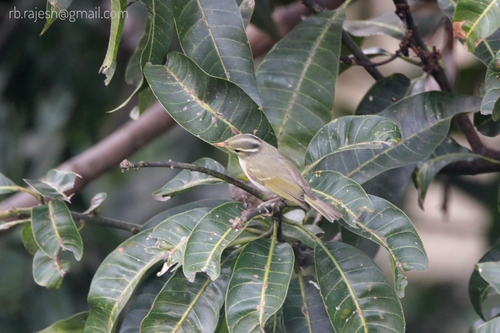
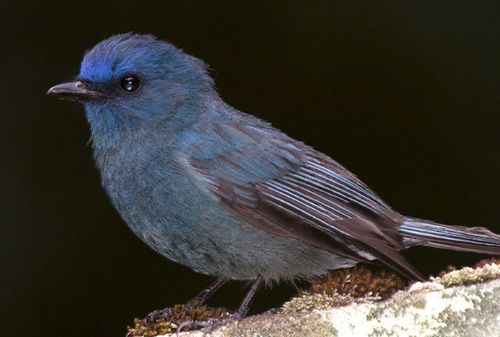
Tytler's Leaf-Warbler

Tytler's Leaf-Warbler

Phylloscopus tytleri

Silhouette: Jiekun He · PhyloPic

LCLeast ConcernNTVUENCR
Daily sighting probability ~10% · With luck
at Eravikulam National Park

In 3 days ~20% in a week ~30%

20 Verified sightings at Eravikulam National Park From 2019 to 2026
20 In 1 park
January Best month
☀️ Diurnal When it's spotted

About the Tytler's Leaf-Warbler

Tytler's leaf warbler (Phylloscopus tytleri) is a songbird species. Like all leaf warblers, it was formerly placed in the "Old World warbler" assemblage, but now belongs to the new leaf-warbler family Phylloscopidae. It is found in Afghanistan, Pakistan, Nepal, and India. It passes through the Western Himalayas to winter in southern India, particularly in the Western Ghats and the Nilgiris.

Its natural habitat is subtropical or tropical moist montane forests. It is threatened by habitat loss. It breeds in the Northwestern Himalayan region and is suspected to breed in the Garhwal and Kumaon Himalayas. The name commemorates the British naturalist Robert Christopher Tytler.

In museum specimens, the thin bill is clear and there is a long exposed nasal groove along the bill. The rictal bristles are short and few and the feathering at the base of the beak is reduced giving a very pointed face profile. The lower mandible is not flesh coloured in tytleri as in most trochiloides and it is not dark black as in Phylloscopus collybita tristis. They do not have any wing bars. Wikipedia →

Sounds

Song0:12

India · 2025

© Peter Boesman · XC1030786 · CC BY-NC-ND 4.0

Call0:12

India · 2017

© pradnyavant mane · XC362256 · CC BY-NC-SA 4.0

Song1:17

India · 2019

© Andrew Spencer · XC547829 · CC BY-NC-ND 4.0

Global Distribution

Parks Where Found

# Park Country Daily sighting probability
1 Eravikulam National Park 🇮🇳 India
~10%

More parks will be added in future updates.

Cities Where Found

# City Country Daily sighting probability
1 Pune 🇮🇳 India
<5%
2 Bengaluru 🇮🇳 India
<5%

Before you go

What are the chances of seeing a Tytler's Leaf-Warbler in Eravikulam National Park?

With luck

About 10% of wildlife watchers report a Tytler's Leaf-Warbler sighting in Eravikulam National Park on a given day, based on 20 verified sightings from GBIF citizen-science data from 2019 to 2026. It is the 65th most-seen of the 116 birds we can rate there. Over three days the chance rises to about 20%, and over a week to about 30%, if each day is a fresh chance.

When is the best time to see a Tytler's Leaf-Warbler in Eravikulam National Park?

December and January

In those months about 10% of wildlife watchers report a Tytler's Leaf-Warbler in Eravikulam National Park on a given day, against under 5% in February to November, the lowest months. Those are among Eravikulam National Park's driest months, with about 85 mm of rain a month against 450 mm in July.

What time of day is best to see a Tytler's Leaf-Warbler?

Between 7 and 10 am

Across all the parks we cover, that three-hour window holds the most Tytler's Leaf-Warbler sightings with a recorded time, and about 9 in 10 of them come between 6 am and 6 pm: it is a daytime animal.

Where else can you see a Tytler's Leaf-Warbler?

Only Eravikulam National Park, in our data

Eravikulam National Park is the only park on Wallace's Line with enough records to rate Tytler's Leaf-Warbler sightings: about 10% of wildlife watchers there report one on a given day.

Which relatives of the Tytler's Leaf-Warbler live in Eravikulam National Park?

Same genus: Phylloscopus

The closest relatives of the Tytler's Leaf-Warbler that you can see in Eravikulam National Park (genus Phylloscopus, Leaf Warblers) are Greenish Warbler (about 60%), Tickell's Leaf Warbler (about 30%) and Large-billed Leaf-Warbler (about 10%), with each one's daily chance of a sighting.

Where does the Tytler's Leaf-Warbler sighting chance come from?

GBIF citizen-science records

It is estimated from how often the Tytler's Leaf-Warbler is recorded against all the birds logged in Eravikulam National Park (20 verified sightings from 2019 to 2026), calibrated against known sighting rates. Figures are rounded to the nearest 10% because citizen-science data supports honest approximations, not decimals, and months with records from fewer than five people show "—". How it works.

← Back to Eravikulam National Park