Allen's Gallinule

Allen's Gallinule

Porphyrio alleni

Silhouette: Sheatherius · PhyloPic

LCLeast ConcernNTVUENCR
Daily sighting probability <5% · Rare
at Etosha National Park

In 3 days <5%

5 Verified sightings at Etosha National Park From 2019 to 2026
189 In all 12 parks
November Best month
☀️ Diurnal When it's spotted

About the Allen's Gallinule

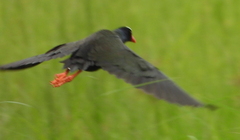
Allen's gallinule (Porphyrio alleni), formerly known as the lesser gallinule, is a small waterbird of the family Rallidae. Its former binomial name is Porphyrula alleni. Porphyrio is the Latin for "swamphen", and alleni, like the English name, commemorates British naval officer Rear-Admiral William Allen (1792–1864).

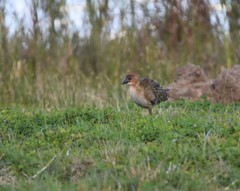
Allen's gallinules are found year-round in marshes and lakes in Sub-Saharan Africa. It has occurred as a vagrant in several European countries, and is the only purely Sub-Saharan bird species to reach Great Britain. They are similar in size to the only slightly larger water rail. The Allen's gallinule has a short red bill, greenish back and purple upperparts. They have red legs with long toes, and a short tail which is white with a dark central bar underneath. Breeding males have a blue frontal shield, which is green in the female. Immature Allen's gallinules are sandy brown with a buff undertail. The downy chicks are black, as with all rails. They nod their heads as they swim.

Allen's gallinules are very secretive in the breeding season, particularly in the dense swamps they favour, and are... Wikipedia →

Sounds

Call0:27

Senegal · 2026

© Peter Boesman · XC1081358 · CC BY-NC-ND 4.0

Call0:19

Senegal · 2024

© Frank Lambert · XC1041469 · CC BY-NC-ND 4.0

Call0:13

Zambia · 2006

© Derek Solomon · XC39322 · CC BY-NC-ND 2.5

Global Distribution

Parks Where Found

# Park Country Daily sighting probability
1 Liwonde National Park 🇲🇼 Malawi
~10%
2 Garden Route National Park 🇿🇦 South Africa
<5%
3 iSimangaliso Wetland Park 🇿🇦 South Africa
<5%
4 Moremi Game Reserve 🇧🇼 Botswana
<5%
5 Arusha National Park 🇹🇿 Tanzania
<5%
6 South Luangwa National Park 🇿🇲 Zambia
<5%
7 Tarangire National Park 🇹🇿 Tanzania
<5%
8 Murchison Falls National Park 🇺🇬 Uganda
<5%
9 Chobe National Park 🇧🇼 Botswana
<5%
10 Amboseli National Park 🇰🇪 Kenya
<5%
11 Etosha National Park 🇳🇦 Namibia
<5%
12 Kruger National Park 🇿🇦 South Africa
<5%

Cities Where Found

# City Country Daily sighting probability
1 Mombasa 🇰🇪 Kenya
~30%
2 Ouagadougou 🇧🇫 Burkina Faso
~10%
3 N'Djamena 🇹🇩 Chad
~10%
4 Abuja 🇳🇬 Nigeria
~10%
5 Harare 🇿🇼 Zimbabwe
<5%

Zoos & Centres Where Found

# Zoo / Centre Country
1 Leipzig Zoological Garden 🇩🇪 Germany In captivity
2 Zoo Pilsen 🇨🇿 Czechia In captivity
3 Zoologischer Garten Leipzig 🇩🇪 Germany In captivity
4 Oregon Zoo 🇺🇸 United States In captivity
5 Philadelphia Zoo 🇺🇸 United States In captivity
6 Bird Paradise 🇸🇬 Singapore In captivity
7 Rainforest Wild Asia 🇸🇬 Singapore In captivity
8 Wolfgang-Köhler-Primaten-Forschungszentrum 🇩🇪 Germany In captivity

Before you go

What are the chances of seeing an Allen's Gallinule in Etosha National Park?

Rare

Under 5% of wildlife watchers report an Allen's Gallinule sighting in Etosha National Park on a given day, based on 5 verified sightings from GBIF citizen-science data from 2019 to 2026. It is the 256th most-seen of the 260 birds we can rate there. Over three days the chance rises to under 5%, if each day is a fresh chance.

When is the best time to see an Allen's Gallinule in Etosha National Park?

Any time of year

In every month with enough records, under 5% of wildlife watchers report an Allen's Gallinule in Etosha National Park on a given day, so our monthly data shows no clear season.

What time of day is best to see an Allen's Gallinule?

Between 8 and 11 am

Across all the parks we cover, that three-hour window holds the most Allen's Gallinule sightings with a recorded time, and about 9 in 10 of them come between 6 am and 6 pm: it is a daytime animal.

Which relatives of the Allen's Gallinule live in Etosha National Park?

Same family: Rallidae

The closest relatives of the Allen's Gallinule that you can see in Etosha National Park (family Rallidae, Rails, Gallinules, and Coots) are Black Crake (about 20%) and Common Moorhen (about 10%), with each one's daily chance of a sighting.

Where does the Allen's Gallinule sighting chance come from?

GBIF citizen-science records

It is estimated from how often the Allen's Gallinule is recorded against all the birds logged in Etosha National Park (5 verified sightings from 2019 to 2026), calibrated against known sighting rates. Figures are rounded to the nearest 10% because citizen-science data supports honest approximations, not decimals, and months with records from fewer than five people show "—". How it works.

← Back to Etosha National Park