Namib Rock Agama

Namib Rock Agama

Agama planiceps

Silhouette: Natalie Claunch · PhyloPic

LCLeast ConcernNTVUENCR
Daily sighting probability ~20% · Possible
at Etosha National Park

In 3 days ~40% in a week ~70%

16 Verified sightings at Etosha National Park From 2019 to 2026
16 In 1 park
January Best month
☀️ Diurnal When it's spotted

About the Namib Rock Agama

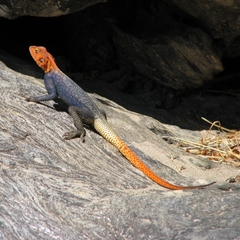
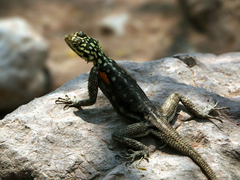
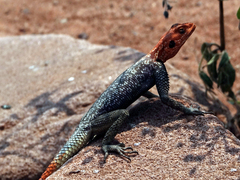
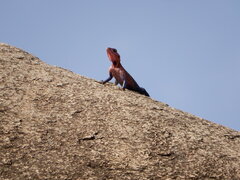
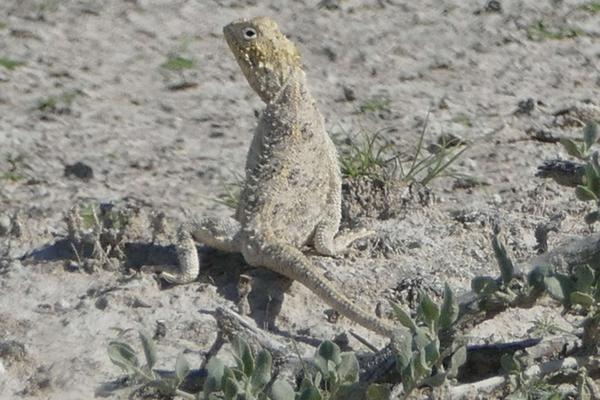
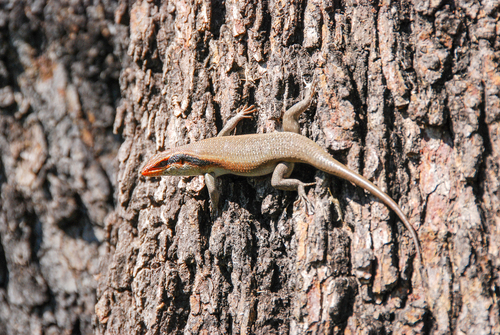
The Namib rock agama (Agama planiceps) is a species of agamid lizard that is native to granite rocky outcrops in northwestern Namibia and southwestern Angola. They occur in Benguela and Namibe provinces of Angola, and in Damaraland and the Kaokoveld region of Namibia.

They exhibit a striking sexual dimorphism, with males in contrasting orange and blue colours, and the females dappled and checkered in brown, grey and yellow. In summer, males court females by running in circles around them while head-bobbing.

The black mongoose also occurs in isolated granite kopjes of this region, and is a known predator of these agamas. The mongooses are most successful during early mornings on cold days when the agamas are less mobile. Other predators include hornbills and rock kestrels. Up to 30% of the adult agamas may have broken tails.

Media related to Agama planiceps at Wikimedia Commons Data related to Agama planiceps at Wikispecies Wikipedia →

Global Distribution

Parks Where Found

# Park Country Daily sighting probability
1 Etosha National Park 🇳🇦 Namibia
~20%

More parks will be added in future updates.

Before you go

What are the chances of seeing a Namib Rock Agama in Etosha National Park?

Possible

About 20% of wildlife watchers report a Namib Rock Agama sighting in Etosha National Park on a given day, based on 16 verified sightings from GBIF citizen-science data from 2019 to 2026. It is the 9th most-seen of the 22 reptiles we can rate there. Over three days the chance rises to about 40%, and over a week to about 70%, if each day is a fresh chance.

When is the best time to see a Namib Rock Agama in Etosha National Park?

January

In that month about 30% of wildlife watchers report a Namib Rock Agama in Etosha National Park on a given day, against under 5% in April, July–August and November, the lowest months. That is one of Etosha National Park's wettest months, with about 75 mm of rain against almost none in June.

What time of day is best to see a Namib Rock Agama?

Between 2 and 5 pm

Across all the parks we cover, that three-hour window holds the most Namib Rock Agama sightings with a recorded time, and about 9 in 10 of them come between 6 am and 6 pm: it is a daytime animal.

Where else can you see a Namib Rock Agama?

Only Etosha National Park, in our data

Etosha National Park is the only park on Wallace's Line with enough records to rate Namib Rock Agama sightings: about 20% of wildlife watchers there report one on a given day.

Which relatives of the Namib Rock Agama live in Etosha National Park?

Same genus: Agama

The closest relatives of the Namib Rock Agama that you can see in Etosha National Park (genus Agama, Typical Agamas) are Ground Agama (about 30%) and Etosha Agama (about 10%), with each one's daily chance of a sighting.

Where does the Namib Rock Agama sighting chance come from?

GBIF citizen-science records

It is estimated from how often the Namib Rock Agama is recorded against all the reptiles logged in Etosha National Park (16 verified sightings from 2019 to 2026), calibrated against known sighting rates. Figures are rounded to the nearest 10% because citizen-science data supports honest approximations, not decimals, and months with records from fewer than five people show "—". How it works.

← Back to Etosha National Park