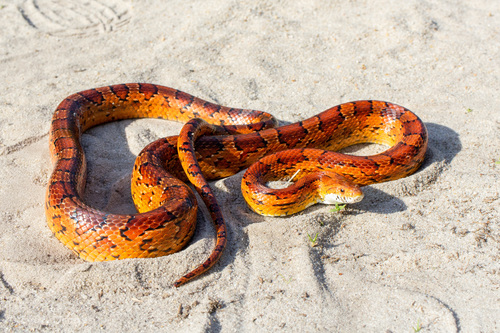
Eastern Indigo Snake

Eastern Indigo Snake

Drymarchon couperi

Silhouette: Alex Slavenko · PhyloPic

LCLeast ConcernNTVUENCR Endemic
Daily sighting probability <5% · Rare
at Everglades National Park

In 3 days ~10% in a week ~20%

10 Verified sightings at Everglades National Park From 2019 to 2026
10 In 1 park
February Best month
☀️ Diurnal When it's spotted

About the Eastern Indigo Snake

The eastern indigo snake (Drymarchon couperi) is a species of large, nonvenomous snake in the subfamily Colubrinae of the family Colubridae. Native to the Southeastern United States, it is the longest native snake species in the country.

The eastern indigo snake was first described by John Edwards Holbrook in 1842. For many years, the genus Drymarchon was considered monotypic with one species, Drymarchon corais, with 12 subspecies, until the early 1990s, when Drymarchon corais couperi was elevated to full species status according to the Society for the Study of Amphibians and Reptiles, in their official names list.

The generic name, Drymarchon, roughly translates to "lord of the forest". It is composed of the Greek words drymos (Δρυμός), meaning "forest", and archon (ἄρχων), meaning "lord" or "ruler". The specific name is a latinization of the surname of American planter James Hamilton Couper (1794–1866). Couper brought Holbrook the type specimen from south of the Altamaha River in Wayne County, Georgia.

Drymarchon couperi has a number of common names, including black snake, blue bull snake, blue gopher snake... Wikipedia →

Global Distribution

Parks Where Found

# Park Country Daily sighting probability
1 Everglades National Park 🇺🇸 United States
<5%

More parks will be added in future updates.

Zoos & Centres Where Found

# Zoo / Centre Country
1 National Zoological Park 🇺🇸 United States In captivity
2 North Carolina Zoo 🇺🇸 United States In captivity
3 Tulsa Zoo 🇺🇸 United States In captivity
4 Brookfield Zoo 🇺🇸 United States In captivity
5 Nashville Zoo at Grassmere 🇺🇸 United States In captivity
6 Milwaukee County Zoo 🇺🇸 United States In captivity
7 Detroit Zoo 🇺🇸 United States In captivity
8 Jacksonville Zoo and Gardens 🇺🇸 United States In captivity
9 Central Florida Zoo and Botanical Gardens 🇺🇸 United States In captivity
10 Birmingham Zoo 🇺🇸 United States In captivity
11 Oklahoma City Zoo and Botanical Garden 🇺🇸 United States In captivity
12 Naples Zoo 🇺🇸 United States In captivity
13 South Carolina Aquarium 🇺🇸 United States In captivity
14 Glen Echo Park Aquarium 🇺🇸 United States In captivity
15 Texas Sealife Center 🇺🇸 United States In captivity
16 Butterfly World 🇺🇸 United States In captivity
17 Jellyfish Museum 🇺🇸 United States In captivity
18 Pregnant Mare Rescue 🇺🇸 United States In captivity
19 Snake Discovery: A Reptile Experience 🇺🇸 United States In captivity
20 Three Sisters Springs Trolley 🇺🇸 United States In captivity
21 Welaka National Fish Hatchery 🇺🇸 United States In captivity
22 Zoológico La Era de las aves 🇪🇸 Spain In captivity

Before you go

What are the chances of seeing an Eastern Indigo Snake in Everglades National Park?

Rare

Under 5% of wildlife watchers report an Eastern Indigo Snake sighting in Everglades National Park on a given day, based on 10 verified sightings from GBIF citizen-science data from 2019 to 2026. It is the 54th most-seen of the 54 reptiles we can rate there. Over three days the chance rises to about 10%, and over a week to about 20%, if each day is a fresh chance.

When is the best time to see an Eastern Indigo Snake in Everglades National Park?

February

In that month about 10% of wildlife watchers report an Eastern Indigo Snake in Everglades National Park on a given day, against under 5% in March to January, the lowest months. That is one of Everglades National Park's driest months, with about 45 mm of rain against 240 mm in June.

What time of day is best to see an Eastern Indigo Snake?

Between 11 am and 2 pm

Across all the parks we cover, that three-hour window holds the most Eastern Indigo Snake sightings with a recorded time, and about 9 in 10 of them come between 6 am and 6 pm: it is a daytime animal.

Where else can you see an Eastern Indigo Snake?

Only Everglades National Park, in our data

Everglades National Park is the only park on Wallace's Line with enough records to rate Eastern Indigo Snake sightings: under 5% of wildlife watchers there report one on a given day.

Which relatives of the Eastern Indigo Snake live in Everglades National Park?

Same family: Colubridae

The closest relatives of the Eastern Indigo Snake that you can see in Everglades National Park (family Colubridae, Colubrid Snakes) are North American Racer (about 40%), Corn Snake (about 30%) and Scarletsnake (about 30%), with each one's daily chance of a sighting.

Where does the Eastern Indigo Snake sighting chance come from?

GBIF citizen-science records

It is estimated from how often the Eastern Indigo Snake is recorded against all the reptiles logged in Everglades National Park (10 verified sightings from 2019 to 2026), calibrated against known sighting rates. Figures are rounded to the nearest 10% because citizen-science data supports honest approximations, not decimals, and months with records from fewer than five people show "—". How it works.

← Back to Everglades National Park