Mexican Free-tailed Bat

Mexican Free-tailed Bat

Tadarida brasiliensis

Silhouette: T. Michael Keesey · PhyloPic

LCLeast ConcernNTVUENCR
Daily sighting probability ~10% · With luck
at Everglades National Park

In 3 days ~20% in a week ~30%

20 Verified sightings at Everglades National Park From 2019 to 2026
42 In all 3 parks
August Best month
☀️🌙 Day & Night When it's spotted

About the Mexican Free-tailed Bat

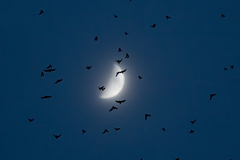
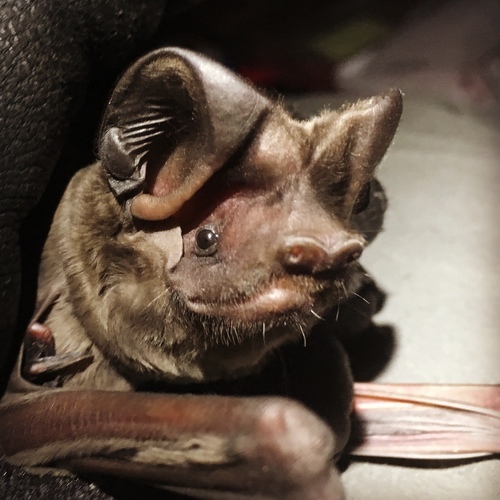
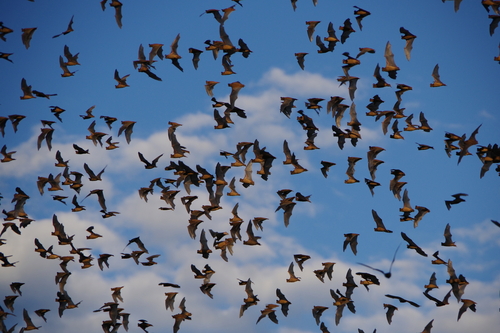
The Mexican free-tailed bat or Brazilian free-tailed bat (Tadarida brasiliensis) is a medium-sized bat native to North, Central, and South America and the Caribbean, so named because its tail can be almost half its total length and is not attached to its uropatagium. It has been claimed to have the fastest horizontal speed of any animal, reaching level flight speed of up to 99 mph (160 km/h). It also flies the highest among bats, at altitudes around 3,300 m (10,800 ft).

It is regarded as one of the most abundant mammals in North America. Its proclivity towards roosting in huge numbers at relatively few locations makes it vulnerable to habitat destruction in spite of its abundance. For instance, up to 1.5 million bats reside under just one bridge in Austin. The Texas Legislature recognized the Mexican free-tailed bat as the "Official Flying Mammal" of the State of Texas in 1995.

The Mexican free-tailed bat was described as a new species in 1824 by French zoologist Isidore Geoffroy Saint-Hilaire. Geoffroy placed it in the now-defunct genus Nyctinomus with a binomial name of Nyctinomus brasiliensis.

The holotype had been collected in Brazil. Molecular sequence data indicate... Wikipedia →
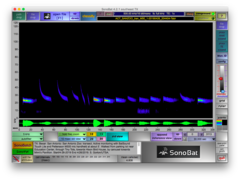
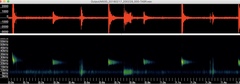
Sounds

Recording0:12

United States · 2025

© Ashley Fruhwirth · iNaturalist · CC BY-NC 4.0

Recording0:17

United States · 2023

© Nicholas Canino · iNaturalist · CC BY-NC 4.0

Recording0:19

United States · 2025

© Debiani · iNaturalist · CC BY-NC 4.0

Global Distribution

Parks Where Found

# Park Country Daily sighting probability
1 Big Cypress National Preserve 🇺🇸 United States
~10%
2 Death Valley National Park 🇺🇸 United States
~10%
3 Everglades National Park 🇺🇸 United States
~10%

Cities Where Found

# City Country Daily sighting probability
1 Santiago 🇨🇱 Chile
~20%
2 Rosario 🇦🇷 Argentina
~20%
3 León 🇲🇽 México
~10%
4 Austin 🇺🇸 United States
~10%
5 Montevideo 🇺🇾 Uruguay
~10%
6 Sacramento 🇺🇸 United States
~10%
7 Houston 🇺🇸 United States
~10%
8 Phoenix 🇺🇸 United States
~10%
9 San Antonio 🇺🇸 United States
~10%
10 Buenos Aires 🇦🇷 Argentina
~10%

Zoos & Centres Where Found

# Zoo / Centre Country
1 California Academy of Sciences 🇺🇸 United States In captivity
2 Turtle Bay Exploration Park 🇺🇸 United States In captivity
3 Bat World Sanctuary 🇺🇸 United States In captivity

Before you go

What are the chances of seeing a Mexican Free-tailed Bat in Everglades National Park?

With luck

About 10% of wildlife watchers report a Mexican Free-tailed Bat sighting in Everglades National Park on a given day, based on 20 verified sightings from GBIF citizen-science data from 2019 to 2026. It is the 12th most-seen of the 17 mammals we can rate there. Over three days the chance rises to about 20%, and over a week to about 30%, if each day is a fresh chance.

When is the best time to see a Mexican Free-tailed Bat in Everglades National Park?

April–May, August–September and November

In those months about 10% of wildlife watchers report a Mexican Free-tailed Bat in Everglades National Park on a given day, against under 5% in June–July, October and December–March, the lowest months.

What time of day is best to see a Mexican Free-tailed Bat?

Between 7 and 10 pm

Across all the parks we cover, that three-hour window holds the most Mexican Free-tailed Bat sightings with a recorded time, and about 6 in 10 of them come between 6 pm and 6 am: it is seen both by day and at night.

Is Everglades National Park the best place to see a Mexican Free-tailed Bat?

Among the best

Of the 3 parks where we can rate Mexican Free-tailed Bat sightings, Everglades National Park ranks 3rd at about 10%, level with the leaders once rounded. The best odds are in Big Cypress National Preserve (United States, about 10%) and Death Valley National Park (United States, about 10%).

Where does the Mexican Free-tailed Bat sighting chance come from?

GBIF citizen-science records

It is estimated from how often the Mexican Free-tailed Bat is recorded against all the mammals logged in Everglades National Park (20 verified sightings from 2019 to 2026), calibrated against known sighting rates. Figures are rounded to the nearest 10% because citizen-science data supports honest approximations, not decimals, and months with records from fewer than five people show "—". How it works.

← Back to Everglades National Park