


Completed


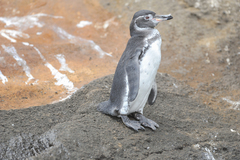

Galápagos Penguin
Spheniscus mendiculus
Silhouette: Edwin Price · PhyloPic
- KingdomAnimalia (Animals)
- PhylumChordata (Chordates)
- ClassAves (Birds)
- OrderSphenisciformes (Penguins)
- FamilySpheniscidae (Penguins)
- GenusSpheniscus (Banded Penguins)
- SpeciesSpheniscus mendiculus (Galápagos Penguin)
In 3 days ~50% in a week ~80%
3,782 Verified sightings at Galápagos Islands From 2019 to 2026
3,782 In 1 park
March Best month
☀️ Diurnal When it's spotted


Completed
About the Galápagos Penguin
The Galápagos penguin (Spheniscus mendiculus) is a penguin endemic to the Galápagos Islands of Ecuador. It is the only penguin found north of the equator. Most inhabit Fernandina Island and the west coast of Isabela Island. The cool waters of the Humboldt and Cromwell Currents allow it to survive despite the tropical latitude. The Galápagos penguin is one of the banded penguins, the other species of which live mostly on the coasts of Africa and mainland South America. Due to their warm environment, Galápagos penguins have developed techniques to stay cool. The feathers on their back, flippers, and head are black, and they have a white belly and a stripe looping from their eyes down to their neck and chin. Each penguin keeps only one mate, and breeds year-round. Because there are no soft areas to nest, their nests are typically in caves and crevices which also provide protection against predators and the harsh environment. The Galápagos penguin has a lifespan of 20 years, but due to predation, life expectancy in the wild could be significantly reduced. They have been critically impacted to the point of endangerment by climate change and pollution caused by plastic waste due to tourism and urbanization. Wikipedia →
Sounds
Call0:17
Ecuador · 2017
© Jesse Fagan · XC383122 · CC BY-NC-SA 4.0
Recent sightings of Galápagos Penguin in Galápagos Islands
LIVEiNaturalistGlobal Distribution
Parks Where Found
| # | Park | Country | Daily sighting probability |
|---|---|---|---|
| 1 | Galápagos Islands | 🇪🇨 Ecuador |
More parks will be added in future updates.
Zoos & Centres Where Found
| # | Zoo / Centre | Country | |
|---|---|---|---|
| 1 | Elmwood Park Zoo | 🇺🇸 United States |
Closest Relatives at Galápagos Islands
No species of the same family or order lives in Galápagos Islands, so these are its closest relatives here: other birds.


Before you go
What are the chances of seeing a Galápagos Penguin in Galápagos Islands?
Possible
About 20% of wildlife watchers report a Galápagos Penguin sighting in Galápagos Islands on a given day, based on 3,782 verified sightings from GBIF citizen-science data from 2019 to 2026. It is the 33rd most-seen of the 114 birds we can rate there. Over three days the chance rises to about 50%, and over a week to about 80%, if each day is a fresh chance.
When is the best time to see a Galápagos Penguin in Galápagos Islands?
January and March–April
In those months about 30% of wildlife watchers report a Galápagos Penguin in Galápagos Islands on a given day, against about 20% in February and May–December, the lowest months. Those are among Galápagos Islands's wettest months, with about 40 mm of rain a month against almost none in August.
What time of day is best to see a Galápagos Penguin?
Between 9 am and noon
Across all the parks we cover, that three-hour window holds the most Galápagos Penguin sightings with a recorded time, and about 9 in 10 of them come between 6 am and 6 pm: it is a daytime animal.
Where else can you see a Galápagos Penguin?
Only Galápagos Islands, in our data
Galápagos Islands is the only park on Wallace's Line with enough records to rate Galápagos Penguin sightings: about 20% of wildlife watchers there report one on a given day.
Where does the Galápagos Penguin sighting chance come from?
GBIF citizen-science records
It is estimated from how often the Galápagos Penguin is recorded against all the birds logged in Galápagos Islands (3,782 verified sightings from 2019 to 2026), calibrated against known sighting rates. Figures are rounded to the nearest 10% because citizen-science data supports honest approximations, not decimals, and months with records from fewer than five people show "—". How it works.
