Southern Right Whale

Southern Right Whale

Eubalaena australis

Silhouette: Chris huh · PhyloPic

LCLeast ConcernNTVUENCR
Daily sighting probability ~20% · Possible
at Falkland Islands

In 3 days ~40% in a week ~70%

7 Verified sightings at Falkland Islands From 2019 to 2026
323 In all 7 parks
May Best month
☀️ Diurnal When it's spotted

About the Southern Right Whale

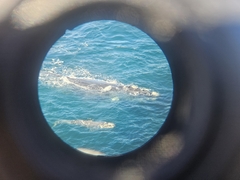
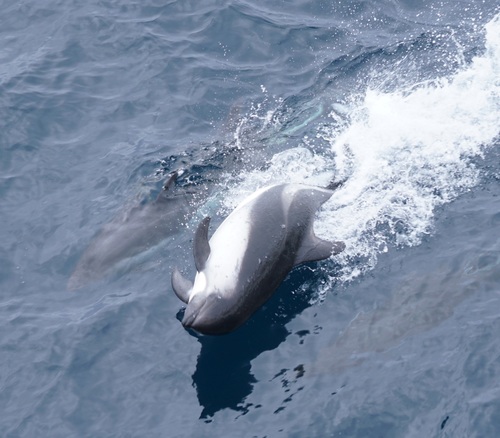
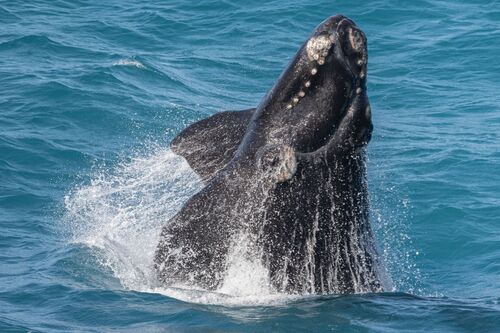
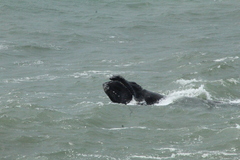
The southern right whale (Eubalaena australis) is a large baleen whale and one of three species of right whale belonging to the genus Eubalaena. Found throughout the Southern Hemisphere, it inhabits oceans between the latitudes of 20° and 60° south. Like its northern relatives, the southern right whale is noted by its broad back without a dorsal fin, a long, arching mouth, and white growths on its head known as callosities. Previously hunted for hundreds of years, almost to extinction, the species is now protected and its global population was estimated to be around 13,600 (2009).

Each year, the southern right whale migrates. During the summer months, it feeds on zooplankton and krill in the cold waters of the Southern Ocean, often near Antarctica. In the winter, it travels northward to the warmer coastal waters off Argentina, Australia, Brazil, South Africa, and New Zealand to breed and calve. The whales are known for their active behavior at the surface, which includes breaching and a unique practice called "tail sailing," where they use their flukes to catch the wind.

Historically, southern right whales were the primary target for whalers (thus the "right" whale to hunt), who killed tens of thousands from the 18th to the 20th century, decimating the population. International protection was established in 1937, though illegal whaling by the Soviet Union continued into the 1970s. Since cessation of industrialized whale slaughtering, the population has seen a steady increase, growing an estimated 7% per year. Today, the species is a focus for whale watching, though it continues to face threats from ship strikes, entanglement in fishing gear, and pollution.
Wikipedia →

Sounds

Recording0:42

Argentina · 2024

© Matias Ian Popoff · iNaturalist · CC BY-NC 4.0

Recording0:09

Australia · 2023

© Bryce van der Heide · iNaturalist · CC BY-NC 4.0

Global Distribution

Parks Where Found

# Park Country Daily sighting probability
1 Península Valdés 🇦🇷 Argentina
~80%
2 De Hoop Nature Reserve 🇿🇦 South Africa
~60%
3 South Georgia and the South Sandwich Islands 🇬🇸 South Georgia and the South Sandwich Islands
~20%
4 Falkland Islands 🇫🇰 Falkland Islands
~20%
5 Garden Route National Park 🇿🇦 South Africa
~10%
6 Great Otway National Park 🇦🇺 Australia
~10%
7 Table Mountain National Park 🇿🇦 South Africa
~10%

Before you go

What are the chances of seeing a Southern Right Whale in Falkland Islands?

Possible

About 20% of wildlife watchers report a Southern Right Whale sighting in Falkland Islands on a given day, based on 7 verified sightings from GBIF citizen-science data from 2019 to 2026. It is the 7th most-seen of the 7 mammals we can rate there. Over three days the chance rises to about 40%, and over a week to about 70%, if each day is a fresh chance.

When is the best time to see a Southern Right Whale in Falkland Islands?

May

In that month about 50% of wildlife watchers report a Southern Right Whale in Falkland Islands on a given day, against under 5% in April, June and October–December, the lowest months. July and August have too few records to rate.

What time of day is best to see a Southern Right Whale?

Between 1 and 4 pm

Across all the parks we cover, that three-hour window holds the most Southern Right Whale sightings with a recorded time, and about 8 in 10 of them come between 6 am and 6 pm: it is a daytime animal.

Which relatives of the Southern Right Whale live in Falkland Islands?

Same order: Cetacea

The closest relatives of the Southern Right Whale that you can see in Falkland Islands (order Cetacea) are Commerson's Dolphin (about 50%), Peale's Dolphin (about 50%) and Sei Whale (about 30%), with each one's daily chance of a sighting.

Where does the Southern Right Whale sighting chance come from?

GBIF citizen-science records

It is estimated from how often the Southern Right Whale is recorded against all the mammals logged in Falkland Islands (7 verified sightings from 2019 to 2026), calibrated against known sighting rates. Figures are rounded to the nearest 10% because citizen-science data supports honest approximations, not decimals, and months with records from fewer than five people show "—". How it works.

← Back to Falkland Islands