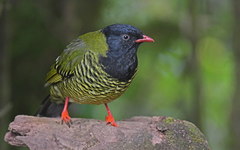
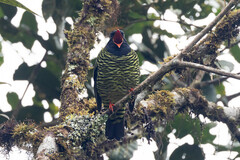
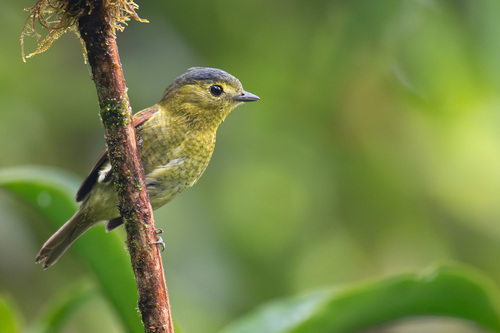
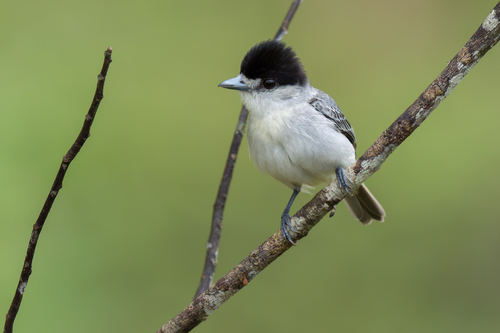
Barred Fruiteater

Barred Fruiteater

Pipreola arcuata

Silhouette: Edwin Price · PhyloPic

LCLeast ConcernNTVUENCR
Daily sighting probability <5% · Rare
at Farallones de Cali National Natural Park

In 3 days <5%

18 Verified sightings at Farallones de Cali National Natural Park From 2019 to 2026
521 In all 3 parks
August Best month
☀️ Diurnal When it's spotted

About the Barred Fruiteater

The barred fruiteater (Pipreola arcuata) is a species of bird in the family Cotingidae, the cotingas. It is found in Bolivia, Colombia, Ecuador, Peru, and Venezuela. The barred fruiteater was originally described as Ampelis arcuata.

The barred fruiteater is among the largest of its genus at 22 to 23 cm (8.7 to 9.1 in) long and weighing 112 to 128 g (4.0 to 4.5 oz). The sexes have different plumage, though uniquely among the fruiteaters both have barred breasts. Adult males of the nominate subspecies have an entirely black head, neck, and upper breast. Their upperparts are olive-green and the wings and tail mostly that color. The wing's greater coverts and tertials have large yellow spots. The tail has a black bar near the end and whitish tips on the feathers. Their underparts are yellow with crisp black bars. Females have an olive-green head instead of the male's black and the black-barred yellow of the underparts includes the throat and upper breast. Both sexes have a red, orange, yellow, or chestnut... Wikipedia →

Sounds

Song0:08

Ecuador · 2025

© Manuel Sánchez-Nivicela · XC1154748 · CC BY-NC-ND 4.0

Call0:11

Colombia · 2021

© Peter Boesman · XC693770 · CC BY-NC-ND 4.0

Dawn song0:05

Peru · 2018

© Rolf A. de By · XC468883 · CC BY-NC-SA 4.0

Global Distribution

Parks Where Found

# Park Country Daily sighting probability
1 Podocarpus National Park 🇪🇨 Ecuador
~30%
2 Los Nevados National Natural Park 🇨🇴 Colombia
<5%
3 Farallones de Cali National Natural Park 🇨🇴 Colombia
<5%

Cities Where Found

# City Country Daily sighting probability
1 Quito 🇪🇨 Ecuador
<5%

Zoos & Centres Where Found

# Zoo / Centre Country
1 Dallas World Aquarium 🇺🇸 United States In captivity

Before you go

What are the chances of seeing a Barred Fruiteater in Farallones de Cali National Natural Park?

Rare

Under 5% of wildlife watchers report a Barred Fruiteater sighting in Farallones de Cali National Natural Park on a given day, based on 18 verified sightings from GBIF citizen-science data from 2019 to 2026. It is the 423rd most-seen of the 542 birds we can rate there. Over three days the chance rises to under 5%, if each day is a fresh chance.

When is the best time to see a Barred Fruiteater in Farallones de Cali National Natural Park?

Any time of year

In every month with enough records, under 5% of wildlife watchers report a Barred Fruiteater in Farallones de Cali National Natural Park on a given day, so our monthly data shows no clear season.

What time of day is best to see a Barred Fruiteater?

Between 8 and 11 am

Across all the parks we cover, that three-hour window holds the most Barred Fruiteater sightings with a recorded time, and nearly all of them come between 6 am and 6 pm: it is a daytime animal.

Is Farallones de Cali National Natural Park the best place to see a Barred Fruiteater?

3rd of 3

Of the 3 parks where we can rate Barred Fruiteater sightings, Farallones de Cali National Natural Park ranks 3rd at under 5%. The best odds are in Podocarpus National Park (Ecuador, about 30%) and Los Nevados National Natural Park (Colombia, under 5%).

Where does the Barred Fruiteater sighting chance come from?

GBIF citizen-science records

It is estimated from how often the Barred Fruiteater is recorded against all the birds logged in Farallones de Cali National Natural Park (18 verified sightings from 2019 to 2026), calibrated against known sighting rates. Figures are rounded to the nearest 10% because citizen-science data supports honest approximations, not decimals, and months with records from fewer than five people show "—". How it works.

← Back to Farallones de Cali National Natural Park