Black-billed Peppershrike

Black-billed Peppershrike

Cyclarhis nigrirostris

Silhouette: Sheatherius · PhyloPic

LCLeast ConcernNTVUENCR
Daily sighting probability ~20% · Possible
at Farallones de Cali National Natural Park

In 3 days ~40% in a week ~70%

568 Verified sightings at Farallones de Cali National Natural Park From 2019 to 2026
857 In all 2 parks
April Best month
☀️ Diurnal When it's spotted

About the Black-billed Peppershrike

The black-billed peppershrike (Cyclarhis nigrirostris) is a species of bird in the family Vireonidae. It is found in the Andes of Colombia and northern Ecuador. It inhabits subtropical or tropical moist montane forests and heavily degraded former forest.

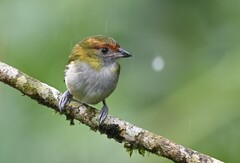
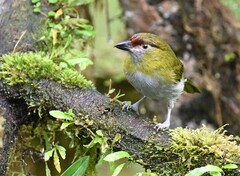
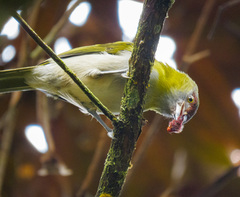
Olive coloured overall with grey throat, belly, cheek and forecrown and a rufous stripe above the eye and lore. Differs from the more common Rufous-browed peppershrike by its black-tipped bill, thinner rufous superciliary stripe, and olive neck and cap.

The black-billed peppershrike was described by Frédéric de Lafresnaye in 1842 as Cyclaris nigrirostris (sic) from a specimen collected in Bogotá. There are two recognised subspecies: Cyclaris nigrirostris nigrirostris Lafresnaye, 1842 – Colombia west of the East Andes as well as in Ecuador

Cyclaris nigrirostric atrirostris Sclater, 1887 – West Andes of southern Colombia, further south into Pichincha Province, Ecuador The black-billed peppershrike is found in the Andes of Colombia and Ecuador. Its diet consists entirely of arthropods which it searches for in the canopy and mid-levels of trees. Found alone or alongside... Wikipedia →

Sounds

Song0:14

Ecuador · 2026

© Daan van der Hoeven · XC1137840 · CC BY-NC-SA 4.0

Recording1:03

Colombia · 2000

© Daniel Cadena (Colección de Sonidos Ambientales - Instituto Humboldt) · XC525789 · CC BY-NC-SA 4.0

Begging call0:24

Ecuador · 2007

© Mitch Lysinger · XC261020 · CC BY-NC-SA 4.0

Global Distribution

Parks Where Found

# Park Country Daily sighting probability
1 Farallones de Cali National Natural Park 🇨🇴 Colombia
~20%
2 Los Nevados National Natural Park 🇨🇴 Colombia
~10%

Before you go

What are the chances of seeing a Black-billed Peppershrike in Farallones de Cali National Natural Park?

Possible

About 20% of wildlife watchers report a Black-billed Peppershrike sighting in Farallones de Cali National Natural Park on a given day, based on 568 verified sightings from GBIF citizen-science data from 2019 to 2026. It is the 93rd most-seen of the 542 birds we can rate there. Over three days the chance rises to about 40%, and over a week to about 70%, if each day is a fresh chance.

When is the best time to see a Black-billed Peppershrike in Farallones de Cali National Natural Park?

March–May, July–September and December–January

In those months about 20% of wildlife watchers report a Black-billed Peppershrike in Farallones de Cali National Natural Park on a given day, against about 10% in February, June and October–November, the lowest months.

What time of day is best to see a Black-billed Peppershrike?

Between 6 and 9 am

Across all the parks we cover, that three-hour window holds the most Black-billed Peppershrike sightings with a recorded time, and about 8 in 10 of them come between 6 am and 6 pm: it is a daytime animal.

Is Farallones de Cali National Natural Park the best place to see a Black-billed Peppershrike?

Yes

Of the 2 parks where we can rate Black-billed Peppershrike sightings, Farallones de Cali National Natural Park has the highest daily chance: about 20%. Next come Los Nevados National Natural Park (Colombia, about 10%).

Which relatives of the Black-billed Peppershrike live in Farallones de Cali National Natural Park?

Same family: Vireonidae

The closest relatives of the Black-billed Peppershrike that you can see in Farallones de Cali National Natural Park (family Vireonidae, Vireos, Shrike-Babblers, and Erpornis) are Slaty-capped Shrike-Vireo (about 20%), Red-eyed Vireo (about 10%) and Brown-capped Vireo (about 10%), with each one's daily chance of a sighting.

Where does the Black-billed Peppershrike sighting chance come from?

GBIF citizen-science records

It is estimated from how often the Black-billed Peppershrike is recorded against all the birds logged in Farallones de Cali National Natural Park (568 verified sightings from 2019 to 2026), calibrated against known sighting rates. Figures are rounded to the nearest 10% because citizen-science data supports honest approximations, not decimals, and months with records from fewer than five people show "—". How it works.

← Back to Farallones de Cali National Natural Park