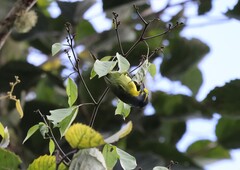

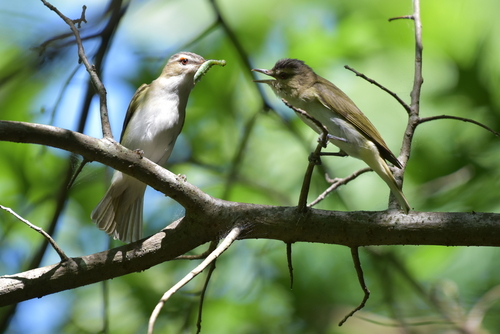
Slaty-capped Shrike-Vireo

Slaty-capped Shrike-Vireo

Vireolanius leucotis

Silhouette: Sheatherius · PhyloPic

LCLeast ConcernNTVUENCR
Daily sighting probability ~20% · Possible
at Farallones de Cali National Natural Park

In 3 days ~40% in a week ~70%

656 Verified sightings at Farallones de Cali National Natural Park From 2019 to 2026
751 In all 5 parks
September Best month
☀️ Diurnal When it's spotted

About the Slaty-capped Shrike-Vireo

The slaty-capped shrike-vireo (Vireolanius leucotis) is a species of bird in the family Vireonidae, the vireos, greenlets, and shrike-babblers. It is found in every mainland South American country except Argentina, Chile, Paraguay, and Uruguay.

The slaty-capped shrike-vireo was originally described in 1838 as Malaconotus leucotis. It was eventually placed in genus Vireolanius but for a time in the early twentieth century it was placed in genus Smaragdolanius and its own family, Vireolaniidae. By the 1970s Smaragdolanius had been merged into Vireolanius and included in the family Vireonidae.

The slaty-capped shrike-vireo's further taxonomy is unsettled. The IOC, the Clements taxonomy, and AviList assign it these four subspecies: Clements recognizes that it is distinctive within the larger species by calling it the "slaty-capped shrike-vireo (pale-legged)... Wikipedia →

Sounds

Song0:52

Ecuador · 2023

© Manuel Sánchez-Nivicela · XC1162363 · CC BY-NC-ND 4.0

Call0:33

Brazil · 2025

© JAYRSON ARAUJO DE OLIVEIRA · XC1045000 · CC BY-NC-SA 4.0

Song0:47

Bolivia · 2023

© Richard E. Webster · XC862662 · CC BY-NC-SA 4.0

Global Distribution

Parks Where Found

# Park Country Daily sighting probability
1 Farallones de Cali National Natural Park 🇨🇴 Colombia
~20%
2 Amboró National Park 🇧🇴 Bolivia
<5%
3 Manu National Park 🇵🇪 Peru
<5%
4 Amacayacu National Natural Park 🇨🇴 Colombia
<5%
5 Tambopata National Reserve 🇵🇪 Peru
<5%

Before you go

What are the chances of seeing a Slaty-capped Shrike-Vireo in Farallones de Cali National Natural Park?

Possible

About 20% of wildlife watchers report a Slaty-capped Shrike-Vireo sighting in Farallones de Cali National Natural Park on a given day, based on 656 verified sightings from GBIF citizen-science data from 2019 to 2026. It is the 86th most-seen of the 542 birds we can rate there. Over three days the chance rises to about 40%, and over a week to about 70%, if each day is a fresh chance.

When is the best time to see a Slaty-capped Shrike-Vireo in Farallones de Cali National Natural Park?

July and September

In those months about 30% of wildlife watchers report a Slaty-capped Shrike-Vireo in Farallones de Cali National Natural Park on a given day, against about 10% in April–May and October–November, the lowest months.

What time of day is best to see a Slaty-capped Shrike-Vireo?

Between 9 am and noon

Across all the parks we cover, that three-hour window holds the most Slaty-capped Shrike-Vireo sightings with a recorded time, and about 8 in 10 of them come between 6 am and 6 pm: it is a daytime animal.

Is Farallones de Cali National Natural Park the best place to see a Slaty-capped Shrike-Vireo?

Yes

Of the 5 parks where we can rate Slaty-capped Shrike-Vireo sightings, Farallones de Cali National Natural Park has the highest daily chance: about 20%. Next come Amboró National Park (Bolivia, under 5%) and Manu National Park (Peru, under 5%).

Which relatives of the Slaty-capped Shrike-Vireo live in Farallones de Cali National Natural Park?

Same family: Vireonidae

The closest relatives of the Slaty-capped Shrike-Vireo that you can see in Farallones de Cali National Natural Park (family Vireonidae, Vireos, Shrike-Babblers, and Erpornis) are Black-billed Peppershrike (about 20%), Red-eyed Vireo (about 10%) and Brown-capped Vireo (about 10%), with each one's daily chance of a sighting.

Where does the Slaty-capped Shrike-Vireo sighting chance come from?

GBIF citizen-science records

It is estimated from how often the Slaty-capped Shrike-Vireo is recorded against all the birds logged in Farallones de Cali National Natural Park (656 verified sightings from 2019 to 2026), calibrated against known sighting rates. Figures are rounded to the nearest 10% because citizen-science data supports honest approximations, not decimals, and months with records from fewer than five people show "—". How it works.

← Back to Farallones de Cali National Natural Park