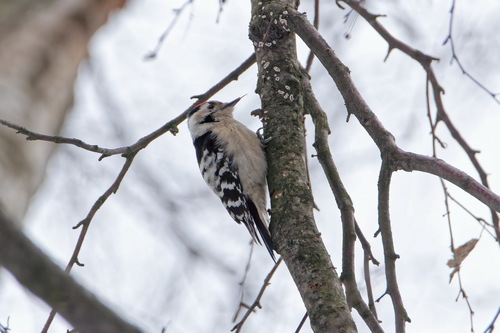
Syrian Woodpecker

Syrian Woodpecker

Dendrocopos syriacus

Silhouette: Steven Traver · PhyloPic

LCLeast ConcernNTVUENCR
Daily sighting probability ~10% · With luck
at Fertő-Hanság National Park

In 3 days ~20% in a week ~50%

94 Verified sightings at Fertő-Hanság National Park From 2019 to 2026
240 In all 3 parks
February Best month
☀️ Diurnal When it's spotted

About the Syrian Woodpecker

The Syrian woodpecker (Dendrocopos syriacus) is a member of the woodpecker family, the Picidae. The Syrian woodpecker was first described as Picus syriacus by Wilhelm Hemprich and Christian Gottfried Ehrenberg in 1833, from a specimen collected on Mount Lebanon.

The woodpecker is a resident breeding bird from southeastern Europe east to Iran. Its range has expanded further northwest into Europe in recent years. It is an inhabitant of open woodlands, cultivation with trees and scrubs, and parks, depending for food and nesting sites upon old trees. It is often an inconspicuous bird, in spite of the plumage.

The woodpecker is 23 cm (9.1 in) long, and is very similar to the great spotted woodpecker, Dendrocopos major. The upper parts of the male are glossy black, with a crimson spot on the nape and white on the forehead, sides of the face and neck. On the shoulder is a large white patch and the flight feathers are black with white spots forming three wingbars. The three outer tail feathers show only a few white spots; these show when the short stiff tail is outspread, acting as a support in climbing. The under parts are... Wikipedia →

Sounds

Call1:19

Ukraine · 2026

© Taras Vykhovanets · XC1164000 · CC BY-NC-ND 4.0

Drumming1:09

Hungary · 2025

© Márton Molnár · XC981473 · CC BY-NC-SA 4.0

Recording0:29

Turkey · 2022

© Mehmet Ali Demiral · XC741333 · CC BY-NC-SA 4.0

Global Distribution

Parks Where Found

# Park Country Daily sighting probability
1 Hortobágy National Park 🇭🇺 Hungary
~10%
2 Kiskunság National Park 🇭🇺 Hungary
~10%
3 Fertő-Hanság National Park 🇭🇺 Hungary
~10%

Cities Where Found

# City Country Daily sighting probability
1 Jerusalem 🇮🇱 Israel
~80%
2 Ramallah 🇵🇸 Palestine
~70%
3 Karaj 🇮🇷 Iran
~60%
4 Bucharest 🇷🇴 Romania
~50%
5 Yerevan 🇦🇲 Armenia
~50%
6 Ankara 🇹🇷 Turkey
~40%
7 Tehran 🇮🇷 Iran
~40%
8 Sofia 🇧🇬 Bulgaria
~30%
9 Rostov-on-Don 🇷🇺 Russia
~20%
10 Sincan 🇹🇷 Turkey
~20%

Before you go

What are the chances of seeing a Syrian Woodpecker in Fertő-Hanság National Park?

With luck

About 10% of wildlife watchers report a Syrian Woodpecker sighting in Fertő-Hanság National Park on a given day, based on 94 verified sightings from GBIF citizen-science data from 2019 to 2026. It is the 113th most-seen of the 207 birds we can rate there. Over three days the chance rises to about 20%, and over a week to about 50%, if each day is a fresh chance.

When is the best time to see a Syrian Woodpecker in Fertő-Hanság National Park?

January–May, July, September and November

In those months about 10% of wildlife watchers report a Syrian Woodpecker in Fertő-Hanság National Park on a given day, against under 5% in June, August, October and December, the lowest months.

What time of day is best to see a Syrian Woodpecker?

Between 8 and 11 am

Across all the parks we cover, that three-hour window holds the most Syrian Woodpecker sightings with a recorded time, and about 8 in 10 of them come between 6 am and 6 pm: it is a daytime animal.

Is Fertő-Hanság National Park the best place to see a Syrian Woodpecker?

Among the best

Of the 3 parks where we can rate Syrian Woodpecker sightings, Fertő-Hanság National Park ranks 3rd at about 10%, level with the leaders once rounded. The best odds are in Hortobágy National Park (Hungary, about 10%) and Kiskunság National Park (Hungary, about 10%).

Where does the Syrian Woodpecker sighting chance come from?

GBIF citizen-science records

It is estimated from how often the Syrian Woodpecker is recorded against all the birds logged in Fertő-Hanság National Park (94 verified sightings from 2019 to 2026), calibrated against known sighting rates. Figures are rounded to the nearest 10% because citizen-science data supports honest approximations, not decimals, and months with records from fewer than five people show "—". How it works.

← Back to Fertő-Hanság National Park