Willow Clytra

Willow Clytra

Clytra laeviuscula

Daily sighting probability ~10% · With luck
at Fertő-Hanság National Park

In 3 days ~30% in a week ~60%

17 Verified sightings at Fertő-Hanság National Park From 2019 to 2026
47 In all 4 parks
June Best month
☀️ Diurnal When it's spotted

About the Willow Clytra

Clytra laeviuscula, the ant bag beetle, is a species of short-horned leaf beetles belonging to the family Chrysomelidae, subfamily Cryptocephalinae. They are found in most of Europe, in the eastern part of the Palearctic realm, and in the Near East.

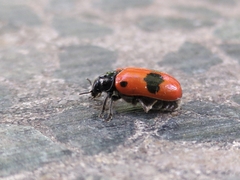
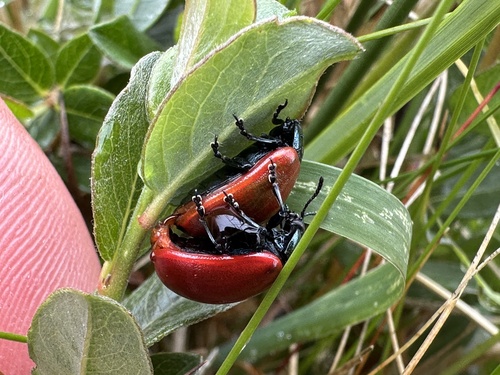
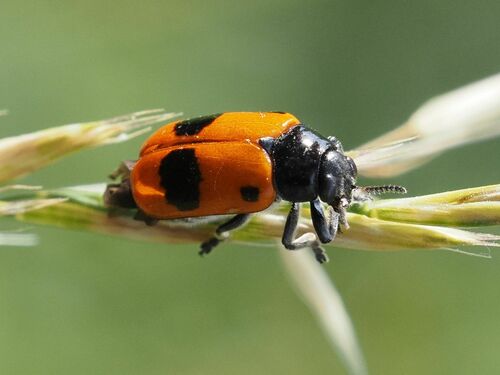
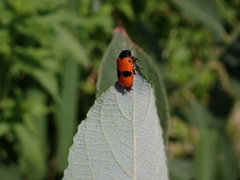
These beetles inhabit wet forests, sunny forest edges, dry slopes and dry grasslands, but also floodplains and parks. Clytra laeviuscula can reach a length of 7.5–11.5 millimetres (0.30–0.45 in) and a width of about 4 millimetres (0.16 in). These beetles have elongated bodies and shiny red-orange elytra with four black spots, two larger around the center of the elytra and two smaller on the shoulders. The prothorax is black and shiny. The head and legs are black, as well as the antennae that are quite short.

Clytra laeviuscula can be distinguished from ladybirds (family Coccinellidae) by its more elongated form and by its tarsi (ends of the legs) formed of five parts (three for ladybugs). This species is rather similar to Clytra quadripunctata.

Adults occurs frequently from May to August. They are phytophagous. They feed on leaves, flowers and pollen of deciduous trees, mainly... Wikipedia →
Global Distribution

Parks Where Found

# Park Country Daily sighting probability
1 Fertő-Hanság National Park 🇭🇺 Hungary
~10%
2 Triglav National Park 🇸🇮 Slovenia
~10%
3 Bavarian Forest National Park 🇩🇪 Germany
~10%
4 Cévennes National Park 🇫🇷 France
<5%

Cities Where Found

# City Country Daily sighting probability
1 Kharkiv 🇺🇦 Ukraine
~10%
2 Berlin 🇩🇪 Germany
~10%
3 Prague 🇨🇿 Czechia
~10%
4 Budapest 🇭🇺 Hungary
~10%
5 Kyiv 🇺🇦 Ukraine
~10%
6 Paris 🇫🇷 France
~10%
7 Vienna 🇦🇹 Austria
~10%
8 Lyon 🇫🇷 France
~10%
9 Munich 🇩🇪 Germany
~10%
10 Bucharest 🇷🇴 Romania
<5%

Before you go

What are the chances of seeing a Willow Clytra in Fertő-Hanság National Park?

With luck

About 10% of wildlife watchers report a Willow Clytra sighting in Fertő-Hanság National Park on a given day, based on 17 verified sightings from GBIF citizen-science data from 2019 to 2026. It is the 49th most-seen of the 243 insects we can rate there. Over three days the chance rises to about 30%, and over a week to about 60%, if each day is a fresh chance.

When is the best time to see a Willow Clytra in Fertő-Hanság National Park?

June

In that month about 30% of wildlife watchers report a Willow Clytra in Fertő-Hanság National Park on a given day, against under 5% in July to April, the lowest months.

What time of day is best to see a Willow Clytra?

Between 10 am and 1 pm

Across all the parks we cover, that three-hour window holds the most Willow Clytra sightings with a recorded time, and about 8 in 10 of them come between 6 am and 6 pm: it is a daytime animal.

Is Fertő-Hanság National Park the best place to see a Willow Clytra?

Yes

Of the 4 parks where we can rate Willow Clytra sightings, Fertő-Hanság National Park has the highest daily chance: about 10%. Next come Triglav National Park (Slovenia, about 10%) and Bavarian Forest National Park (Germany, about 10%).

Which relatives of the Willow Clytra live in Fertő-Hanság National Park?

Same family: Chrysomelidae

The closest relatives of the Willow Clytra that you can see in Fertő-Hanság National Park (family Chrysomelidae, Leaf Beetles) are Colorado Potato Beetle (about 10%), Lachnaia sexpunctata (about 10%) and Cassida nebulosa (about 10%), with each one's daily chance of a sighting.

Where does the Willow Clytra sighting chance come from?

GBIF citizen-science records

It is estimated from how often the Willow Clytra is recorded against all the insects logged in Fertő-Hanság National Park (17 verified sightings from 2019 to 2026), calibrated against known sighting rates. Figures are rounded to the nearest 10% because citizen-science data supports honest approximations, not decimals, and months with records from fewer than five people show "—". How it works.

← Back to Fertő-Hanság National Park