New Zealand Falcon

New Zealand Falcon

Falco novaeseelandiae

Silhouette: Shyamal · PhyloPic

LCLeast ConcernNTVUENCR Endemic
Daily sighting probability ~10% · With luck
at Fiordland National Park

In 3 days ~30% in a week ~50%

271 Verified sightings at Fiordland National Park From 2019 to 2026
684 In all 6 parks
February Best month
☀️ Diurnal When it's spotted

About the New Zealand Falcon

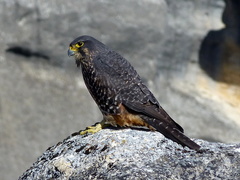
The New Zealand falcon (Māori: kārearea, kārewarewa, or kāiaia; Falco novaeseelandiae) is New Zealand's only falcon, and one of only four living native and two endemic birds of prey. It is frequently mistaken for the larger and more common swamp harrier. It is the country's most threatened bird of prey, with only around 5000–15000 individuals remaining. Under the New Zealand Threat Classification System the falcon is stable at Threatened, with conservation research needed. The kārearea was voted Bird of the Year winner in the annual Forest & Bird competition in 2012 and again in 2025.

The New Zealand falcon was formally described in 1788 by the German naturalist Johann Friedrich Gmelin in his revised and expanded edition of Carl Linnaeus's Systema Naturae. He placed it with the falcons and eagles in the genus Falco and coined the binomial name Falco novaeseelandiae. Gmelin based his description on the "New-Zealand falcon" that had been described and illustrated in 1781 by the English ornithologist John Latham. Latham had examined specimens both in the British Museum and in the Leverian Museum.

Ornithologists variously described the New Zealand falcon as an aberrant hobby... Wikipedia →

Sounds

Begging call0:48

New Zealand · 2021

© Ken George · XC1169418 · CC BY-NC-SA 4.0

Call0:32

New Zealand · 2010

© Sandra Valderrama · XC53839 · CC BY-NC-ND 2.5

Flight call0:11

New Zealand · 2014

© David Lloyd-Jones · XC212869 · CC BY-NC-SA 4.0

Global Distribution

Parks Where Found

# Park Country Daily sighting probability
1 Aoraki Mount Cook National Park 🇳🇿 New Zealand
~30%
2 Arthur's Pass National Park 🇳🇿 New Zealand
~10%
3 Abel Tasman National Park 🇳🇿 New Zealand
~10%
4 Fiordland National Park 🇳🇿 New Zealand
~10%
5 Egmont National Park 🇳🇿 New Zealand
~10%
6 Rakiura National Park 🇳🇿 New Zealand
<5%

Zoos & Centres Where Found

# Zoo / Centre Country
1 Hamilton Zoo 🇳🇿 New Zealand In captivity
2 Willowbank Wildlife Reserve 🇳🇿 New Zealand In captivity
3 Belgrade Zoo 🇷🇸 Serbia In captivity
4 Kiwi Park 🇳🇿 New Zealand In captivity
5 Ōtorohanga Kiwi House 🇳🇿 New Zealand In captivity
6 Wingspan National Bird of Prey Centre 🇳🇿 New Zealand In captivity

Before you go

What are the chances of seeing a New Zealand Falcon in Fiordland National Park?

With luck

About 10% of wildlife watchers report a New Zealand Falcon sighting in Fiordland National Park on a given day, based on 271 verified sightings from GBIF citizen-science data from 2019 to 2026. It is the 46th most-seen of the 94 birds we can rate there. Over three days the chance rises to about 30%, and over a week to about 50%, if each day is a fresh chance.

When is the best time to see a New Zealand Falcon in Fiordland National Park?

February and July

In those months about 20% of wildlife watchers report a New Zealand Falcon in Fiordland National Park on a given day, against under 5% in August and October, the lowest months.

What time of day is best to see a New Zealand Falcon?

Between 11 am and 2 pm

Across all the parks we cover, that three-hour window holds the most New Zealand Falcon sightings with a recorded time, and nearly all of them come between 6 am and 6 pm: it is a daytime animal.

Where does the New Zealand Falcon sighting chance come from?

GBIF citizen-science records

It is estimated from how often the New Zealand Falcon is recorded against all the birds logged in Fiordland National Park (271 verified sightings from 2019 to 2026), calibrated against known sighting rates. Figures are rounded to the nearest 10% because citizen-science data supports honest approximations, not decimals, and months with records from fewer than five people show "—". How it works.

← Back to Fiordland National Park