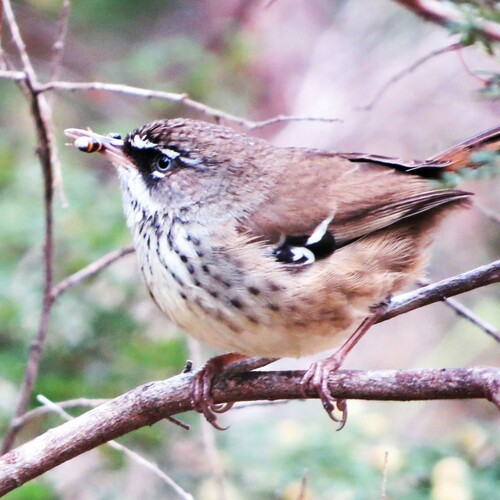
Shy Heathwren

Shy Heathwren

Calamanthus cautus

LCLeast ConcernNTVUENCR Endemic
Daily sighting probability ~10% · With luck
at Flinders Chase

In 3 days ~40% in a week ~70%

21 Verified sightings at Flinders Chase From 2019 to 2026
81 In all 3 parks
July Best month
☀️ Diurnal When it's spotted

About the Shy Heathwren

The shy heathwren (Hylacola cauta) is a species of small bird in the family Acanthizidae, endemic to Australia. They inhabit mostly mallee woodland that has relatively dense shrub and heath understorey. Their taxonomic name was formerly Calamanthus cautus—classing them as fieldwrens—until they were renamed in 2008. The generic name Hylacola derives from the Greek hylē 'woodland' and the Latin -cola 'dweller'. The specific epithet derives from the Latin cautus 'shy, wary'. Common names for the species include shy hylacola and mallee heathwren.

The birds are cock-tailed with a chestnut rump that darkens towards the tip. Their feathers are white with brown streaking underneath and greyish-brown on the back and crown. They have a white eyebrow, tail tip and patch on the flight feathers, and a black bill. Their eyes are brown to yellowish-brown and legs are slate-brown. Females have slightly duller colouring, and immature... Wikipedia →

Sounds

Dawn song0:24

Australia · 2024

© Khristos Nizamis · XC917147 · CC BY-NC-ND 4.0

Song and call0:29

Australia · 2023

© Peter Boesman · XC859905 · CC BY-NC-ND 4.0

Song0:52

Australia · 2022

© Eddy Smith · XC751092 · CC BY-NC-SA 4.0

Global Distribution

Parks Where Found

# Park Country Daily sighting probability
1 Flinders Chase 🇦🇺 Australia
~10%
2 Flinders Ranges National Park 🇦🇺 Australia
~10%
3 Hattah-Kulkyne National Park 🇦🇺 Australia
<5%

Before you go

What are the chances of seeing a Shy Heathwren in Flinders Chase?

With luck

About 10% of wildlife watchers report a Shy Heathwren sighting in Flinders Chase on a given day, based on 21 verified sightings from GBIF citizen-science data from 2019 to 2026. It is the 43rd most-seen of the 68 birds we can rate there. Over three days the chance rises to about 40%, and over a week to about 70%, if each day is a fresh chance.

When is the best time to see a Shy Heathwren in Flinders Chase?

July

In that month about 30% of wildlife watchers report a Shy Heathwren in Flinders Chase on a given day, against about 10% in October and December–March, the lowest months. That is one of Flinders Chase's wettest months, with about 85 mm of rain against 25 mm in February. August has too few records to rate.

What time of day is best to see a Shy Heathwren?

Between 9 am and noon

Across all the parks we cover, that three-hour window holds the most Shy Heathwren sightings with a recorded time, and about 9 in 10 of them come between 6 am and 6 pm: it is a daytime animal.

Is Flinders Chase the best place to see a Shy Heathwren?

Yes

Of the 3 parks where we can rate Shy Heathwren sightings, Flinders Chase has the highest daily chance: about 10%. Next come Flinders Ranges National Park (Australia, about 10%) and Hattah-Kulkyne National Park (Australia, under 5%).

Which relatives of the Shy Heathwren live in Flinders Chase?

Same family: Acanthizidae

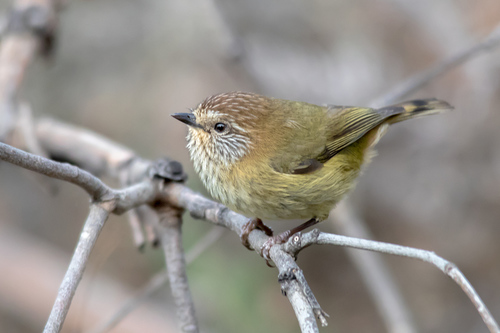
The closest relatives of the Shy Heathwren that you can see in Flinders Chase (family Acanthizidae, Thornbills and Allies) are Brown Thornbill (about 40%), Spotted Scrubwren (about 40%) and Striated Thornbill (about 40%), with each one's daily chance of a sighting.

Where does the Shy Heathwren sighting chance come from?

GBIF citizen-science records

It is estimated from how often the Shy Heathwren is recorded against all the birds logged in Flinders Chase (21 verified sightings from 2019 to 2026), calibrated against known sighting rates. Figures are rounded to the nearest 10% because citizen-science data supports honest approximations, not decimals, and months with records from fewer than five people show "—". How it works.

← Back to Flinders Chase