Western Quoll

Western Quoll

Dasyurus geoffroii

Silhouette: Sarah Werning · PhyloPic

LCNTNear ThreatenedVUENCR Endemic
Daily sighting probability ~40% · Likely
at Flinders Ranges National Park

In 3 days ~80% in a week >90%

46 Verified sightings at Flinders Ranges National Park From 2019 to 2026
46 In 1 park
November Best month
☀️ Diurnal When it's spotted

About the Western Quoll

The western quoll (Dasyurus geoffroii) is Western Australia's largest endemic mammalian carnivore. One of the many marsupial mammals native to Australia, it is also known as the chuditch. The species is currently classed as near-threatened.

The western quoll is a member of the family Dasyuridae and is most closely related to the bronze quoll (Dasyurus spartacus), a recently described species from New Guinea that was for some time believed to be an outlying population of the western quoll. Its species name, geoffroii, refers to the prominent French naturalist Étienne Geoffroy Saint-Hilaire, who named the genus Dasyurus in 1796. The species has occasionally been placed in the genus Dasyurinus.

It is also known as the chuditch in Western Australia (from Noongar djooditj); chuditch serves as both the singular and plural form. Other common names include atyelpe or chilpa (from Arrernte), kuninka (from Western Desert language); idnya (Adnyamathanha people of the Flinders Ranges) and the archaic western native cat.

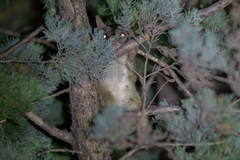
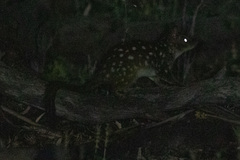
The western quoll is about the size of a domestic cat. It is coloured a rufous brown and has 40–70 white spots on its back with a creamy white... Wikipedia →

Sounds

Recording0:18

Australia · 2025

© Antoni Camozzato · iNaturalist · CC BY-NC 4.0

Global Distribution

Parks Where Found

# Park Country Daily sighting probability
1 Flinders Ranges National Park 🇦🇺 Australia
~40%

More parks will be added in future updates.

Zoos & Centres Where Found

# Zoo / Centre Country
1 Taronga Zoo 🇦🇺 Australia In captivity

Before you go

What are the chances of seeing a Western Quoll in Flinders Ranges National Park?

Likely

About 40% of wildlife watchers report a Western Quoll sighting in Flinders Ranges National Park on a given day, based on 46 verified sightings from GBIF citizen-science data from 2019 to 2026. It is the 5th most-seen of the 7 mammals we can rate there. Over three days the chance rises to about 80%, and over a week to over 90%, if each day is a fresh chance.

When is the best time to see a Western Quoll in Flinders Ranges National Park?

March and November

In those months about 60% of wildlife watchers report a Western Quoll in Flinders Ranges National Park on a given day, against about 20% in October, the lowest month.

What time of day is best to see a Western Quoll?

Between noon and 3 pm

Across all the parks we cover, that three-hour window holds the most Western Quoll sightings with a recorded time, and about 7 in 10 of them come between 6 am and 6 pm: it is a daytime animal.

Where else can you see a Western Quoll?

Only Flinders Ranges National Park, in our data

Flinders Ranges National Park is the only park on Wallace's Line with enough records to rate Western Quoll sightings: about 40% of wildlife watchers there report one on a given day.

Where does the Western Quoll sighting chance come from?

GBIF citizen-science records

It is estimated from how often the Western Quoll is recorded against all the mammals logged in Flinders Ranges National Park (46 verified sightings from 2019 to 2026), calibrated against known sighting rates. Figures are rounded to the nearest 10% because citizen-science data supports honest approximations, not decimals, and months with records from fewer than five people show "—". How it works.

← Back to Flinders Ranges National Park