Yellow-footed Rock-wallaby

Yellow-footed Rock-wallaby

Petrogale xanthopus

Silhouette: Lani Mohan · PhyloPic

LCNTNear ThreatenedVUENCR Endemic
Daily sighting probability ~90% · Very likely
at Flinders Ranges National Park

In 3 days >90%

263 Verified sightings at Flinders Ranges National Park From 2019 to 2026
263 In 1 park
December Best month
🌅 Crepuscular When it's spotted

About the Yellow-footed Rock-wallaby

The yellow-footed rock-wallaby (Petrogale xanthopus), formerly known as the ring-tailed rock-wallaby, is a member of the macropod family (the marsupial family that includes the kangaroos, wallabies, tree-kangaroos, and wallaroos).

This species was first described by John Edward Grey in 1855 in the Proceedings of the Zoological Society of London. The description was based on two specimens (a male and a female), which were possibly collected from the Richmond River. The illustration that accompanied the published description was produced by Joseph Wolf.

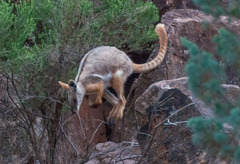
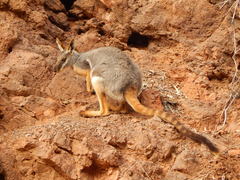
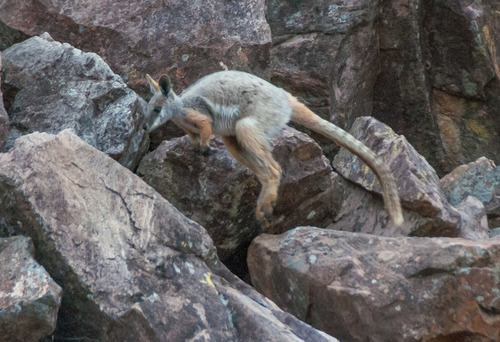
The yellow-footed rock-wallaby is grey to fawn-grey above and light-coloured below with a black mid-dorsal stripe from the crown of the head to the centre of the back. There is a distinct white cheek stripe, with ears ranging in colour from orange to grey-brown. The forearms and hind legs are bright yellow to rich orange to a light orange-brown. The tail is orange-brown irregularly ringed with dark brown and golden-brown, with the colour of the tip variable from dark brown to white. The head and body length is 480–650 mm (usually 600 mm), with tail length 570–700 mm (usually 690 mm), and weight 6–11 kg... Wikipedia →
Global Distribution

Parks Where Found

# Park Country Daily sighting probability
1 Flinders Ranges National Park 🇦🇺 Australia
~90%

More parks will be added in future updates.

Zoos & Centres Where Found

# Zoo / Centre Country
1 Copenhagen Zoo 🇩🇰 Denmark In captivity
2 Tierpark Berlin 🇩🇪 Germany In captivity
3 Australia Zoo 🇦🇺 Australia In captivity
4 Living Desert Zoo and Gardens 🇺🇸 United States In captivity
5 Los Angeles Zoo 🇺🇸 United States In captivity
6 Tama Zoological Park 🇯🇵 Japan In captivity
7 ZooTampa 🇺🇸 United States In captivity
8 Cleland Wildlife Park 🇦🇺 Australia In captivity
9 Halls Gap Zoo 🇦🇺 Australia In captivity
10 San Antonio Zoo 🇺🇸 United States In captivity
11 Zoo Aquarium de Madrid 🇪🇸 Spain In captivity
12 Sydney Zoo 🇦🇺 Australia In captivity
13 Adelaide Zoo 🇦🇺 Australia In captivity
14 Pyrénées Animal Park 🇫🇷 France In captivity
15 Sacramento Zoo 🇺🇸 United States In captivity
16 Australian Reptile Park 🇦🇺 Australia In captivity
17 Gorge Wildlife Park 🇦🇺 Australia In captivity
18 Featherdale Sydney Wildlife Park 🇦🇺 Australia In captivity
19 Sea Life Sydney Aquarium 🇦🇺 Australia In captivity
20 Wild Life Sydney 🇦🇺 Australia In captivity
21 Wildlife HQ Zoo 🇦🇺 Australia In captivity

Before you go

What are the chances of seeing a Yellow-footed Rock-wallaby in Flinders Ranges National Park?

Very likely

About 90% of wildlife watchers report a Yellow-footed Rock-wallaby sighting in Flinders Ranges National Park on a given day, based on 263 verified sightings from GBIF citizen-science data from 2019 to 2026. It is the most-seen of the 7 mammals we can rate there. Over three days the chance rises to over 90%, if each day is a fresh chance.

When is the best time to see a Yellow-footed Rock-wallaby in Flinders Ranges National Park?

November to August

In those months about 90% of wildlife watchers report a Yellow-footed Rock-wallaby in Flinders Ranges National Park on a given day, against about 80% in September and October, the lowest months.

What time of day is best to see a Yellow-footed Rock-wallaby?

Between 8 and 11 am

Across all the parks we cover, that three-hour window holds the most Yellow-footed Rock-wallaby sightings with a recorded time, and about 6 in 10 of them come between 6 am and 6 pm: it is most active around dawn and dusk.

Where else can you see a Yellow-footed Rock-wallaby?

Only Flinders Ranges National Park, in our data

Flinders Ranges National Park is the only park on Wallace's Line with enough records to rate Yellow-footed Rock-wallaby sightings: about 90% of wildlife watchers there report one on a given day.

Which relatives of the Yellow-footed Rock-wallaby live in Flinders Ranges National Park?

Same family: Macropodidae

The closest relatives of the Yellow-footed Rock-wallaby that you can see in Flinders Ranges National Park (family Macropodidae, Kangaroos, Wallabies and Allies) are Wallaroo (about 80%), Western Grey Kangaroo (about 60%) and Blue Flier (Females) (about 40%), with each one's daily chance of a sighting.

Where does the Yellow-footed Rock-wallaby sighting chance come from?

GBIF citizen-science records

It is estimated from how often the Yellow-footed Rock-wallaby is recorded against all the mammals logged in Flinders Ranges National Park (263 verified sightings from 2019 to 2026), calibrated against known sighting rates. Figures are rounded to the nearest 10% because citizen-science data supports honest approximations, not decimals, and months with records from fewer than five people show "—". How it works.

← Back to Flinders Ranges National Park