Blue Flier (Females)

Blue Flier (Females)

Macropus rufus

Silhouette: Pascal Abel · PhyloPic

Daily sighting probability ~40% · Likely
at Flinders Ranges National Park

In 3 days ~80% in a week >90%

22 Verified sightings at Flinders Ranges National Park From 2019 to 2026
37 In all 2 parks
February Best month
🌅 Crepuscular When it's spotted

About the Blue Flier (Females)

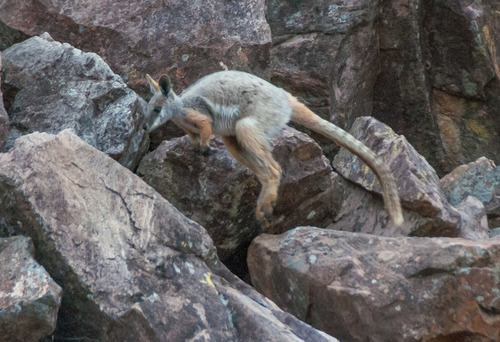
The red kangaroo (Osphranter rufus) is the largest of all kangaroos, the largest terrestrial mammal native to Australia, and the largest extant marsupial. It is found across mainland Australia, except for the more fertile areas, such as southern Western Australia, the eastern and southeastern coasts, and the rainforests along the northern coast.

The initial description of the species by A.G. Desmarest was published in 1822. The type location was given as an unknown location west of the Blue Mountains. The author assigned the new species to the genus Kangurus. In 1842, Gould reassigned the species to the genus Osphranter,

a taxon later submerged as a subgenus of Macropus. A taxonomic restructure in 2015 in Taxonomy of Australian Mammals by Jackson and Groves promoted Osphranter back to the genus level, redefining the red kangaroo, among others, as a species within the genus Osphranter. This was further supported by genetic analysis in 2019.

This species is a very large kangaroo with long, pointed ears and a square shaped muzzle (snout/nose). They are sexually dimorphic; males have short, red-brown fur, fading to pale buff below and on the limbs, while... Wikipedia →

Global Distribution

Parks Where Found

# Park Country Daily sighting probability
1 Flinders Ranges National Park 🇦🇺 Australia
~40%
2 Hattah-Kulkyne National Park 🇦🇺 Australia
~30%

Before you go

What are the chances of seeing a Blue Flier (Females) in Flinders Ranges National Park?

Likely

About 40% of wildlife watchers report a Blue Flier (Females) sighting in Flinders Ranges National Park on a given day, based on 22 verified sightings from GBIF citizen-science data from 2019 to 2026. It is the 7th most-seen of the 7 mammals we can rate there. Over three days the chance rises to about 80%, and over a week to over 90%, if each day is a fresh chance.

When is the best time to see a Blue Flier (Females) in Flinders Ranges National Park?

February

In that month about 60% of wildlife watchers report a Blue Flier (Females) in Flinders Ranges National Park on a given day, against under 5% in October and November, the lowest months. That is one of Flinders Ranges National Park's driest months, with about 5 mm of rain against 40 mm in November.

What time of day is best to see a Blue Flier (Females)?

Between 7 and 10 am

Across all the parks we cover, that three-hour window holds the most Blue Flier (Females) sightings with a recorded time, and about 6 in 10 of them come between 6 pm and 6 am: it is most active around dawn and dusk.

Is Flinders Ranges National Park the best place to see a Blue Flier (Females)?

Yes

Of the 2 parks where we can rate Blue Flier (Females) sightings, Flinders Ranges National Park has the highest daily chance: about 40%. Next come Hattah-Kulkyne National Park (Australia, about 30%).

Which relatives of the Blue Flier (Females) live in Flinders Ranges National Park?

Same genus: Macropus

The closest relatives of the Blue Flier (Females) that you can see in Flinders Ranges National Park (genus Macropus, Grey Kangaroos) are Wallaroo (about 80%) and Western Grey Kangaroo (about 60%), with each one's daily chance of a sighting.

Where does the Blue Flier (Females) sighting chance come from?

GBIF citizen-science records

It is estimated from how often the Blue Flier (Females) is recorded against all the mammals logged in Flinders Ranges National Park (22 verified sightings from 2019 to 2026), calibrated against known sighting rates. Figures are rounded to the nearest 10% because citizen-science data supports honest approximations, not decimals, and months with records from fewer than five people show "—". How it works.

← Back to Flinders Ranges National Park