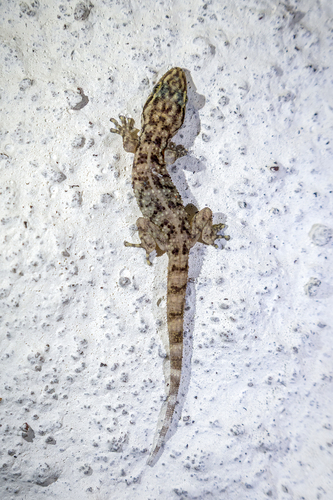
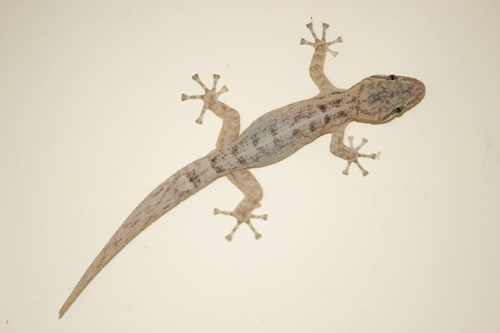
San Cristóbal Island Leaf-toed Gecko

San Cristóbal Island Leaf-toed Gecko

Phyllodactylus leei

Silhouette: Jose Carlos Arenas-Monroy · PhyloPic

LCNTNear ThreatenedVUENCR Endemic
Daily sighting probability ~10% · With luck
at Galápagos Islands

In 3 days ~20% in a week ~30%

17 Verified sightings at Galápagos Islands From 2019 to 2026
17 In 1 park
August Best month
🌙 Nocturnal When it's spotted

About the San Cristóbal Island Leaf-toed Gecko

Phyllodactylus leei, also known commonly as the San Cristóbal Island leaf-toed gecko and the Chatham leaf-toed gecko, is a species of lizard in the family Phyllodactylidae. The species is endemic to San Cristóbal Island in the Galapagos Islands.

The specific name, leei, is in honor of American naturalist Dr. Thomas Lee, who was on board the United States Fish Commission (USFC) research vessel USS Albatross when she visited Chatham Island in 1888. P. leei is oviparous. Eggs are laid in rocky areas in October and November.

Cope ED (1889). "Scientific Results of Explorations by the U. S. Fish Commission Steamer Albatross. No. III.—Report on the Batrachians and Reptiles Collected in 1887–'88". Proceedings of the United States National Museum 12: 141–147. (Phyllodactylus leei, p. 145).

Fitter, Julian; Fitter, Daniel; Hosking, David (2016). Wildlife of the Galápagos, Fully Revised Second Edition. Princeton Pocket Guides. Princeton and Oxford: Princeton University Press. 287 pp. ISBN 978-0-691-17042-8. (Phyllodactylus leei, p. 94).

Rösler H (2000). "Kommentierte Liste der rezent, subrezent und fossil bekannten Geckotaxa... Wikipedia →
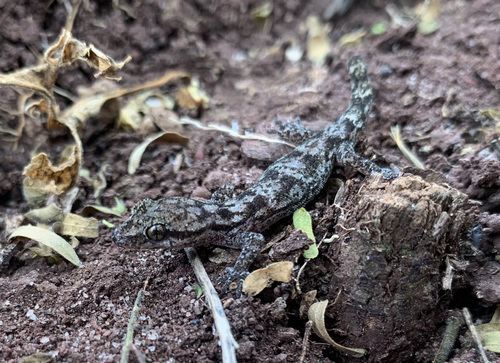
Global Distribution

Parks Where Found

# Park Country Daily sighting probability
1 Galápagos Islands 🇪🇨 Ecuador
~10%

More parks will be added in future updates.

Closest Relatives at Galápagos Islands

Before you go

What are the chances of seeing a San Cristóbal Island Leaf-toed Gecko in Galápagos Islands?

With luck

About 10% of wildlife watchers report a San Cristóbal Island Leaf-toed Gecko sighting in Galápagos Islands on a given day, based on 17 verified sightings from GBIF citizen-science data from 2019 to 2026. It is the 28th most-seen of the 31 reptiles we can rate there. Over three days the chance rises to about 20%, and over a week to about 30%, if each day is a fresh chance.

When is the best time to see a San Cristóbal Island Leaf-toed Gecko in Galápagos Islands?

March, May, July–August and December

In those months about 10% of wildlife watchers report a San Cristóbal Island Leaf-toed Gecko in Galápagos Islands on a given day, against under 5% in January–February, April, June and September–November, the lowest months.

What time of day is best to see a San Cristóbal Island Leaf-toed Gecko?

Between 6 and 9 pm

Across all the parks we cover, that three-hour window holds the most San Cristóbal Island Leaf-toed Gecko sightings with a recorded time, and about 7 in 10 of them come between 6 pm and 6 am: it is mostly seen at night.

Where else can you see a San Cristóbal Island Leaf-toed Gecko?

Only Galápagos Islands, in our data

Galápagos Islands is the only park on Wallace's Line with enough records to rate San Cristóbal Island Leaf-toed Gecko sightings: about 10% of wildlife watchers there report one on a given day.

Which relatives of the San Cristóbal Island Leaf-toed Gecko live in Galápagos Islands?

Same genus: Phyllodactylus

The closest relatives of the San Cristóbal Island Leaf-toed Gecko that you can see in Galápagos Islands (genus Phyllodactylus, Leaf-toed Geckos) are Darwin's Leaf-toed Gecko (about 10%) and Peters' Leaf-toed Gecko (about 10%), with each one's daily chance of a sighting.

Where does the San Cristóbal Island Leaf-toed Gecko sighting chance come from?

GBIF citizen-science records

It is estimated from how often the San Cristóbal Island Leaf-toed Gecko is recorded against all the reptiles logged in Galápagos Islands (17 verified sightings from 2019 to 2026), calibrated against known sighting rates. Figures are rounded to the nearest 10% because citizen-science data supports honest approximations, not decimals, and months with records from fewer than five people show "—". How it works.

← Back to Galápagos Islands