Clouded Apollo

Clouded Apollo

Parnassius mnemosyne

Daily sighting probability ~20% · Possible
at Gauja National Park

In 3 days ~50% in a week ~80%

5 Verified sightings at Gauja National Park From 2019 to 2026
169 In all 7 parks
June Best month
☀️ Diurnal When it's spotted

About the Clouded Apollo

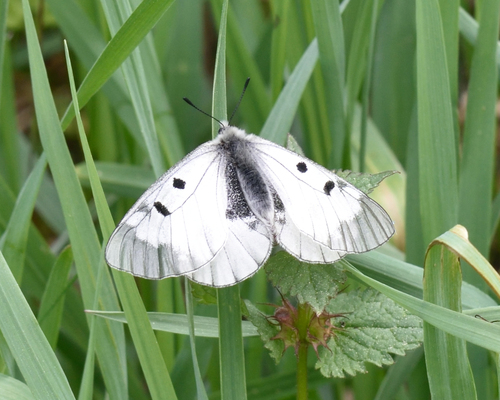
The clouded Apollo (Parnassius mnemosyne) is a butterfly species of the family of swallowtail butterflies (Papilionidae) found in the Palearctic realm. It is a large butterfly which inhabits meadows and deciduous woodland clearings with plenty of flowering plants, but cannot survive in denser forest. It is found both in the lowlands and in the mountains but not usually found at altitudes above 1,500 m (4,900 ft) except in the Central Asian mountains where it is also known from higher altitudes.

Its range of distribution extends from the Pyrenees, across the Central Massif, the Alps, and the Carpathians as far as central Asia. It inhabits all European countries including Norway, where it appears rarely and only in certain places. A subspecies lived in Denmark, but is now extinct. A great number of geographical races and individual forms are distinguished in this extensive region. The most striking specimens include the dark race from the eastern Bavarian Alps (subspecies hartmanni); form melania has the most pronounced dark colouring.

The paper of Dr. I.N. Bolotov and colleagues (2013) summarizes data on the northern localities of Parnassius mnemosyne, which are mostly... Wikipedia →
Global Distribution

Parks Where Found

# Park Country Daily sighting probability
1 Gauja National Park 🇱🇻 Latvia
~20%
2 Vanoise National Park 🇫🇷 France
~20%
3 Mercantour National Park 🇫🇷 France
~20%
4 Aigüestortes National Park 🇪🇸 Spain
~20%
5 Triglav National Park 🇸🇮 Slovenia
~20%
6 Pyrénées National Park 🇫🇷 France
~10%
7 Ecrins National Park 🇫🇷 France
~10%

Before you go

What are the chances of seeing a Clouded Apollo in Gauja National Park?

Possible

About 20% of wildlife watchers report a Clouded Apollo sighting in Gauja National Park on a given day, based on 5 verified sightings from GBIF citizen-science data from 2019 to 2026. It is the 17th most-seen of the 29 insects we can rate there. Over three days the chance rises to about 50%, and over a week to about 80%, if each day is a fresh chance.

When is the best time to see a Clouded Apollo in Gauja National Park?

May and June

In those months about 40% of wildlife watchers report a Clouded Apollo in Gauja National Park on a given day, against under 5% in April and July–September, the lowest months. January and February have too few records to rate.

What time of day is best to see a Clouded Apollo?

Between 10 am and 1 pm

Across all the parks we cover, that three-hour window holds the most Clouded Apollo sightings with a recorded time, and about 9 in 10 of them come between 6 am and 6 pm: it is a daytime animal.

Is Gauja National Park the best place to see a Clouded Apollo?

Yes

Of the 7 parks where we can rate Clouded Apollo sightings, Gauja National Park has the highest daily chance: about 20%. Next come Vanoise National Park (France, about 20%) and Mercantour National Park (France, about 20%).

Which relatives of the Clouded Apollo live in Gauja National Park?

Same order: Lepidoptera

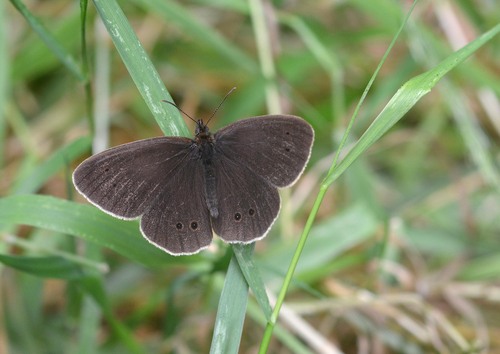
The closest relatives of the Clouded Apollo that you can see in Gauja National Park (order Lepidoptera, Butterflies and Moths) are Ringlet (about 30%), European Comma (about 30%) and European Peacock Butterfly (about 30%), with each one's daily chance of a sighting.

Where does the Clouded Apollo sighting chance come from?

GBIF citizen-science records

It is estimated from how often the Clouded Apollo is recorded against all the insects logged in Gauja National Park (5 verified sightings from 2019 to 2026), calibrated against known sighting rates. Figures are rounded to the nearest 10% because citizen-science data supports honest approximations, not decimals, and months with records from fewer than five people show "—". How it works.

← Back to Gauja National Park