Mongolian Finch

Mongolian Finch

Bucanetes mongolicus

Silhouette: Sheatherius · PhyloPic

LCLeast ConcernNTVUENCR
Daily sighting probability ~40% · Likely
at Gobi Gurvansaikhan National Park

In 3 days ~80% in a week >90%

176 Verified sightings at Gobi Gurvansaikhan National Park From 2019 to 2026
176 In 1 park
June Best month
☀️ Diurnal When it's spotted

About the Mongolian Finch

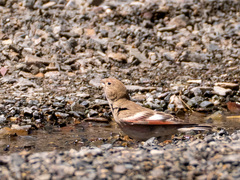
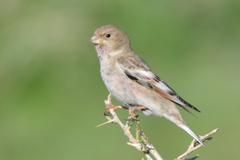
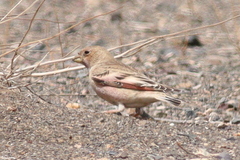
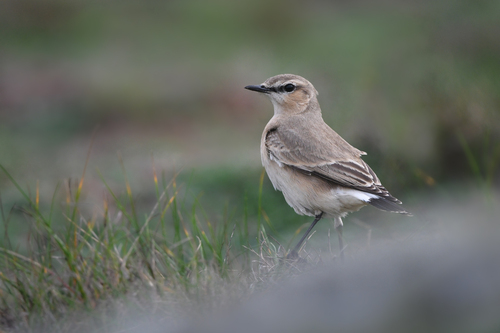
The Mongolian finch (Bucanetes mongolicus), also known as the Mongolian trumpeter finch, is a small passerine bird in the finch family Fringillidae. The Mongolian finch is a small, long-winged bird. It has a large head and short, thick greyish-yellow bill. In breeding plumage, males have a pink flush to their face and underparts, and there are extensive white and pink areas in the wings, a pattern that is also present but less marked in non-breeding plumage. Females have fainter, almost unnoticeable pink.

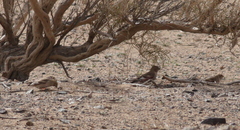
The Mongolian finch is fairly quiet outside of the breeding season. Calls consist of various rising nasal notes and chirrups, while songs are a jumbled series of these notes. This bird is a resident from eastern Turkey, across the Caucasus, east into Central Asia and on to western China and Mongolia and south into the Kashmir. Mountainous areas of stony desert or semi-arid scrub and rocky slopes are favoured for breeding. It is native to Afghanistan, Armenia, Azerbaijan, China, Pakistan, Iran, Kazakhstan, Kyrgyzstan, Mongolia, India, Nepal, Russia, Tajikistan, Turkey and Uzbekistan. It is a vagrant in Bahrain.

The first... Wikipedia →

Sounds

Call1:00

India · 2023

© Viral joshi · XC824416 · CC BY-NC-SA 4.0

Flight call0:24

Mongolia · 2022

© Stanislas Wroza · XC768042 · CC BY-NC-SA 4.0

Call0:47

Mongolia · 2019

© Frank Lambert · XC481535 · CC BY-NC-ND 4.0

Global Distribution

Parks Where Found

# Park Country Daily sighting probability
1 Gobi Gurvansaikhan National Park 🇲🇳 Mongolia
~40%

More parks will be added in future updates.

Before you go

What are the chances of seeing a Mongolian Finch in Gobi Gurvansaikhan National Park?

Likely

About 40% of wildlife watchers report a Mongolian Finch sighting in Gobi Gurvansaikhan National Park on a given day, based on 176 verified sightings from GBIF citizen-science data from 2019 to 2026. It is the 14th most-seen of the 122 birds we can rate there. Over three days the chance rises to about 80%, and over a week to over 90%, if each day is a fresh chance.

When is the best time to see a Mongolian Finch in Gobi Gurvansaikhan National Park?

June

In that month about 50% of wildlife watchers report a Mongolian Finch in Gobi Gurvansaikhan National Park on a given day, against about 10% in September, the lowest month. January–April and October–November have too few records to rate.

What time of day is best to see a Mongolian Finch?

Between 3 and 6 pm

Across all the parks we cover, that three-hour window holds the most Mongolian Finch sightings with a recorded time, and about 9 in 10 of them come between 6 am and 6 pm: it is a daytime animal.

Where else can you see a Mongolian Finch?

Only Gobi Gurvansaikhan National Park, in our data

Gobi Gurvansaikhan National Park is the only park on Wallace's Line with enough records to rate Mongolian Finch sightings: about 40% of wildlife watchers there report one on a given day.

Which relatives of the Mongolian Finch live in Gobi Gurvansaikhan National Park?

Same family: Fringillidae

The closest relatives of the Mongolian Finch that you can see in Gobi Gurvansaikhan National Park (family Fringillidae, Finches, Euphonias, and Allies) are Chinese Beautiful Rosefinch (about 40%), Twite (about 40%) and Common Rosefinch (about 30%), with each one's daily chance of a sighting.

Where does the Mongolian Finch sighting chance come from?

GBIF citizen-science records

It is estimated from how often the Mongolian Finch is recorded against all the birds logged in Gobi Gurvansaikhan National Park (176 verified sightings from 2019 to 2026), calibrated against known sighting rates. Figures are rounded to the nearest 10% because citizen-science data supports honest approximations, not decimals, and months with records from fewer than five people show "—". How it works.

← Back to Gobi Gurvansaikhan National Park