White's Thrush

White's Thrush

Zoothera aurea

Silhouette: Francesco "Architetto" Rollandin · PhyloPic

LCLeast ConcernNTVUENCR
Daily sighting probability <5% · Rare
at Gobi Gurvansaikhan National Park

In 3 days ~10% in a week ~30%

11 Verified sightings at Gobi Gurvansaikhan National Park From 2019 to 2026
215 In all 6 parks
September Best month
☀️ Diurnal When it's spotted

About the White's Thrush

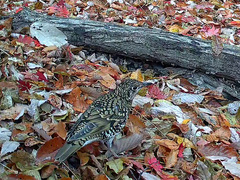
White's thrush (Zoothera aurea) is a member of the thrush family, Turdidae. It was named after the English naturalist Gilbert White. The genus name Zoothera comes from the Ancient Greek zoon, "animal" and theras, "hunter". The specific aurea is from Latin aureus, "golden".

It breeds in wet coniferous taiga, mainly in the eastern Palearctic in Siberia to Manchuria, Korea and Japan. Northern races are strongly migratory, with most birds moving to southeastern Asia during the winter. It is a very rare vagrant to western Europe.

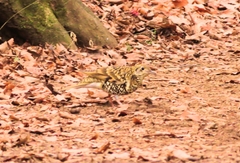
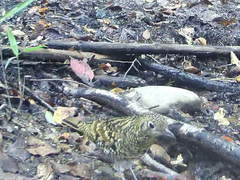
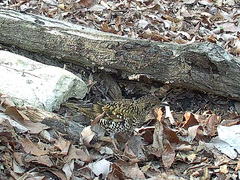
The sexes are similar, 27–31 cm long, with black scaling on a paler white or yellowish background. The most striking identification feature in flight is the black band on the white underwings, a feature shared with Siberian thrush. The male has a song which is a loud, far-carrying mechanical whistle, with 5–10 second pauses between each one second long phrase twee...tuuu....tuuu....tuuu.

It was previously considered a subspecies of the scaly thrush. Wikipedia →

Sounds

Song0:57

Russian Federation · 2018

© Lars Edenius · XC498365 · CC BY-NC-SA 4.0

Call0:17

China · 2014

© Tom Beeke · XC182159 · CC BY-NC-SA 4.0

Song1:09

Russian Federation · 2016

© R. Martin · XC364885 · CC BY-NC-SA 4.0

Global Distribution

Parks Where Found

# Park Country Daily sighting probability
1 Cuc Phuong National Park 🇻🇳 Vietnam
~10%
2 Taroko National Park 🇹🇼 Taiwan
~10%
3 Gobi Gurvansaikhan National Park 🇲🇳 Mongolia
<5%
4 Nikko National Park 🇯🇵 Japan
<5%
5 Kaeng Krachan National Park 🇹🇭 Thailand
<5%
6 Khao Yai National Park 🇹🇭 Thailand
<5%

Cities Where Found

# City Country Daily sighting probability
1 Novosibirsk 🇷🇺 Russia
~10%
2 Qingdao 🇨🇳 China
~10%
3 Xiamen City 🇨🇳 China
~10%
4 Shanghai 🇨🇳 China
~10%
5 Nanjing 🇨🇳 China
<5%
6 Hong Kong 🇨🇳 China
<5%
7 Tuen Mun 🇨🇳 China
<5%
8 Suzhou 🇨🇳 China
<5%
9 Busan 🇰🇷 South Korea
<5%
10 Hangzhou 🇨🇳 China
<5%

Zoos & Centres Where Found

# Zoo / Centre Country
1 Khao Kheow Open Zoo 🇹🇭 Thailand In captivity
2 Inokashira Park Zoo 🇯🇵 Japan In captivity

Before you go

What are the chances of seeing a White's Thrush in Gobi Gurvansaikhan National Park?

Rare

Under 5% of wildlife watchers report a White's Thrush sighting in Gobi Gurvansaikhan National Park on a given day, based on 11 verified sightings from GBIF citizen-science data from 2019 to 2026. It is the 90th most-seen of the 122 birds we can rate there. Over three days the chance rises to about 10%, and over a week to about 30%, if each day is a fresh chance.

When is the best time to see a White's Thrush in Gobi Gurvansaikhan National Park?

September

In that month about 20% of wildlife watchers report a White's Thrush in Gobi Gurvansaikhan National Park on a given day, against under 5% in June–August and December, the lowest months. January–April and October–November have too few records to rate.

What time of day is best to see a White's Thrush?

Between noon and 3 pm

Across all the parks we cover, that three-hour window holds the most White's Thrush sightings with a recorded time, and about 8 in 10 of them come between 6 am and 6 pm: it is a daytime animal.

Is Gobi Gurvansaikhan National Park the best place to see a White's Thrush?

3rd of 6

Of the 6 parks where we can rate White's Thrush sightings, Gobi Gurvansaikhan National Park ranks 3rd at under 5%. The best odds are in Cuc Phuong National Park (Vietnam, about 10%) and Taroko National Park (Taiwan, about 10%).

Which relatives of the White's Thrush live in Gobi Gurvansaikhan National Park?

Same family: Turdidae

The closest relatives of the White's Thrush that you can see in Gobi Gurvansaikhan National Park (family Turdidae, Thrushes) are Red-throated Thrush (about 10%) and Eyebrowed Thrush (about 10%), with each one's daily chance of a sighting.

Where does the White's Thrush sighting chance come from?

GBIF citizen-science records

It is estimated from how often the White's Thrush is recorded against all the birds logged in Gobi Gurvansaikhan National Park (11 verified sightings from 2019 to 2026), calibrated against known sighting rates. Figures are rounded to the nearest 10% because citizen-science data supports honest approximations, not decimals, and months with records from fewer than five people show "—". How it works.

← Back to Gobi Gurvansaikhan National Park